The Futility Infielder
A Baseball Journal by Jay Jaffe I'm a baseball fan living in New York City. In between long tirades about the New York Yankees and the national pastime in general, I'm a graphic designer.Monday, February 22, 2010
All Quilting, All the Time
Both quilts feature autographs of players which Rothmeier then embroidered. The "Stars" quilt has over 300 of them, along with 44 fabric "portraits." Numerous players represented on that one are in the Hall of Fame.
Both quilts were bought by Phyllis LaPlant, Rothmeier's niece who was responsible for arranging and promoting the auction. "The more I promoted it, the more I fell in love to it," said LaPlant, who plans to ask the National Baseball Hall of Fame to display the quilts again. All of the quilts sold, mostly to family members, with the average cost of the other ones around $1,200. The proceeds will be distributed among some surviving family members as well.
I wonder who got the 1955 Brooklyn Dodgers one?
Labels: memorabilia


Friday, February 19, 2010
Best. Quilt. Ever. Now Up for Auction
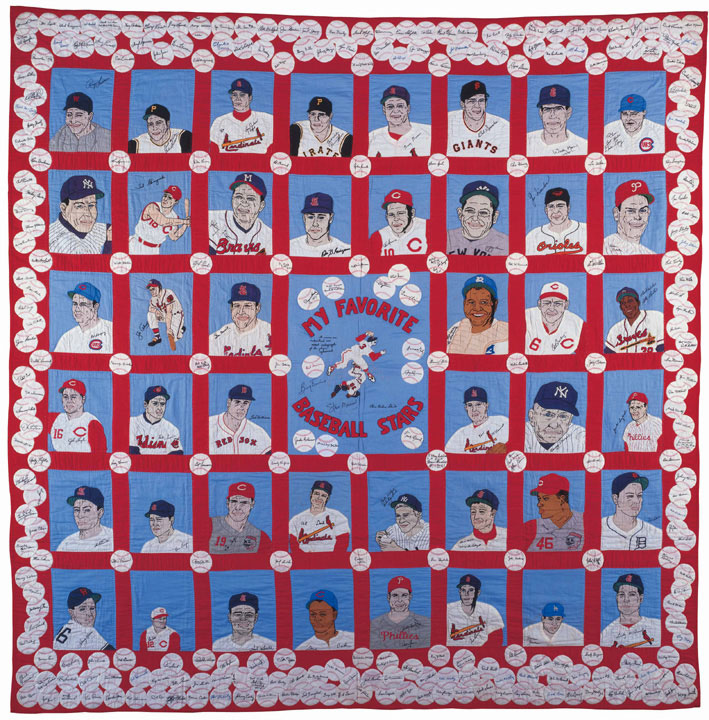
On Saturday, February 20, in Union, Missouri, a unique and amazing collection of baseball memorabilia will be auctioned off. Baseball fan Clara Schmitt Rothmeier, who passed away last June, created several baseball-themed quilts, the most famous of which, a piece called "My Favorite Baseball Stars," was exhibited by the National Baseball Hall of Fame in Cooperstown in 1959-1960. It came to my attention as part of the 2003 American Folk Art Museum exhibit, "A Perfect Game," which I reviewed here. This is what I wrote at the time:
One of the most prominent pieces of the exhibit is a 7' x7' quilt called "My Favorite Baseball Stars," created by Clara Schmitt Rothmeier, the daughter of a minor league ballplayer. (This photo of the quilt and the other photos I link to for this article were generously provided by Susan Flamm of the AFAM for the purposes of this review). Over a ten-year period from the mid-Fifties to the mid-Sixties, Rothmeier drew pictures of her favorite players, traced them onto fabric, appliquéd and embroidered each one, then sent them to the players for their autographs. Once a panel was returned, she would add it to her quilt, embroidering the signature as well. Midway into the project, she added a border of cloth baseballs, each featuring another signature that she'd collected. The finished quilt contains forty-four panels and about three hundred autographed balls. There are some heavy hitters among those portrayed: Ted Williams, Stan Musial, Yogi Berra, Roy Campanella, Casey Stengel, Mickey Mantle, Whitey Ford, Robin Roberts, Al Kaline, and a sleeveless Ted Kluszewski. Among the signed and embroidered balls are even more legends: Ty Cobb, Tris Speaker, Jimmie Foxx, Frankie Frisch, Dizzy Dean, Joe DiMaggio, Jackie Robinson, Satchel Paige, "Cool Papa" Bell, Bob Gibson, and Sandy Koufax. Yeah, some of those guys could play ball.Here's Rothmeier's bio on the auction site, along with links to a few of the other quilts which are up for auction:

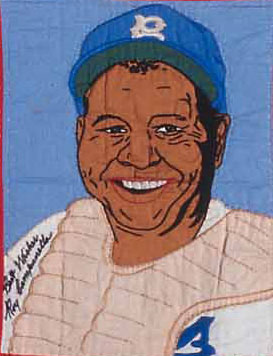
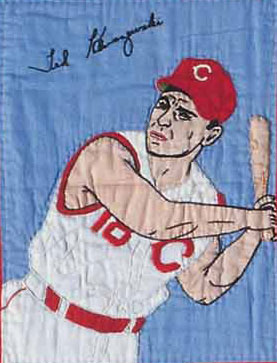
Born in 1931, hailing from Japan, Missouri, Clara Schmitt Rothmeier was certainly no stranger to the diamond.Also via the auction site, here's a bit about her most famous quilt's trip to Cooperstown:
Clara was an accomplished baseball player as well as a quiltmaker. Her father played minor league ball in the Pittsburgh organization, and her five brothers and four sisters had all played on traveling baseball and softball teams. Clara herself played first base for a traveling softball team from Springfield, Illinois. While on the road, she started sewing to keep busy. Her "My Favorite Baseball Stars" quilt took more than 10 years to complete, has 340 actual autographs, and was exhibited in the Baseball Hall of Fame in Cooperstown, New York in 1959-1960.
She has also made quilts commemorating the 1951 and 1956 St. Louis Cardinals (her favorite club) [here and here], the major league teams of 1948, and Jackie Robinson's 1955 World Champion Dodgers [here], and the "Major League Baseball Stars" quilt [here] containing 537 actual autographs.


This quilt graced the National Baseball Hall of Fame and Museum in Cooperstown, NY from 1959-1960. Clara took the quilt to the offices of J. Taylor Spink, editor of the Sporting News in St. Louis to see if she could have a picture of the completed quilt put in the paper so that those who had contributed their names would be able to see the finished quilt.Also up for auction besides the quilts are autographed pictures, autographed baseballs and other memorabilia, and 10,000 baseball cards. I imagine this stuff will fetch a pretty penny — according to one of Rothmeier's nephews, the main attraction has been valued at "anywhere from $10,000 to six figures" — and am hopeful some high roller will step in and purchase the quilts, then loan or donate them to the Hall of Fame for exhibition so that they can be shared with the widest audience possible. This stuff is simply too cool and too unique to not to be shared.
The picture of the quilt, and Rothmeier and Spink, ran in the Sporting News in March of 1959. Sid Keener, director of the Hall of Fame, saw the picture and made arrangements with Rothmeier to have the quilt displayed in Cooperstown, where it was on public view for almost one year.
The president of the Hall of Fame invited her to go to Cooperstown to see it on display, and arranged for her to see the Cleveland Indians and Chicago Cubs play at Doubleday Field. "After the game there was a tea party where I met the entire Cubs team including Ron Santo," Clara adds, unable to restrain her obvious love for the game. "Nobody could throw it like him!"
In addition to meeting the Cubs, Clara was able to meet many other baseball greats because of her exposure at the Hall of Fame. One such player was former Yankee great Joe DiMaggio. "I loved Joe DiMaggio the moment I met him," said Clara. "He got a lot of autographs for me, and interviewed me on his Fan in the Stands show. When he asked me if I'd do it, I was really unsure about it, and told him I wouldn't know what to say. He said, 'That's okay, nobody listens to me anyway.' Talking with him you felt like you'd known him all your life."


Labels: memorabilia, passings
Thursday, February 11, 2010
Say Hey, Kid!
Though too young to have seen him play, I'd already read books about Mays, and heard stories about his legend from my father and grandfather. By then I knew that he'd hit 660 home runs in his career, less than only Hank Aaron and Babe Ruth, pretty good company, that he'd made the most famous catch in baseball history, and that he was known as the Say Hey Kid. I took the one Mays card I owned at the time, a 1973 Topps* showing an aged Mays near the end of his career wearing the foreign, pinstriped uniform of the Mets. The card was handed down from my cousin Allan, who bestowed upon me a couple thousand such cards in the 1966-1975 range, including some very valuable ones.

*Though autographed, this is not a scan of card from my collection, merely an image found on Google.
I stood in line for what seemed like an eternity to ask Mr. Mays for his autograph. When I did, he obliged disinterestedly, not even making eye contact or breaking his conversation with whichever adult it was he was talking to, barely nodding an acknowledgment when I thanked him. Honestly, I wasn't terribly bothered, though. It was WILLIE MAYS! Though none of my card-collecting peers believed the autograph was legit – "You probably just got your baby brother to scribble on your card!" — I knew that it was, and I still have that card. It's in a plastic sheet on the front page of a light blue three-ring binder in the closet of my childhood bedroom in Salt Lake City, right next to a few Hank Aarons and a Jim Bouton. The best of my best.
Mays is back in the news, making the rounds thanks to an authorized biography that just came out, Willie Mays: The Life, The Legend by James S. Hirsch, published by Scribner. The 628-page book is something of a coup, marking the first time the 78-year-old legend has ever cooperated with a biographer*. The early reviews haven't been glowing, suggesting the book gets a bit bogged down in the details, but for a player as monumental and enigmatic as Mays, a closer look is merited. Breaking into the majors in 1951, the man battled racism and brought an inimitable style to the majors, becoming arguably the best all-around player the game has ever seen. I received my review copy in the mail last week, and I'm dying to sink my teeth into it. I'll report back when I do.
*update: Allen Barra begs to differ on that score, though Hirsch defends the distinction, and Bruce Weber, who repeated the claim in long piece for the New York Times, backing him up.
In the meantime, on Wednesday night Mays made an appearance on The Daily Show with Jon Stewart. Check out Stewart and the Say Hey Kid talking about his days playing in Trenton (where he started his pro career, hitting .353 in 81 games in 1950), how many homers he might have hit if he hadn't missed two years due to military service, and how he had to room with the son of manager Leo Durocher as a rookie:
Labels: books, memorabilia
Friday, June 19, 2009
My Favorite Baseball Quilt
I've never attended a perfect game, but back in the summer of 2003, I attended "A Perfect Game," an exhibit at the American Folk Art Museum devoted to baseball. I was so taken with it that I wrote a lengthy review, which included this bit about the image above:
One of the most prominent pieces of the exhibit is a 7' x7' quilt called "My Favorite Baseball Stars," created by Clara Schmitt Rothmeier, the daughter of a minor league ballplayer. (This photo of the quilt and the other photos I link to for this article were generously provided by Susan Flamm of the AFAM for the purposes of this review). Over a ten-year period from the mid-Fifties to the mid-Sixties, Rothmeier drew pictures of her favorite players, traced them onto fabric, appliquéd and embroidered each one, then sent them to the players for their autographs. Once a panel was returned, she would add it to her quilt, embroidering the signature as well. Midway into the project, she added a border of cloth baseballs, each featuring another signature that she'd collected. The finished quilt contains forty-four panels and about three hundred autographed balls. There are some heavy hitters among those portrayed: Ted Williams, Stan Musial, Yogi Berra, Roy Campanella, Casey Stengel, Mickey Mantle, Whitey Ford, Robin Roberts, Al Kaline, and a sleeveless Ted Kluszewski. Among the signed and embroidered balls are even more legends: Ty Cobb, Tris Speaker, Jimmie Foxx, Frankie Frisch, Dizzy Dean, Joe DiMaggio, Jackie Robinson, Satchel Paige, "Cool Papa" Bell, Bob Gibson, and Sandy Koufax. Yeah, some of those guys could play ball.Born in 1931, hailing from Gerald, Missouri, Rothmeier was certainly no stranger to the diamond. From her bio in the exhibit catalog, The Perfect Game:
Rothmeier was an accomplished baseball player as well as a quiltmaker. Her father played minor league ball in the Pittsburgh organization, and her five brothers and four sisters had all played on traveling baseball and softball teams. Rothmeier herself played first base for a traveling softball team from Springfield, Illinois. While on the road, she started sewing to keep busy. Her "favorite stars" quilt took more than 10 years to complete. She has also made quilts commemorating the 1951 and 1956 St. Louis Cardinals (her favorite club), the major league teams of 1948, and Jackie Robinson's 1955 World Champion Dodgers.Last night, I received an email from a woman named Elizabeth Hixson informing me that Rothmeier, her great aunt, had passed away this week due to cancer. "She was a great artist [and] she was a great person," wrote Hixson.
My deepest condolences to Rothmeier's family and friends.
Labels: memorabilia, passings
Sunday, February 10, 2008
Further Adventures in Bobbleheadhunting

In the summer of 2006, in anticipation of Tony Gwynn's induction to the Hall of Fame the following year, an employee of the Everett AquaSox of the Northwest League contacted me about a plan to commemorate Gwynn's career with a bobblehead doll. Gwynn never actually played for Everett, but that franchise is the transplanted successor to the Walla Walla Padres club my grandfather took my brother and me to see back in the late Seventies and early Eighties.
By the time I found him playing for Walla Walla in 1981, Gwynn was already a familiar face to me. I'd seen him play basketball for San Diego State University against my hometown University of Utah as part of the annual Western Athletic Conference schedule. Gwynn was the Aztecs' starting point guard (!), and he was a good one, setting school records for assists that still stand and earning all-WAC honors twice. Though he was a late-round pick by the NBA's Clippers, by that point it was clear that baseball was Gwynn's ticket to professional stardom. The Padres chose him in the third round of the 1981 draft and sent him to Walla Walla to start his pro career. He wasn't long for the Northwest League, but he was still there when my brother and I visited our grandparents. He hit .331/.406/.612 with 12 homers and 17 steals in just 42 games before being promoted to Double-A Amarillo, where he hit .462 in 90 at-bats. By the end of the next season, he was a San Diego Padre, and he was still a Padre 3,141 hits later when he retired in 2001.
Anyway, the AquaSox employee had discovered via Google that I'd written about seeing Gwynn, and wrote to ask whether I had any pictures that they could use to find out his uniform number and other details. Though lacking a picture of Gwynn, or any color photos at all, I dig up his number (#3) off an old roster that also lists future major leaguers John Kruk and Greg Booker. Via a bit of supersleuthing though a couple of old programs and a copy of Mark Okkkonen's Baseball Uniforms of the 20th Century (a database of which is now online via the Hall of Fame) I discovered that the 1981 Walla Walla team wore the 1979 big club's uniforms. Handing down uniforms to the low minors clubs was still common in those days, and the position of the numbers on the front of the uniform and the piping around "Padres" enabled me to deduce the uniform in question.

As for the finished result of the Gwynn doll, the browns are a bit more reddish than I would have liked to see, but for a run of 1,000 that was apparently hand-detailed, it's not too shabby. Good enough for me to add the title of "Bobblehead Consultant" next to "Sausage Race contestant" on my long and distinguished resume, and good enough for the Gwynn doll to sit next to the Tommy John Bobble-Arm (if not that elusive Jason Tyner) on my mantle.

Now, when are they going to make the damn Luis Sojo bobblehead?
Labels: bobbleheads, memorabilia, Walla Walla
Archives
June 2001 July 2001 August 2001 September 2001 October 2001 November 2001 December 2001 January 2002 February 2002 March 2002 April 2002 May 2002 June 2002 July 2002 August 2002 September 2002 October 2002 November 2002 December 2002 January 2003 February 2003 March 2003 April 2003 May 2003 June 2003 July 2003 August 2003 September 2003 October 2003 November 2003 December 2003 January 2004 February 2004 March 2004 April 2004 May 2004 June 2004 July 2004 August 2004 September 2004 October 2004 November 2004 December 2004 January 2005 February 2005 March 2005 April 2005 May 2005 June 2005 July 2005 August 2005 September 2005 October 2005 November 2005 December 2005 January 2006 February 2006 March 2006 April 2006 May 2006 June 2006 July 2006 August 2006 September 2006 October 2006 November 2006 December 2006 January 2007 February 2007 March 2007 April 2007 May 2007 June 2007 July 2007 August 2007 September 2007 October 2007 November 2007 December 2007 January 2008 February 2008 March 2008 April 2008 May 2008 June 2008 July 2008 August 2008 September 2008 October 2008 November 2008 December 2008 January 2009 February 2009 March 2009 April 2009 May 2009 June 2009 July 2009 August 2009 September 2009 October 2009 November 2009 December 2009 January 2010 February 2010 March 2010 April 2010 May 2010

Subscribe to Posts [Atom]