The Futility Infielder
A Baseball Journal by Jay Jaffe I'm a baseball fan living in New York City. In between long tirades about the New York Yankees and the national pastime in general, I'm a graphic designer.Friday, April 09, 2010
The Swindle Continues: Malcolm McLaren (1946-2010)
But anyone who thinks McLaren was the inventor of punk as a musical style ought to check out what bands like the Stooges, the New York Dolls, Richard Hell and the Voidoids, and the Ramones and others were doing before he came along (he ruined the Dolls, actually), to say nothing of countless Sixties garage bands anthologized on the Nuggets, and Pebbles series of compilations. And anyone who thinks that McLaren was the real brains behind the Sex Pistols would do well to check out Julien Temple's incredible documentary, The Filth and the Fury.
The movie acts as a counter to Temple's 1978 mockumentary, The Great Rock 'n' Roll Swindle, which tells the story of the Pistols from McLaren's point of view. Watching the documentary, it's abundantly clear that John Lydon (a/k/a Johnny Rotten, the Pistols' lead singer) was nobody's fool, and more than two decades after the fact (the movie was released in 2000), the venom he reserves for McClaren rivals that with which he delivered such memorably antisocial statements like, "I am an antichrist!" and "God save the queen, the fascist regime!" Just as it's the players who deserve the credit for winning a ballgame or a World Series, it's the Sex Pistols themselves who deserve the credit as a band who could peel paint off the walls. They were a fucking force. "This band wasn't about making people happy," recalls Lydon. "It was attack. Attack, attack, attack."
To the assertion that it was McLaren that created the Rotten persona, Lydon replied:
You don't create me. I am me. There is a difference... There was never a relationship with the manager, for me, other than he would always try to steal my ideas and claim them to be his own. I had to accept that he was the manager, because he was their manager before I joined the band.Here's the first of 11 segments of the movie, sliced and diced via YouTube:
Here's the band performing "God Save the Queen":
Here's their infamous BBC interview with Bill Grundy, from which the ensuing tabloid coverage gave the doc its name:
Of course, there are two sides to every story. The Guardian offers a rather balanced take on McLaren's relationship with the Pistols:
He was a nonpareil orchestrator of outrage during their early career, but proved incapable of dealing with its consequences. McLaren knew exactly what buttons to press, but seemed to have no idea what to do once he'd pressed them: fatally so in the case of Sid Vicious, who was only too willing to play the monster role that McLaren wrote for him right up to a suitably grim conclusion.Even Lydon had a few kind words for the manager as he shuffled off this mortal coil: "For me Malc was always entertaining, and I hope you remember that. Above all else he was an entertainer and I will miss him, and so should you."
...It wasn't until after the band split up that McLaren attempted to reassert his authority over the Sex Pistols: rewriting their story in the film The Great Rock'n'Roll Swindle as a masterplan he had controlled all along, the band merely his stooges. It wasn't a terribly convincing argument, nor was it a terribly good film.
Understandably outraged, Johnny Rotten has spent the subsequent years airbrushing McLaren from the Sex Pistols story, pointing out that the music had nothing to do with him, reinventing the band as autodidacts who would have been even more successful without his interference.
But that seems reductive too: without McLaren's ideas, his art-school grounding in Situationism, without the clothes he and Vivienne Westwood designed for them, the Sex Pistols wouldn't have been the same band, nor would they have had the same impact. Neither party would ever admit it, but they needed each other.
Still, if nothing else, the ongoing argument meant Malcolm McLaren remained a controversial figure up to his death, and will remain a controversial figure beyond it – which is presumably just what he wanted.
Labels: non-baseball, passings


Wednesday, March 24, 2010
Lift a Finger

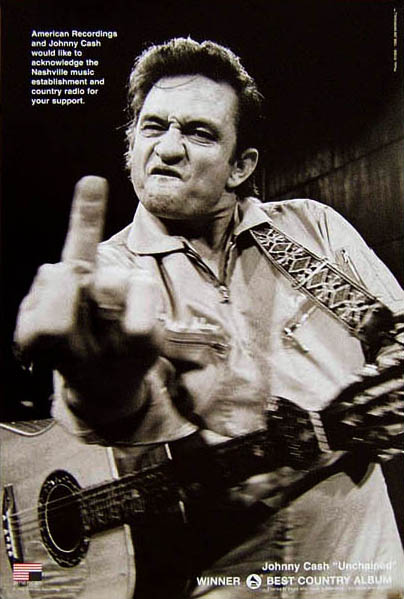
That bad-ass shot was taken at San Quentin Prison in 1969, when Cash performed a famous concert for the inmates which was filmed for documented on the incredible Johnny Cash at San Quentin. On that album, the bond between the great performer and his audience audibly collides with the tension of the prison security. When Cash sings the composed-for-the-occasion "San Quentin" for the second time in a row, you can practically hear the guards drawing their truncheons, ready to bust heads in a full-scale riot. No live album has ever carried such an edge.
In the deluxe repackaged version which was released a few years ago, here's what Cash had to say about the photo:
During the show at San Quentin in 1969, it seemed that Granada TV was on stage in front of me. At some point I walked around my microphone and yelled, "Clear the stage! I can't see my audience!" Nobody moved. So I gave them "the bird." Hence that picture.Here's what Sylvie Simmons' liner notes have to say:
Cash snarls like a punk rocker at the camera with his middle finger raised... Whatever brought it on, nothing sums up the defiant, macho, outlaw Johnny Cash quite like that picture and the concert it was taken at. As Bob Johnston, At San Quentin's producer, recalls, "God, I'd never seen anything like it. When Cash sang 'San Quentin, may you rot and burn in hell,' they were on the tables yelling. A lot of the guards were up on the runways with loaded guns, backing up the doors, and I'm backed up to the door with all of these guards with guns, and I'm thinking, 'Man! I should have brought Tammy Wynette and George Jones — anybody but Johnny Cash!'"Several years ago, I acquired a poster of the photo, cropped to serve as a promotion for American Recordings celebrating The Man In Black's unlikely latter-day comeback album Unchained winning the Grammy for Best Country Album. The inscription in the upper left reads: "American Recordings and Johnny Cash would like to acknowledge the Nashville Music establishment and country radio for your support."
Cracks me up every time, which is why I have that poster hanging above my desk. Johnny Cash may be giving someone the finger, but to borrow a line from one of his singer pals, it ain't me, babe.
Labels: non-baseball, passings
Thursday, March 18, 2010
Children By the Millions Sing for Alex Chilton (1950-2010)
John and I were only paired in our tiny East Village apartment for about eight months, and while we weren't exactly the fastest of friends, we had some common ground when it came to basketball (remind me to tell you the Reggie Miller story sometime) and more importantly, music. The largest portion of John's collection was devoted to Alex Chilton, the former lead singer of the Memphis teen soul group the Box Tops and the quintessential power pop band Big Star. The latter was the vehicle by which I knew Chilton best, having purchased the band's all-too-small catalog sometime shortly after college graduation.
John was a connoisseur of the ups and downs of Chilton's post-Big Star ride, a solo career that had redefined the term erratic. He let me comb through that fascinating collection, and long after he bailed on the apartment to take a cross-country road trip, we'd cross paths at Chilton shows at small, dingy dives like Under Acme and Coney Island High and catch up. I haven't seen John in years, but I think of him when I spin outre classics such as Bach's Bottom and Like Flies on Sherbert whose warped, gritty charms were to the John Spencer Blues Explosion what the pristine melodies of #1 Record were to R.E.M. and the Replacements a decade earlier.
Chilton died Wednesday of an apparent heart attack at the age of 59, and while I was instantly saddened upon reading the news, what amazed me was how many friends on Facebook and Twitter had something to share about it — from college pals to current colleagues, as well as the more tenuous social network acquaintances (not that there's anything wrong with them) — the vast majority of whom I'd never, ever discussed Big Star, the Box Tops or anything Chilton.
Literally, the lines in the Replacements' tribute to a man who spent most of his career confined to cult status — despite having sung on a #1 hit song as a teenage sensation for the Box Tops, penned and recorded the original version of "In the Streets," which as covered by disciples Cheap Trick became the theme song to the long-running That '70s Show, and in between made three of the most beautiful, unsettling, influential and ultimately important albums of the post-Beatles canon — had come to life:
"Children by the millions sing for Alex Chilton when he comes round / They say, "I'm in love, what's that song? / I'm in love with that song."
Having not paid much mind to the mid-Nineties reunion in which Chilton and Big Star drummer Jody Stephens were joined by two members of the band the Posies, I guess the band wound up reaching further than I'd ever imagined, as the fans of so many bands who had cited Chilton as an influence actually gave a damn and listened to the records, bothering to track down whoever it was that sang that song they loved. Imagine that. Though he retained a standoffish attitude towards his own career, and often seemed hell-bent on self-sabotaging any shot at success, at least Chilton got to feel some of the adulation that had long eluded him.
A handful of links, both for the initiated and the not:
• An Entertainment Tonight segment on "The Letter," the song which set a commercial high bar he never topped... or even tried to. Chilton notoriously avoided interviews later in life, so to see him actually playing ball is rather fascinating.
• A mid-Eighties segment of Chilton on 120 Minutes, playing fragments of his famous songs on acoustic guitar, again surprisingly willing to talk about his career relative to his later reluctance.
• Big Star's "September Gurls," my favorite track among many:
• Or maybe I meant their "Nightime," another Big Star favorite:
• Pitchfork's brief obit and a selection of videos.
• A lengthy Crawdaddy piece covering Chilton's career, with a special focus on the odd twists and turns his post-Big Star days took
• A nice little tribute from Caryn Rose of Metsgrrl and Jukeboxgraduate.com
• Chilton eulogized on the floor of the House of Representatives (!) by Steve Cohen (D-Tennessee):
• And finally, the Replacements' "Alex Chilton," the song that both cemented his legend and ultimately provide a fitting epitaph:
Children by the millions will miss you, Alex Chilton.
Labels: music, non-baseball, passings
Wednesday, March 17, 2010
Willie Davis (1940-2010)
Alas, that turned out to be Koufax's final game. The pitcher was actually forgiving of Davis' woes, and as the great Los Angeles Times columnist Jim Murray wrote, "I don't think the shock of Game 2 of the World Series was that Willie Davis dropped two fly balls off Koufax fastballs in center field, I think it was that Koufax fastballs ended up in center field in the first place."
Anyway, Davis was so much more than that. He patrolled center field for the Dodgers for 14 year, from 1960 through 1973, a span during which they won three pennants and two World Series. The tail end of his career overlapped with the beginnings of the great Longest Running Infield which drove the team's next four pennants (1974-1981). He is the Los Angeles era franchise leader in hits (2,091), extra-base hits (585), at-bats (7,495), runs (1,004), triples (110) and total bases (3,094). His legacy looms large.
Davis passed away on March 9, and he was fondly remembered at a ceremony at Dodger Stadium on Tuesday which brought together several generations of Dodgers, from Peter O'Malley to Frank McCourt, from Maury Wills and Tommy Davis to Bill Russell, Ron Cey and Reggie Smith. Both his talent and humanity drew tribute. "Willie treated every player with respect and he made you feel welcomed," said Smith, who watched Davis while growing up in Southern California and played with him in St. Louis in 1975. "Willie had it all and he was probably the fastest man I ever saw in baseball."
Indeed, his speed was remarkable. "He was the only man I've ever seen who, when he hit a ball in the gap, the opposing team watched him run," said Lou Johnson, another Dodger teammate from the Sixties. Recalled Tommy Davis (no relation), who raced against him in a 60-yard dash in spring training, ""I realized he was fast," Davis said, "because Johnny Podres and Stan Williams were betting on him -- and those guys knew how to bet."
Davis had his critics as well, not to mention his problems. He converted to Buddhism late in his career, and was often ridiculed by closed-minded sportswriters. He had financial woes late in his career, and following it. Playing in the death valley of 1960s Dodger Stadium, the most parched run scoring environment on earth, his numbers looked meager; he hit .275/.306/.385 for his career at Chavez Ravine, .281/.314/.428 everywhere else. Still, his lifetime True Average (a/k/a Equivalent Average) was .274; a .260 is league average after adjusting for park and league scoring levels, so he was actually a significantly above-average hitter for his time. Translated to a 4.5 runs per game environment (as BP does for every player), his career line comes out to .300/.335/.467, with 2,738 hits, 242 homers and 438 steals — numbers that start to look Hall of Fame caliber — and his defense, according to BP's numbers, was 104 runs above average for his career.
Still, he was viewed as something of an erratic player and character. As the New York Times obituary notes, Murray "suggested that Davis had tinkered with his batting stance too much. 'Willie, you see, did imitations. The only way you could tell it wasn’t Stan Musial was when he popped up.'" (The entire Murray column from which that was taken is here. It's worth a read.)
The best of the Davis tributes online belongs to Bruce Jenkins of the San Francisco Chronicle:
Willie Davis might have been the coolest ballplayer I ever saw. He exuded style, a sense of the pure aesthetic, and he could have excelled at any sport. His choice of baseball was a blessing to the game, and among those of us who watched him up close at Dodger Stadium in the early 1960s, there was no question he was the fastest man alive. In a race from first to third with a running start, I'm not sure even Bob Hayes could have caught him.As Tommy Lasorda inevitably lamented, Davis has gone to visit the big Dodger in the sky. So long, Willie.
Davis was found dead Tuesday at the age of 69 (authorities believe there was no foul play), leaving behind a legacy of unique, unforgettable talent. He made two All-Star teams, racked up 2,561 hits, had a 31-game hitting streak, won three consecutive Gold Glove awards, but he wasn't an elite outfielder in the National League. With the likes of Willie Mays, Henry Aaron, Frank Robinson and Roberto Clemente in the mix, that just wasn't possible.
What none of those players had — few that I can recall in any era — was Davis' combination of urban cool and blazing speed. He addressed the world at a slow, measured pace, never in a rush. He basically let life come to him. Even as he approached home plate with a bat in his hands, he struck the impression of a man wearing shades at the far corner table of a jazz club.
There was lightning inside him. He turned it loose at the crack of the bat. Like so many good left-handed hitters, he crushed the low fastball, drilling it up the alleys on a laser path. That's when Willie Davis struck fear in the hearts of every opponent, because that would be a triple.
Friday, February 19, 2010
Best. Quilt. Ever. Now Up for Auction
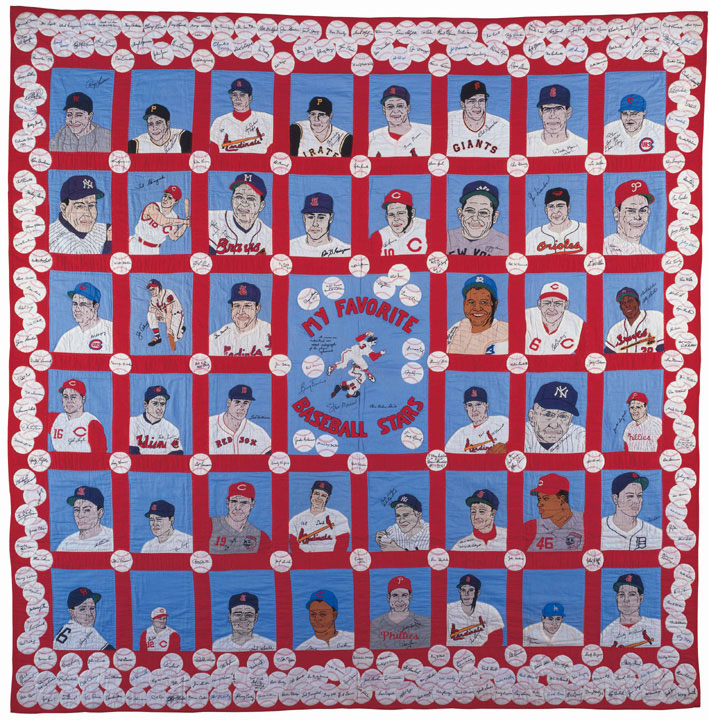
On Saturday, February 20, in Union, Missouri, a unique and amazing collection of baseball memorabilia will be auctioned off. Baseball fan Clara Schmitt Rothmeier, who passed away last June, created several baseball-themed quilts, the most famous of which, a piece called "My Favorite Baseball Stars," was exhibited by the National Baseball Hall of Fame in Cooperstown in 1959-1960. It came to my attention as part of the 2003 American Folk Art Museum exhibit, "A Perfect Game," which I reviewed here. This is what I wrote at the time:
One of the most prominent pieces of the exhibit is a 7' x7' quilt called "My Favorite Baseball Stars," created by Clara Schmitt Rothmeier, the daughter of a minor league ballplayer. (This photo of the quilt and the other photos I link to for this article were generously provided by Susan Flamm of the AFAM for the purposes of this review). Over a ten-year period from the mid-Fifties to the mid-Sixties, Rothmeier drew pictures of her favorite players, traced them onto fabric, appliquéd and embroidered each one, then sent them to the players for their autographs. Once a panel was returned, she would add it to her quilt, embroidering the signature as well. Midway into the project, she added a border of cloth baseballs, each featuring another signature that she'd collected. The finished quilt contains forty-four panels and about three hundred autographed balls. There are some heavy hitters among those portrayed: Ted Williams, Stan Musial, Yogi Berra, Roy Campanella, Casey Stengel, Mickey Mantle, Whitey Ford, Robin Roberts, Al Kaline, and a sleeveless Ted Kluszewski. Among the signed and embroidered balls are even more legends: Ty Cobb, Tris Speaker, Jimmie Foxx, Frankie Frisch, Dizzy Dean, Joe DiMaggio, Jackie Robinson, Satchel Paige, "Cool Papa" Bell, Bob Gibson, and Sandy Koufax. Yeah, some of those guys could play ball.Here's Rothmeier's bio on the auction site, along with links to a few of the other quilts which are up for auction:

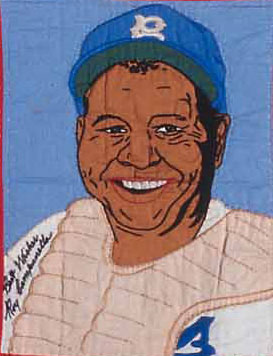
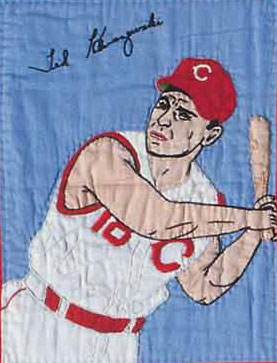
Born in 1931, hailing from Japan, Missouri, Clara Schmitt Rothmeier was certainly no stranger to the diamond.Also via the auction site, here's a bit about her most famous quilt's trip to Cooperstown:
Clara was an accomplished baseball player as well as a quiltmaker. Her father played minor league ball in the Pittsburgh organization, and her five brothers and four sisters had all played on traveling baseball and softball teams. Clara herself played first base for a traveling softball team from Springfield, Illinois. While on the road, she started sewing to keep busy. Her "My Favorite Baseball Stars" quilt took more than 10 years to complete, has 340 actual autographs, and was exhibited in the Baseball Hall of Fame in Cooperstown, New York in 1959-1960.
She has also made quilts commemorating the 1951 and 1956 St. Louis Cardinals (her favorite club) [here and here], the major league teams of 1948, and Jackie Robinson's 1955 World Champion Dodgers [here], and the "Major League Baseball Stars" quilt [here] containing 537 actual autographs.


This quilt graced the National Baseball Hall of Fame and Museum in Cooperstown, NY from 1959-1960. Clara took the quilt to the offices of J. Taylor Spink, editor of the Sporting News in St. Louis to see if she could have a picture of the completed quilt put in the paper so that those who had contributed their names would be able to see the finished quilt.Also up for auction besides the quilts are autographed pictures, autographed baseballs and other memorabilia, and 10,000 baseball cards. I imagine this stuff will fetch a pretty penny — according to one of Rothmeier's nephews, the main attraction has been valued at "anywhere from $10,000 to six figures" — and am hopeful some high roller will step in and purchase the quilts, then loan or donate them to the Hall of Fame for exhibition so that they can be shared with the widest audience possible. This stuff is simply too cool and too unique to not to be shared.
The picture of the quilt, and Rothmeier and Spink, ran in the Sporting News in March of 1959. Sid Keener, director of the Hall of Fame, saw the picture and made arrangements with Rothmeier to have the quilt displayed in Cooperstown, where it was on public view for almost one year.
The president of the Hall of Fame invited her to go to Cooperstown to see it on display, and arranged for her to see the Cleveland Indians and Chicago Cubs play at Doubleday Field. "After the game there was a tea party where I met the entire Cubs team including Ron Santo," Clara adds, unable to restrain her obvious love for the game. "Nobody could throw it like him!"
In addition to meeting the Cubs, Clara was able to meet many other baseball greats because of her exposure at the Hall of Fame. One such player was former Yankee great Joe DiMaggio. "I loved Joe DiMaggio the moment I met him," said Clara. "He got a lot of autographs for me, and interviewed me on his Fan in the Stands show. When he asked me if I'd do it, I was really unsure about it, and told him I wouldn't know what to say. He said, 'That's okay, nobody listens to me anyway.' Talking with him you felt like you'd known him all your life."


Labels: memorabilia, passings
Wednesday, February 17, 2010
Jim Bibby (1944-2010)
Bibby's best years came with the Pirates, particularly the "We Are Family" World Champions of 1979 with the Stargell Stars on their goofy train conductor hats. How could a nine-year-old kid not fall for that team?

Bibby's shining moment on the diamond came during Game Seven of the 1979 World Series. Pitching for the Pirates on three days' rest, he yielded just one run in four innings before nervous nellie manager Chuck Tanner pulled him for a pinch-hitter, trailing 1-0. Willie Stargell connected for a two-run homer in the sixth, and the Pirates' bullpen — Don Robinson, Grant Jackson and Kent Tekulve — shut out the Orioles for the final five innings, in marked contrast to their self-immolation during Bibby's previous start, a 6.1-inning, 3-run, 7-strikeout effort whose squandering put the Bucs in a 3-1 hole. Bibby earned his World Series ring.
Bibby had a hard road to the majors. A free agent signing by the Mets in 1965, he served a two-year stint in Vietnam and missed a year due to spinal fusion surgery before being traded to the Cardinals in an eight-player deal in 1971. He was nearly 28 years old by the time he reached the majors, but stuck around for 12 seasons with the Cards, Rangers, Indians and Pirates. Best known for his heater, of which his control was only sporadic, he threw the first no-hitter in Rangers history on July 30, 1973. His 19-19 record in 41 starts the following year certainly stands out, but it was in 1980 when he really put it all together, going 19-6 with a 3.32 ERA, earning All-Star honors and placing third in the Cy Young voting.
Bibby was the object of an unforgettable passage in Mike Shropshire's Seasons in Hell, a gonzo account of the 1973-1975 Rangers under Whitey Herzog and Billy Martin which I declared to be "the funniest baseball book of all time" a few years back. Craig Calcaterra of Hardball Talk puts it all together. Suffice it to say that Jim Bibby will be remembered.
Update: Great stuff from Joe Posnanski on Bibby here, including his remembrance of Bibby's time with the Indians, and this bit on Bibby's 1974 season:
That year, Bibby won 19 games with a horrifically bad 75 ERA+. Nobody in baseball history has ever won that many games with a sub-80 ERA+. How did he do it? Well, for one thing, he lost 19 games, too. But, more to the point, he simply was great some days, awful on others.
In his 19 victories, he had a 2.50 ERA and the league hit .194 against him.
In his 19 losses, he had a 9.23 ERA* and the league hit .359/.443/.589 against him. To give you an idea of just how awful this, the league leading core numbers were .364/.433/.563 (Carew/Carew/Allen)...
• In his first six starts, Bibby was 4-2 with a 3.05 ERA and four complete games, including a shutout.
• In his next six starts, Bibby was 1-5 with an 8.07 ERA, and in the game he won he allowed nine runs in eight innings.
• In his next six starts (you getting the pattern?), Bibby was 5-1 with a 2.44 ERA and had two shutouts.
• In his next six starts (it's amazing how this is working), Bibby was 1-4 with a 5.91 ERA -- he actually pitched well in a couple of those games, but he did not make it out of the second inning in either of his first two starts of the stretch.
• Then he threw a shutout at Yankee Stadium.
• Then he went 3-2 with a 7.86 ERA in his next five outings.
• Then he threw a shutout against Detroit.
And so on.
It's a remarkable season. The rest of his career was not quite so up and down, not quite the same blend of brilliant and disastrous. But Jim Bibby always seemed to carry a part of 1974 with him... it seemed like most days when he went out there to pitch, a team would say "Oh man, we don't stand a chance tonight." Trouble is, you never knew which team.
Monday, January 25, 2010
Bobby Bragan (1917-2010)
Bragan last made headlines in 2005, when he came out of retirement at 87 years old for one game to become not only the oldest manager in professional baseball history (beating Connie Mack by a week) but also the oldest manager to get ejected; he was tossed on the heels of the ejection of one of his players. Around the country, he's been memorialized as the last manager of the Braves' Milwaukee era, the first of their Atlanta era, and as Fort Worth's foremost ambassador to the sport, a man simply known as "Mr. Baseball."
As a Brooklyn resident and a Dodger fan, to me the most compelling part of his career is the transformation Bragan experienced during his four seasons in Brooklyn (1943-1944, 1947-1948, with two seasons missed due to military service). It wasn't for his hitting (.258/.306/.324 during his Dodger days, highlighted by a game-tying pinch-double in Game Six of the 1947 World Series) but rather for his initial opposition to and ultimate championing of Jackie Robinson, whose breaking of the color barrier afforded him a front-row seat to an earth-shaking change. During the spring of 1947, Alabama native Bragan supported Dixie Walker's infamous petition stating that he didn't want to play with Robinson. Unsympathetic, manager Leo Durocher roused his team at 1 AM andtold them, "Take the petition and, you know, wipe your ass."
Bragan soon paid a visit to Rickey's office. From the Fort Worth Star-Telegram's Randy Galloway:
I will always treasure the Alabama-native drawl telling me this one from long ago:From the Atlanta Journal-Constitution's Ken Sugiura:
"Mr. Rickey, well, since you asked, sir, I got to admit, I don't want no colored boy playing on the Dodgers."
And so, in 1947 the Jackie Robinson story was about to begin in Brooklyn, and general manager Branch Rickey, whom Bobby claimed to have admired and feared "as much as God himself" told the Dodgers' backup catcher, "Bobby, I ought to get rid of you, but you know what, I don’t think I really believe that’s in your heart, what you now tell me about this young man [Robinson]."
Within six months of Bobby meeting Jackie in spring training, and Jackie breaking baseball's color line, Bragan began a family friendship with Robinson that would last until Jackie passed away, and then continued with Jackie's widow.
"Knowing Jackie Robinson turned my life around," Bobby always said.
Bragan initially resisted Robinson, as did other teammates, most of them like Bragan raised in the South. Bragan even sought to be traded rather than play with Robinson.Profiled as the leadoff personality in Donald Honig's The Man in the Dugout: Fifteen Big League Managers Speak Their Minds (you can read the entire chapter via Google Books), Bragan elaborated:
That changed when the team took a two-week road trip early in the season.
"On those long train rides, that's when I really started to get to know Jackie," Bragan told the Fort Worth Star-Telegram in 2007, the 60th anniversary of Robinson's entry into major league baseball. All of us did, actually. This man was about class, culture and courage. All my prejudices begin to slowly fade.
"I started off that trip determined to have nothing to do with Jackie. But when that trip was over, the team goes back home, then, when the second road trip started, I was one of those jockeying to sit next to Jackie on the train. Jackie Robinson, the person and the ballplayer, changed my views, and changed my life."
Jackie won the respect of everybody by sheer guts and ability. Nobody ever came into the big leagues under less favorable circumstances, and he handled himself beautifully and he played like a demon. he was one of the greatest ballplayers ever to come down the pike.A gifted raconteur, Bragan had a lighter side as well, particularly when it came to his managing career. After finishing above .500 in three straight years in Milwaukee (1963-1965) but failing to climb higher than fifth place in a 10-team league, he recalled, "I told them in Milwaukee that I was leaving, and I got the biggest ovation I ever got... But I'm taking the team with me." Former Star-Telegram columnist Jim Reeves retells a scene from Bragan's autobiography:
Being Jackie Robinson's teammate was one of the best breaks I ever got. Watching what he had to go through helped me. It helped make me a better, more enlightened man, and it helped me to have a future in baseball as a manager because later on I was gong to have to manage fellows like Felipe Alou, Maury Wills, Henry Aaron, and plenty of other black players. If I hadn't had that experience with Jackie, I don't think I could have done it. It was a breakthrough for me, a great experience that I learned from and built upon later in life.
Jackie and I became good friends. Side by side we mourned our great loss in the same pew at Mr. Rickey's funeral. The respect and admiration that we shared for our mutual "father" served to cement our friendship.
In the foreword to Bragan's book, "You Can't Hit the Ball with the Bat on Your Shoulder," Howard Cosell called him "baseball's Music Man ... Elmer Gantry in uniform."Judging from all of the testimonials to Bragan that have surfaced, he cemented many a friendship during his time in the game. He'll be missed.
Cosell tells about the day in 1957 when Bragan, then Pittsburgh's skipper, was sitting at the piano in Howard's Manhattan apartment, playing and singing "Mack the Knife," when he was interrupted by a call from Pirates GM Joe Brown. Bobby took the call, talked for a couple of minutes, then resumed singing.
"What did Joe want?" Cosell asked.
"Mack the knife is ... back in town," Bragan sang, then added a new verse. "Joe Brown just fired me."
Friday, June 26, 2009
Death Scores a Hat Trick
I'm old enough to remember when Thriller hit the racks and was all the rage; I didn't have a copy, but my brother did, and that was more than enough for me to get sick of it — except for maybe Eddie Van Halen's guitar playing on "Beat It" - because for a couple of years, his songs were everywhere. Still, for a kid who didn't have cable TV, I have to admit that his videos, watched sparingly in their rotation on Friday Night Videos, were something else.
Nonetheless, for some reason the two video clips I thought of with regards to Michael Jackson's music aren't those well-worn classics but these rather off-the-beaten-path ones which speak to his broad cultural reach by featuring his music but not his image (Cliff Corcoran curated an idiosyncratic selection of Jackson vids at Bronx Banter, while Pitchfork has the motherlode). The first is from the Kevin Smith movie Clerks II, a scene in which Becky (Rosario Dawson) teaches Dante (Brian O'Halloran) to dance to the Jackson 5 classic "ABC." Joyful, absurd, and poignant all at once:
The second one is just surreal — a group of some 1,500 Filipino prisoners at the Cebu Provincial Detention and Rehabilitation Center learning an ensemble dance routine to "Thriller." You can read about the dance program here, but for now, just watch:
Meanwhile, here's a clip of Saxon's band, the Seeds, in a 1967 clip on the Mothers-In-Law show, lip-synching their hit "Pushin' Too Hard," one of many garage rock staples immortalized on the Nuggets compilation. Saxon's the guy with the cape:
As for Fawcett, being the prettiest of Charlie's Angels, married to The Six Million Dollar Man made her about as famous as Reggie Jackson in my eight-year-old mind. Here she is in the opening credits to the pilot episode of her first star vehicle:
Labels: non-baseball, passings, video
Friday, June 19, 2009
My Favorite Baseball Quilt
I've never attended a perfect game, but back in the summer of 2003, I attended "A Perfect Game," an exhibit at the American Folk Art Museum devoted to baseball. I was so taken with it that I wrote a lengthy review, which included this bit about the image above:
One of the most prominent pieces of the exhibit is a 7' x7' quilt called "My Favorite Baseball Stars," created by Clara Schmitt Rothmeier, the daughter of a minor league ballplayer. (This photo of the quilt and the other photos I link to for this article were generously provided by Susan Flamm of the AFAM for the purposes of this review). Over a ten-year period from the mid-Fifties to the mid-Sixties, Rothmeier drew pictures of her favorite players, traced them onto fabric, appliquéd and embroidered each one, then sent them to the players for their autographs. Once a panel was returned, she would add it to her quilt, embroidering the signature as well. Midway into the project, she added a border of cloth baseballs, each featuring another signature that she'd collected. The finished quilt contains forty-four panels and about three hundred autographed balls. There are some heavy hitters among those portrayed: Ted Williams, Stan Musial, Yogi Berra, Roy Campanella, Casey Stengel, Mickey Mantle, Whitey Ford, Robin Roberts, Al Kaline, and a sleeveless Ted Kluszewski. Among the signed and embroidered balls are even more legends: Ty Cobb, Tris Speaker, Jimmie Foxx, Frankie Frisch, Dizzy Dean, Joe DiMaggio, Jackie Robinson, Satchel Paige, "Cool Papa" Bell, Bob Gibson, and Sandy Koufax. Yeah, some of those guys could play ball.Born in 1931, hailing from Gerald, Missouri, Rothmeier was certainly no stranger to the diamond. From her bio in the exhibit catalog, The Perfect Game:
Rothmeier was an accomplished baseball player as well as a quiltmaker. Her father played minor league ball in the Pittsburgh organization, and her five brothers and four sisters had all played on traveling baseball and softball teams. Rothmeier herself played first base for a traveling softball team from Springfield, Illinois. While on the road, she started sewing to keep busy. Her "favorite stars" quilt took more than 10 years to complete. She has also made quilts commemorating the 1951 and 1956 St. Louis Cardinals (her favorite club), the major league teams of 1948, and Jackie Robinson's 1955 World Champion Dodgers.Last night, I received an email from a woman named Elizabeth Hixson informing me that Rothmeier, her great aunt, had passed away this week due to cancer. "She was a great artist [and] she was a great person," wrote Hixson.
My deepest condolences to Rothmeier's family and friends.
Labels: memorabilia, passings
Wednesday, June 03, 2009
Koko Taylor, RIP
In late September 1999, the aforementioned Nick Stone and I took a trip to the Midwest to see some baseball. The impetus was a chance to see a game at Tiger Stadium, which was in its final week of functionality. We began our trip in Cleveland, where we visited the Rock and Roll Hall of Fame and saw the Yankees beat the Indians in an 11-7 slugfest. From there we drove to Detroit, where we saw the Tribe bow to the Tigers, and then it was onto Wrigley Field for a pair between the Cubs and Cardinals.
Those are stories for another day, but back to the matter at hand, in looking for something to do on Saturday night, Nick and I discovered that Taylor was playing at some downtown restaurant/bar. It was a rather cheesy venue, too brightly lit, and by the look of things, so was Ms. Taylor. "Man, that's a fucked-up hair situation," I famously remarked, seeing her beaded, multi-colored wig as it shifted uneasily around her head while the 70-year-old legend belted out blues standards. Still, she had the joint shaking, no more so than when she got down to business with her most famous hit, "Wang Dang Doodle," late in the set.
Here she is, performing it circa 1965, when she originally recorded the song, a Willie Dixon number originally written for Howlin' Wolf:
It wasn't baseball she was singing about, but you gotta love these lyrics:
Tell automatic SlimDamn right. Rest in peace.
To tell razor toting Jim
To tell butcher knife toting Annie
To tell fast-talking Fanny
We're gonna pitch a ball
Down to the union hall
We're gonna romp and stomp till midnight
We're gonna fuss and fight till daylight
We're gonna pitch a wang dang doodle all night long
Friday, April 17, 2009
Here's to You, Mrs. Olbermann
My mother was one of the best-known baseball fans in this country. She attended Yankees [games] from 1934 through 2004, and she watched or listened to every one she didn't go to, up until last month. My guess is, she went to at least 1500 of them, most in Box 47E in the suddenly "old" Yankee Stadium.Olbermann credits his mom with being the one who stimulated his passion for baseball, not to mention providing the ham for his media persona. It's a funny and touching piece, well worth reading. My condolences to the Olbermann family, and to the reclusive Knoblauch, who'd probably just as soon not be reminded of the whole episode one more time.
...[T]rust me: Mom loved being famous in the ballparks.
Even if that fame had to be achieved in the way it was, on June 17th, 2000, when the sudden, and growing, inability of the ill-fortuned second baseman Chuck Knoblauch to make any kind of throw, easy or hard, to first base, culminated in him picking up a squib off the bat of Greg Norton of the White Sox and throwing it not back towards first, but, instead, off the roof of the Yankees' dugout where it picked up a little reverse english and smacked my mother right in the bridge of her glasses.
Chuck was in the middle of losing his beloved father at that time and though I thought I "got" what that meant to him, I didn't really understand it until today as I wrote this, and struggled to find the right keys, let alone the right words.
In any event, for three days in 2000, Mom was on one or both of the covers, of The New York Post and The New York Daily News and Newsday. She was somewhere in every newspaper in America.
And all this happened, while I was the host of the Game of the Week, for Fox. Literally sitting in a studio in Los Angeles, watching a bank of monitors with a different game on every monitor and recognizing instantly what must have happened (based on a lifetime of knowing the camera angles in the ballpark in which I grew up). I said, maybe too matter-of-factly, "that probably hit my mother." The crew laughed and I repeated it. More laughs. Then the next shot was of an older woman being led up the aisle towards an aid station - my mother.
I actually got to do a highlight cut-in for the broadcast by Joe Buck and Tim McCarver of a game at Dodger Stadium, and said, as I remember it: "Chuck Knoblauch's throwing problem is getting personal. He picks up Greg Norton's grounder, bounces it off the dugout roof and hits... my mother. I've talked to Mom, she's fine, she'll be back out there tomorrow. Joe? Tim?"
Silence.
• • •
Speaking of the new Yankee Stadium and its crosstown counterpart, I've got brief bits on both ballparks — admittedly little of which may be new for those following my recent coverage of them — for BP and ESPN Insider.
Enough about those. The Dodgers top the week's Hit List for the first time in nearly four years:
Dodger Dog: Orlando Hudson hits for the cycle, becoming the first Dodger to do so since Wes Parker in 1970, and helping the team beat Randy Johnson in LA for the first time in the Big Unit's 22-year career. The O-Dog is hitting .366/.435/.659. Meanwhile, Clayton Kershaw (7 1 1 1 1 13) one-ups Chad Billingsley (7 5 1 1 0 11) against the hapless Giants' lineup as the rotation holds opposing hitters to a .195 batting average through the first 10 games.I missed Billingsley's performance but Kershaw's was dazzling; effortlessly and consistently, he kept dropping that big curveball — "Public Enemy Number One," as Vin Scully calls it — in there for a strike against the Giants. More on that game — tangentially at least — in an upcoming post.
Labels: ESPN Insider, futility infielders, Hit List, passings
Tuesday, April 14, 2009
Losing Streak: Three in a Row
As NFL Films president Steve Sabol, who worked closely with Kalas since 1975, wrote, "In many ways, Harry is the narrator of our memories. His voice lives on not only on film, but inside the heads of everyone who has watched and listened to NFL Films." In a video clip, Sabol further elaborated on Kalas' style: "There was no shtik with Harry. It was just a blend of crisp articulation, resonance and vocal dexterity. He could read the ingredients on a shampoo bottle and and make it dramatic or funny or poignant."
Kalas' last major hurrah, of course, was calling the final out of the Phillies' World Series victory last October:
One strike away; nothing-and-two, the count to Hinske. Fans on the their feet; rally towels are being waved. Brad Lidge stretches. The 0-2 pitch — swing and a miss, struck him out! The Philadelphia Phillies are 2008 World Champions of baseball! Brad Lidge does it again, and stays perfect for the 2008 season! 48-for-48 in save opportunities, and watch the city celebrate! Don't let the 48-hour wait diminish the euphoria of this moment, and the celebration. And it has been 28 years since the Phillies have enjoyed a World Championship; 25 years in this city with a team that has enjoyed a World Championship, and the fans are ready to celebrate. What a night!Kalas was actually deprived of a similar opportunity to call the Phils' 1980 World Series clincher, as the network agreements in place at the time prevented local broadcasters from calling the games. He did record a narration of that final out after the fact, and thanks in part to his popularity, the rule was amended the following year. Not even stuffy old Major League Baseball could resist that voice.
Several years ago, I was flipping through ESPN Classic and I came across an NFL Films-produced documentary called "Bush Leagues to Bright Lights," devoted to pitcher Erskine Thomason, who pitched one inning for the 1974 Phillies. Narrated by Kalas, it followed the 25-year-old righty from spring training through his late season callup, but the footage of his lone appearance had to be staged, because the film crew showed up late and swapped in stock footage from a game filmed the next day. Still, Kalas' voice made it worth catching.
MLB.com has a handful of clips of Kalas, including his call of the final out of the 2008 World Series. ESPN has a clip of Schmidt talking about what Kalas' call of that famous homer meant to him. NFL Films has a brief tribute, and Baseball Prospectus Radio has a 2003 interview he did with Will Carroll.
• • •
Last week saw 22-year-old Angels pitcher Nick Adenhart die in a car crash just hours after he'd thrown six shutout innings against the A's, his first success at the major league level. Though I never actually saw Adenhart pitch -- he made just four big-league appearances -- I followed his progress closely over the last couple of years, reading about him numerous times in BP colleague Kevin Goldstein's columns and writing about him for the Fantasy Baseball Index and in particular, the Index's weekly spring updates. Adenhart had come into the 2008 season as the Angels' top prospect, but an ugly 9-13, 5.76 ERA season at Salt Lake City (my hometown, and a rough place for any pitcher who's trying to get his stuff together) caused his stock to dip. Thanks to the combination of a strong spring and injuries to John Lackey and Ervin Santana, Adenhart broke camp in the rotation, and he gave every indication he was ready to fulfill his promise. For death to come calling as it did -- particularly via a hit-and-run DUI which killed two of his fellow passengers -- was a cruel, heartbreaking blow.
ESPN's Jerry Crasnick chronicles Adenhart's journey to the majors. BP has a poignant guest post by Shane Demmitt, an Angels' employee with a special bond to the fallen pitcher. The Rev of Halos Heaven has a touching piece that begins by recalling former Angels outfielder Lyman Bostock, who died in 1978 -- the first ballplayer death I ever confronted:
In 1978, Lyman Bostock was murdered, a few days before the end of the 1978 baseball season. He had only been with the Angels that season, but the pain for this fan was as real as if he had lived in our house... because in a way he had...• • •
All the moments in which he had excelled had occurred in our house, the television light filling the room, the sound of the radio as much a part of a summer night as the cacophony of your brothers and sisters bursting through the front door just back from a late day at the beach.
These players we will never know are family, we know the illusion of them better than we know some of our own kin. We still tell stories about the time they did this great feat or that terrible blunder as if those curveballs and errors happened in the backyard.
So we had another guest in our house last night, he had just joined the family and we were excited to have him. These kids are so fantastic to have over in the living room, the game taking all of our attention except for a dinner break while they keep playing. It is always a quick run back to see how they are doing.
But a tragedy means he will never be back at our house, at your house, across the homes of this sprawling, tangled neighborhood, this nation, the world even as this sport we love grows in our hearts and imagination. He had an open invitation from every fan in every home, and that invite was a manifestation of the love and hope and competitive drive in each of us. We are sports fans because it allows us to spend time with the absolute best in their prime.
Just hours after the news of Kalas' death broke, word came that Mark "The Bird" Fidrych, the 1976 American League Rookie of the Year, died in a farm accident at the age of 54. Fidrych's antics on the mound, which included talking to the baseball, were the stuff of legend, but arm injuries prevented him from even pitching in as many games over the rest of his career as he did in his fabled rookie season.
I'm too young to remember that magical season firsthand, but by all accounts, Fidrych was every bit the sensation that Fernando Valenzuela or Dwight Gooden were during their rookie campaigns. At the tender age of 21, he went 19-9 with a league-best 2.34 ERA and 24 complete games for the Tigers, and even started the All-Star Game. My sole memory of Fidrych as a player, alas, was on the downslope of his career, a brief outing in 1979. Shown on an NBC "Game of the Week" -- this 1979 outing appears to fit the bill -- it marked the first time I ever heard the phrase "pitch count," as Fidrych was coming off the disabled list or up from the minors and was to be monitored closely and pulled after 50 pitches. Oh, the irony.
Cardboard Gods' Josh Wilker, who's a couple years older than me, remembered Fidrych as "the all time single season leader in joy." Wilker actually launched his site back in 2006 with an entry on Fidrych's 1980 card, and less than two months ago revisited the subject via a 1979 card:
I chose the first baseball card to ever feature on this site by reaching blindly into my unsorted box of old baseball cards. Amazingly, I pulled out the card I might have chosen if I had a lifetime to think about the choice: my one and only Mark Fidrych card. I tried to write about how happy he made me when I was eight years old, in 1976, and about how his card from 1980, the year I edged unwillingly from boyhood to something else altogether, seemed to suggest the feeling that the fleeting joy he'd authored over the course of one beautiful summer had slipped from his fingers for good.My condolences to those of you touched by the passings of Adenhart, Fidrych and Kalas. Excuse me now, I'm going to go pour myself a stiff drink and cry for awhile.
...His lifetime ERA of 2.47 and his age (he was still just 24), gave the back of the card, despite the shrinking yearly stats, a small but undeniable aura of hope.
But the front of the card photo pushes that hope into something closer to desperation. Here is a guy just trying to hang on, banished to the far edge of the field, the screen thrown up to guard him from foul balls seemingly as flimsy and haphazardly placed as the sparse mustache on his face. You can see Fidrych breathing, his furred lips pursed, forcing the breath out instead of letting it come and go naturally, doubts tumbling in his mind.
Imagine being forced to leave it all behind. You'll cling to the margins. You'll try to throw a few pitches without wincing, a few pitches that might allow you to move back across that white chalk line, back into the only world you ever loved.
Labels: announcers, passings
Saturday, February 21, 2009
Larry H. Miller, RIP
So I was deeply saddened to learn of the passing of Jazz owner Larry H. Miller on Friday. A devout Mormon whose faith prevented him from watching his own team play on Sundays, Miller's righteousness and his up-close style sometimes got him into hot water, and deservedly so. At times, he could make a villain or a fool out of himself as well as any Steinbrenner, and he probably holds the professional sports record for tearful press conferences.
Miller invested his heart and soul in the franchise as much as any owner ever did, and the simple fact remains that his 1985-1986 purchase of the Jazz saved professional basketball in Utah and insured that a club in one of the league's smallest markets thrived as a top-shelf organization year in and year out. A large part of that was thanks to his work to build what is now EnergySolutions Arena in 1991 and his willingness to keep the Stockton/Malone/Sloan core together for 15 years (1988-2003), all of them seasons in which the Jazz made the playoffs. That the long-awaited Next Year never arrived on his watch doesn't diminish his efforts one bit, because the team he saved and the organization he built remain strong even after those legends have moved on. He'll be missed.
Labels: non-baseball, passings
Wednesday, February 11, 2009
Angell's in the Outfield
Updike's sentences are fresh-painted. In all his writing, critical or fictional or reportorial, he is a fabulous noticer and expander; he's invented HD. So armed, he felt free from the start to take up and engage with all that lay within the range of his attention and put it down on paper. He had never to my knowledge written about sports when, on a morning in late September, 1960, he was stood up by a woman in Boston with whom he had an assignation and instead went to Fenway Park to see the Red Sox, in the final home game of Ted Williams's career. Ted hit a home run in his last at-bat, and Updike came home and wrote "Hub Fans Bid Kid Adieu" and sent it off to the magazine: the most celebrated baseball piece ever. The text grew not just out of the event but from Updike's youthful attachment to the Splendid Splinter; when he decided to leave New York and The New Yorker, in 1957, and move his young family to the suburbs, he chose Boston, as he later explained, in part to be closer to Ted Williams. My own baseball writing was still two years away when I first read "Hub Fans Bid Kid Adieu," and though it took me a while to become aware of it, John had already supplied my tone, while also seeming to invite me to try for a good sentence now and then, down the line, like the one he slips in when Williams fails to doff his cap after circling the bases in the wake of that homer: "Gods do not answer letters."How about that? Not only was Updike's piece worthy of such a superlative (testifying to the esteem in which it's held, I own it as part of three separate anthologies), but it essentially served as a prototype for one of the great baseball writers of all time. You learn something new every day.
Angell was a latecomer to the world of baseball writing, taking up the challenge when he was in his early forties. His first pieces ran in 1962, not coincidentally the first year of the Mets' existence. This page has a couple of his pieces from around that time. One is about taking up the Mets' cause in their inaugural year, during a stretch where the two former New York teams, the Dodgers and Giants, returned to play the Mets at the Polo Grounds, Angell's favorite haunt:
"I tell you, there isn't one of 'em -- not one -- that could make the Yankee club," one of them said. "I never saw such a collection of dogs."Right out of the box, that last line is almost good enough to hang with Updike's most famous phrase. Here's a shorter piece that leads off The Summer Game, Angell's first collection of essays. Devoted to the arrival of pitchers and catchers, it's a nice little tonic to chase away what is turning out to be one of the ugliest weeks for baseball in a long time:
"Well, what about Frank Thomas?" said the other. "What about him?What's he batting now? .315? .320? He's got thirteen homers, don't he?"
"Yeah, and who's he going to push out of the Yankee outfield? Mantle? Maris? Blanchard? You can't call these characters ballplayers. They all belong back in the minors -- the low minors."
I recognized the tone. It was knowing, cold, full of the contempt that the calculator feels for those who don't play the odds. It was the voice of the Yankee fan. The Yankees have won the American League pennant twenty times in the past thirty years; they have been world champions sixteen times in that period. Over the years, many of their followers have come to watch them with the smugness and arrogance of holders of large blocks of blue-chip stocks. These fans expect no less than perfection. They coolly accept the late-inning rally, the winning homer, as only their due. They are apt to take defeat with ill grace, and they treat their stars as though they were executives hired to protect their interests. During a slump or a losing streak, these capitalists are quick and shrill with their complaints: "They ought to damn well do better than this, considering what they're being paid!"
Suddenly the Mets fans made sense to me. What we were witnessing was precisely the opposite of the kind of rooting that goes on across the river.This was the losing cheer, the gallant yell for a good try -- antimatter to the sounds of Yankee Stadium. This was a new recognition that perfection is admirable but a trifle inhuman, and that a stumbling kind of semi-success can be much more warming. Most of all, perhaps, these exultant yells for the Mets were also yells for ourselves, and came from a wry, half-understood recognition that there is more Met than Yankee in every one of us. I knew for whom that foghorn blew; it blew for me.
Today the Times reported the arrival of the first pitchers and catchers at the spring training camps, and the morning was abruptly brightened,as if by the delivery of a seed catalogue. The view from my city window still yields only frozen tundras of trash, but now spring is guaranteed and one of my favorite urban flowers, the baseball box score, will burgeon and flourish through the warm, languid, information-packed weeks and months just ahead. I can remember a spring, not too many years ago,when a prolonged New York newspaper strike threatened to extend itself into the baseball season, and my obsessively fannish mind tried to contemplate the desert prospect of a summer without daily box scores. The thought was impossible; it was like trying to think about infinity. Had I been deprived of those tiny lists of sporting personae and accompanying columns of runs batted in, strikeouts, double plays, assists, earned runs, and the like, all served up in neat three-inch packages from Pittsburgh, Milwaukee, Baltimore,Houston, and points east and west, only the most aggressive kind of blind faith would have convinced me that the season had begun at all or that its distant, invisible events had any more reality than the silent collision of molecules. This year, thank heaven, no such crisis of belief impends; summer will be admitted to our breakfast table as usual, and in the space of half a cup of coffee I will be able to discover, say, that Ferguson Jenkins went eight innings in Montreal and won his fourth game of the season while giving up five hits, that Al Kaline was horse-collared by Fritz Peterson at the Stadium,that Tony Oliva hit a double and a single off Mickey Lolich in Detroit, that Juan Marichal was bombed by ye Reds in the top of the sixth at Candlestick Park, and that similar disasters and triumphs befell a couple of dozen-odd of the other ballplayers -- favorites and knaves -- whose fortunes I follow from April to October.Hang in there, folks. It's just a couple more days...
The box score, being modestly arcane, is a matter of intense indifference,if not irritation, to the non-fan. To the baseball-bitten, it is not only informative, pictorial, and gossipy but lovely in aesthetic structure. It represents happenstance and physical flight exactly translated into figures and history. Its totals -- batters' credit vs. pitchers' debit -- balance as exactly as those in an accountant's ledger. And a box score is more than a capsule archive. It is a precisely etched miniature of the sport itself, for baseball, in spite of its grassy spaciousness and apparent unpredictability, is the most intensely and satisfyingly mathematical of all our outdoor sports. Every player in every game is subjected to a cold and ceaseless accounting; no ball is thrown and no base is gained without an instant responding judgment -- ball or strike, hit or error, yea or nay -- and an ensuing statistic. This encompassing neatness permits the baseball fan, aided by experience and memory,to extract from a box score the same joy, the same hallucinatory reality, that prickles the scalp of a musician when he glances at a page of his score of Don Giovanni and actually hears bassos and sopranos, woodwinds and violins.
The small magic of the box score is cognominal as well as mathematical.Down the years, the rosters of the big-league teams have echoed and twangled with evocative, hilarious, ominous, impossible, and exactly appropriate names. The daily, breathing reality of the ballplayers' names in box scores accounts in part, it seems to me, for the rarity of convincing baseball fiction.No novelist has yet been able to concoct a baseball hero with as tonic a name as Willie Mays or Duke Snider or Vida Blue. No contemporary novelist would dare a supporting cast of characters with Dickensian names like those that have stuck with me ever since I deciphered my first box scores and began peopling the lively landscape of baseball in my mind -- Ossee Schreckengost, Smead Jolley, Slim Sallee, Elon Hogsett, Urban Shocker, Burleigh Grimes,Hazen Shirley Cuyler, Heinie Manush, Cletus Elwood Poffenberger, Virgil Trucks, Enos Slaughter, Luscious Easter, and Eli Grba. And not even a latter-day O. Henry would risk a tale like the true, electrifying history of a pitcher named Pete Jablonowski, who disappeared from the Yankees in 1933 after several seasons of inept relief work with various clubs. Presumably disheartened by seeing the losing pitcher listed as "J'bl'n's'i" in the box scores of his day, he changed his name to Pete Appleton in the semi-privacy of the minors, and came back to win fourteen games for the Senators in 1936 and to continue in the majors for another decade.
Friday, February 06, 2009
A Toast
Waaaaay back in the day, as a regular poster on Baseball Primer, I was a fan of the mysterious Score Bard, the poet laureate of the baseball blogosphere. Shortly after celebrating his first foray into creating a site to house his verse, and soon after leaving the design job I'd held for nearly six years, I received a touching email from the still-pseudonymous Bard. In it, he talked of his own departure from a dot-com job and subsequent voyage of self-discovery, as well as the connection he shared with his late father over The World Almanac, whose 2002 and 2003 covers I had designed. Obviously, I still have that email.
I'm not sure how much later it was, but one day I was reading his site and stumbled onto a page which linked to some of the Bard's other ventures, unmasking him as Ken Arneson in the process. I kept this bit of information regarding his identity under my hat for months, finally passing it on to Will Carroll and Alex Belth at the Winter Meetings in 2003 in exchange for some other bit of juicy gossip It was probably the only privileged piece of baseball information I had at my disposal; I had no other chips with which to go "all in."
Fast-forward a year later, to the 2004 Winter Meetings in Anaheim. I met Arneson for the first time. He was there to hook up with a few of our mutual blogging pals, including Carroll, Dodger Thoughts' Jon Weisman and the Cub Reporter's Alex Ciepley; they were all working together at All-Baseball.com and in the process of forming what would become Baseball Toaster, an aggregation of a handful of great baseball blogs, some of which had migrated from the A-B hub, Bronx Banter among them. Arneson, a tech wiz, custom built the site's blogging software.
Despite my connections to this great gang of folks -- and my role in pointing them in the general direction of each other -- I never explored the possibility of joining the Toaster group, in part because this site, or at least my vision for it, was more expansive, and in part because I was already headed down the road to becoming a full-fledged member of Baseball Prospectus.
Our voyages of self-discovery would continue in parallel, occasionally intersecting, as I retained a deep connection with the Toaster crew. Dodger Thoughts and Bronx Banter were my chosen houses of worship for my two teams, and I collaborated with DT's Weisman and BB's Belth on a few occasions between All-Baseball and the Toaster. I regularly read Arneson/Bard's Humbug blog, his A's-themed Catfish Stew, Mike's Baseball Rants, Carroll and Scott Long's Juice Blog, and others. Cardboard Gods, which didn't join up until years later, became one of my favorites as well, with Josh Wilker's note-perfect style of incorporating baseball cards and the existential revelations they held into the narrative of his own journey through life -- a model that via The Great American Baseball Card Flipping, Trading and Bubble Gum Book had initially inspired this site, but one that I've invoked with decreasing frequency as my own work here and beyond has grown more analytical. The Toaster sites were among my favorite reads in the baseball blogosphere, and they fostered a great sense of community among its reader-fans.
Alas, there's something about toasters that suggests a built-in obsolescence. After Dark's Flying Toaster screensavers. Cylon Centurions. The fetishization of vintage kitchen appliances. Hell, the slang usage of the word "toast": finished, defunct, done.
And so it is with Baseball Toaster. Earlier this week, Arneson announced that he had decided to unplug the Toaster as multiple bloggers go their separate ways. The departure isn't for lack of interest from readers. Rather, the graduation of Bronx Banter to SNY late last year and Dodger Thoughts to the Los Angeles Times earlier this week -- thus removing the two highest-traffic blogs from the site -- as well as Ken's understandably shifting priorities regarding work and family led to a reconsideration of the enterprise. The impending departures seem to have led a few of the other blogs to give up the ghost as well, though I'm particularly glad to see Cardboard Gods land on its feet.
Wilker's final post on BT concerns Reggie Jackson and the sway he held on those of us fans of a certain age; obviously, I can relate. So can Arneson, who invokes Jackson, among others in the Toaster's final post, a remarkable epic whose role call also includes Moby Dick, Huck Finn, Billy Martin, Ingmar Bergman, Borg-McEnroe, Sinatra, Dylan, Rickey Henderson, Bono, Battlestar Galactica, the Bash Brothers, Yeats, Billy Beane, Gorbachev, the Berlin Wall, original poetry that doesn't suck (this is the Score Bard, after all), the birth of Netscape, the dot-com boom and bust, the futility of banner ads, Kos, Arnold Schwarzenegger and the Terminator movies, the inefficiency of Nigerian diplomats, Elvis Costello, Kraftwerk, Monty Python, Armed Forces Radio, Radio Moscow, Dennis Eckersley, Kirk Gibson and Jack Buck.
Written in honor of Arneson's 43rd birthday as a farewell to the Toaster and to blogging in general, it connects the scraps of personal information which I first gleaned via my initial connection with the Score Bard to classic literature, film and music in perhaps the most ambitious piece of web-based writing I've ever read. It is Ted Williams' final at-bat and John Updike's "Hub Fans Bid Kid Adieu" rolled into one along with so much more. "Well, the internet is over, this post won. Thanks for playing, everybody," wrote Wilker in the comments section, invoking a previous comment to another epic Arneson post that I somehow missed.
Reading that piece and watching the Toaster go toast leads me to voice the inevitable questions regarding my own blogging. For a few years now, this site has become something of a personal back burner as my Baseball Prospectus work occupies more of my time and carries me into new frontiers (see here, here, here, and here as well if you've got a subscription, and know that there's more of this to come). My audience continues to grow via those venues, but it contracts here as my posts grow more scarce and pieces of the site fall into disrepair. On some occasions I vow to begin posting shorter and more frequent entries, reaping the dividend of my occasionally short attention span and my expansive voyages across the Internet in the service of rebuilding this site's traffic. On others, I'll wonder if the blog is a burden to be shed, a childish thing to be put away as my work grows more professional.
In the end, as this site approaches its eighth birthday, I find that I'm still willing to soldier on with Futility Infielder, keeping the pilot light lit if only to illuminate my progress and the occasional bursts of inspiration which wouldn't otherwise find a home. Maybe I will get that shorter-post thing down at some point. Maybe I'll move this thing to a self-contained platform where I don't have to worry about third-party add-ons going kaput. Maybe I'll let this blog evolve into something that's less strictly baseball-oriented. One way or another, you ain't getting rid of me that easily.
In the meantime, I can only offer the fondest farewell and best wishes to my pals at the Toaster as they scatter to the four winds. They've brought me community and plenty of inspiration while taking me a few steps closer towards my own personal enlightenment, and for that I raise my glass and offer my humble thanks. Fare thee well, friends.
Labels: non-baseball, passings
Tuesday, January 27, 2009
Updike Fan Bids Author Adieu
Fenway Park, in Boston, is a lyric little bandbox of a ballpark. Everything is painted green and seems in curiously sharp focus, like the inside of an old-fashioned peeping-type Easter egg. It was built in 1912 and rebuilt in 1934, and offers, as do most Boston artifacts, a compromise between Man's Euclidean determinations and Nature's beguiling irregularities. Its right field is one of the deepest in the American League, while its left field is the shortest; the high left-field wall, three hundred and fifteen feet from home plate along the foul line, virtually thrusts its surface at right-handed hitters. On the afternoon of Wednesday, September 28th, as I took a seat behind third base, a uniformed groundkeeper was treading the top of this wall, picking batting-practice home runs out of the screen, like a mushroom gatherer seen in Wordsworthian perspective on the verge of a cliff. The day was overcast, chill, and uninspirational. The Boston team was the worst in twenty-seven seasons. A jangling medley of incompetent youth and aging competence, the Red Sox were finishing in seventh place only because the Kansas City Athletics had locked them out of the cellar. They were scheduled to play the Baltimore Orioles, a much nimbler blend of May and December, who had been dumped from pennant contention a week before by the insatiable Yankees. I, and 10,453 others, had shown up primarily because this was the Red Sox's last home game of the season, and therefore the last time in all eternity that their regular left fielder, known to the headlines as TED, KID, SPLINTER, THUMPER, TW, and, most cloyingly, MISTER WONDERFUL, would play in Boston. "WHAT WILL WE DO WITHOUT TED? HUB FANS ASK" ran the headline on a newspaper being read by a bulb-nosed cigar smoker a few rows away. Williams' retirement had been announced, doubted (he had been threatening retirement for years), confirmed by Tom Yawkey, the Red Sox owner, and at last widely accepted as the sad but probable truth. He was forty-two and had redeemed his abysmal season of 1959 with a—considering his advanced age—fine one. He had been giving away his gloves and bats and had grudgingly consented to a sentimental ceremony today. This was not necessarily his last game; the Red Sox were scheduled to travel to New York and wind up the season with three games there.Regarding his final at-bat:
...In sum, though generally conceded to be the greatest hitter of his era, he did not establish himself as "the greatest hitter who ever lived." Cobb, for average, and Ruth, for power, remain supreme. Cobb, Rogers Hornsby, Joe Jackson, and Lefty O'Doul, among players since 1900, have higher lifetime averages than Williams' .344. Unlike Foxx, Gehrig, Hack Wilson, Hank Greenberg, and Ralph Kiner, Williams never came close to matching Babe Ruth's season home-run total of sixty. In the list of major-league batting records, not one is held by Williams. He is second in walks drawn, third in home runs, fifth in lifetime averages, sixth in runs batted in, eighth in runs scored and in total bases, fourteenth in doubles, and thirtieth in hits. But if we allow him merely average seasons for the four-plus seasons he lost to two wars, and add another season for the months he lost to injuries, we get a man who in all the power totals would be second, and not a very distant second, to Ruth. And if we further allow that these years would have been not merely average but prime years, if we allow for all the months when Williams was playing in sub-par condition, if we permit his early and later years in baseball to be some sort of index of what the middle years could have been, if we give him a right-field fence that is not, like Fenway's, one of the most distant in the league, and if — the least excusable "if" — we imagine him condescending to outsmart the Williams Shift, we can defensibly assemble, like a colossus induced from the sizable fragments that do remain, a statistical figure not incommensurate with his grandiose ambition. From the statistics that are on the books, a good case can be made that in the combination of power and average Williams is first; nobody else ranks so high in both categories. Finally, there is the witness of the eyes; men whose memories go back to Shoeless Joe Jackson—another unlucky natural—rank him and Williams together as the best-looking hitters they have seen. It was for our last look that ten thousand of us had come.
The afternoon grew so glowering that in the sixth inning the arc lights were turned on — always a wan sight in the daytime, like the burning headlights of a funeral procession. Aided by the gloom, Fisher was slicing through the Sox rookies, and Williams did not come to bat in the seventh. He was second up in the eighth. This was almost certainly his last time to come to the plate in Fenway Park, and instead of merely cheering, as we had at his three previous appearances, we stood, all of us — stood and applauded. Have you ever heard applause in a ballpark? Just applause—no calling, no whistling, just an ocean of handclaps, minute after minute, burst after burst, crowding and running together in continuous succession like the pushes of surf at the edge of the sand. It was a sombre and considered tumult. There was not a boo in it. It seemed to renew itself out of a shifting set of memories as the kid, the Marine, the veteran of feuds and failures and injuries, the friend of children, and the enduring old pro evolved down the bright tunnel of twenty-one summers toward this moment. At last, the umpire signalled for Fisher to pitch; with the other players, he had been frozen in position. Only Williams had moved during the ovation, switching his bat impatiently, ignoring everything except his cherished task. Fisher wound up, and the applause sank into a hush."Gods do not answer letters" ranks among the most memorable lines ever written in the service of sport. Classic stuff well worth reading and savoring in its entirety.
Understand that we were a crowd of rational people. We knew that a home run cannot be produced at will; the right pitch must be perfectly met and luck must ride with the ball. Three innings before, we had seen a brave effort fail. The air was soggy; the season was exhausted. Nevertheless, there will always lurk, around a corner in a pocket of our knowledge of the odds, an indefensible hope, and this was one of the times, which you now and then find in sports, when a density of expectation hangs in the air and plucks an event out of the future.
Fisher, after his unsettling wait, was wide with the first pitch. He put the second one over, and Williams swung mightily and missed. The crowd grunted, seeing that classic swing, so long and smooth and quick, exposed, naked in its failure. Fisher threw the third time, Williams swung again, and there it was. The ball climbed on a diagonal line into the vast volume of air over center field. From my angle, behind third base, the ball seemed less an object in flight than the tip of a towering, motionless construct, like the Eiffel Tower or the Tappan Zee Bridge. It was in the books while it was still in the sky. Brandt ran back to the deepest corner of the outfield grass; the ball descended beyond his reach and struck in the crotch where the bullpen met the wall, bounced chunkily, and, as far as I could see, vanished.
Like a feather caught in a vortex, Williams ran around the square of bases at the center of our beseeching screaming. He ran as he always ran out home runs—hurriedly, unsmiling, head down, as if our praise were a storm of rain to get out of. He didn't tip his cap. Though we thumped, wept, and chanted "We want Ted" for minutes after he hid in the dugout, he did not come back. Our noise for some seconds passed beyond excitement into a kind of immense open anguish, a wailing, a cry to be saved. But immortality is nontransferable. The papers said that the other players, and even the umpires on the field, begged him to come out and acknowledge us in some way, but he never had and did not now. Gods do not answer letters.
Archives
June 2001 July 2001 August 2001 September 2001 October 2001 November 2001 December 2001 January 2002 February 2002 March 2002 April 2002 May 2002 June 2002 July 2002 August 2002 September 2002 October 2002 November 2002 December 2002 January 2003 February 2003 March 2003 April 2003 May 2003 June 2003 July 2003 August 2003 September 2003 October 2003 November 2003 December 2003 January 2004 February 2004 March 2004 April 2004 May 2004 June 2004 July 2004 August 2004 September 2004 October 2004 November 2004 December 2004 January 2005 February 2005 March 2005 April 2005 May 2005 June 2005 July 2005 August 2005 September 2005 October 2005 November 2005 December 2005 January 2006 February 2006 March 2006 April 2006 May 2006 June 2006 July 2006 August 2006 September 2006 October 2006 November 2006 December 2006 January 2007 February 2007 March 2007 April 2007 May 2007 June 2007 July 2007 August 2007 September 2007 October 2007 November 2007 December 2007 January 2008 February 2008 March 2008 April 2008 May 2008 June 2008 July 2008 August 2008 September 2008 October 2008 November 2008 December 2008 January 2009 February 2009 March 2009 April 2009 May 2009 June 2009 July 2009 August 2009 September 2009 October 2009 November 2009 December 2009 January 2010 February 2010 March 2010 April 2010 May 2010

Subscribe to Posts [Atom]