The Futility Infielder
A Baseball Journal by Jay Jaffe I'm a baseball fan living in New York City. In between long tirades about the New York Yankees and the national pastime in general, I'm a graphic designer.Monday, April 19, 2010
Ballgame Barbie She Ain't: Emma Span's 90% of the Game is Half Mental
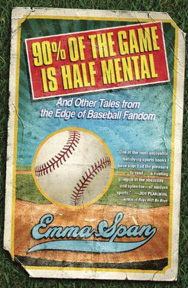
A native of suburban New Jersey who grew up a Yankees fan and came of age early in the Torre dynasty, Emma's currently a regular Bronx Banter contributor as well as the occasional keeper of her own well-named blog, Eephus Pitch (disclosure: I have been known to quaff the odd beer and/or attend the occasional ballgame with Ms. Span and am pleased to report she is delightful company for either endeavor. Also, I am partial to books which borrow their titles from Yogi Berra aphorisms).
As with most fans, male or female, working inside the game was hardly her first calling. As her story goes, after majoring in film studies at Yale, Emma faced the harsh reality of a liberal arts education that could take her only so far, in this case to a dead-end job writing blurbs for dubious direct-to-video titles like Titaboobs Paradise and Stanley the Stinkbug Goes to Camp. Her adventures inside the game began when she caught a break and had the opportunity to cover the 2006 Mets' playoff run for the Village Voice, a venerable alternative weekly rarely known for its sports coverage even as it's gone more mainstream (though Allen Barra heyday for Jockbeat was notably worthwhile). Her run at the Voice was brief — she was laid off after returning from a two-week trip to Florida to cover spring training the following year — but nonetheless long enough to confront the necessity of cultivating a sense of professional detachment from her rooting interests. Along the way she gathered some keen and often hilarious insights into working behind the scenes. Particularly notable is her jaundiced take on Shea Stadium and her introduction to the locker room etiquette of being a female sportswriter — segments of which put a recent Varsity Letters audience in stitches:
I don't really want to pile on Shea, because there's a long line. I heard at least seven or eight different sportswriters experess their eagerness to be the one pushing the plunger when demolition day finally came. (They were all disappointed, as Shea was reduced to rubble slowly and in pieces). But also because, in this age of cookie-cuter nostalgia-fest stadiums, I grudgingly admired Shea's unique ugliness. The place had character — sort of a disagreeable character, but character — and that ought to be worth something. It was a reminder of changing times; Shea was completed less than fifty years ago, in 1964, yet it is now impossible to imagine a scenario in which anyone could look at those blueprints and think, Good idea.After being laid off, Emma turned her energy towards a book project covering the Yankees' and Mets' 2007 seasons in the hope that they would culminate in a Subway Series. Her travels took her well beyond New York, most notably to Milwaukee in the hopes of witnessing Tom Glavine's 300th win as well as the famous sausage race (a topic on which I can claim expertise), and to Taiwan to investigate the state of its professional baseball league as well as the iconic status of Chien-Ming Wang, and the accompanying rabidity of the Yankees' following. Alas, while the Bronx Bombers made the playoffs for the umpteenth straight time (only to eventually be doused by a swarm of midges), the Mets' campaign ended when Glavine crashed and burned on the season's final day.
... On my first day I'd been in the clubhouse less than an hour when Pedro Martinez walked in and started changing by his locker. I wanted to go over and talk to him — ask him a question if I could get up the nerve, or at least listen in to a group session. But I figured I would wait until he got some pants on. It seemed lie the polite thing to do, probably the course of action Emily Post would suggest.
I shifted my weight from one leg to the other and fiddled with my pen; Pedro gave interviews cheerfully and joked with his teammates in Spanish. I glanced over super-briefly, so as not to get too good a look at anything, every few minutes. Pedro really not in a hurry to put on his pants, reads an exasperated scrawl in my notebook from a good twenty minutes later, really underlined three times. Eventually he wandered into the trainer's room, pants still nowhere in evidence.
Emma's plans for that book evolved into 90%, and while the effort to repurpose her tales into a first-person case study on the nature of fandom could have just as easily gone down in flames as that fateful Glavine start, it doesn't. She's a sharp, quick-witted observer with a facility for extrapolating from her own experiences into a more general contemplation of the silly and serious investments we make as fans, often with engaging amounts of self-deprecating humor. She's clear-eyed about the Yankees' excesses, sympathetic to the Mets' inferiority complex, and willing to play both sides of the fence even at the risk of committing baseball polyandry.
As a woman writing about a game played — and largely covered, and followed — by men (or perhaps more accurately, overgrown boys), Emma inevitably confronts the gender divide at several turns, but her light touch ensures that the topic hardly wears out its welcome. Nowhere does she wind up needing to apologize for any deficit of understanding on account of her femininity; she doesn't cower in fear of scorecards or Baseball Prospectus' advanced metrics, nor does she turn into Ballgame Barbie, more concerned with fashion sense and celebrity gossip than batting orders. Yet she doesn't strain to be one of the boys, either. Instead she simply turns her unique perspective into an asset, emerging with a work that's tough to put down until you've sailed through its 166 pages. Male or female, if you've had the chance to read her work at Bronx Banter, the Voice, or her own site, you know this already. If not, you're in for a treat.

Tuesday, February 09, 2010
Checking in
As for the writing, since we last spoke...
• I identified the positions where teams got the worst production in the majors last year (offense and defense taken together), the so-called "Vortices of Suck. Much like my previous piece on the Replacement Level Killers (the dead spots in the lineup which helped prevent teams from reaching the postseason), I also identified what teams had done over the winter to shore up these problems. Here's what I had to say about the Royals' shortstop situation:
Shortstop: Yuniesky Betancourt (.220 EqA, -1.4 WARP), Willie Bloomquist (.241 EqA, 0.6 WARP), and Mike Aviles (.154 EqA, -0.6 WARP), Royals• I wrote about the potential landing spots for Johnny Damon in the wake of the Randy Winn signing, which finally closed the door on just about every last shred of hope that he might return to the Yankees. Here are two of the six options I identified:
Royals general manager Dayton Moore has produced his share of headscratchers and howlers, turning the team into a laughingstock even in the eyes of its most ardent supporters. But no move generated—or deserved—quite as much ridicule as the team's mid-July acquisition of Betancourt, who at the time was already vying for this list in Seattle via a .220 EqA, -8 FRAA and -0.9 WARP in just 62 games. To be fair, the Royals did actually enter the year with a better plan at short; Aviles had hit .325/.354/.480 in two-thirds of a season as a rookie in 2008, good enough to place fourth in the Rookie of the Year balloting. Alas, he struggled at the start of the year due to forearm soreness, and was found to need Tommy John surgery, which he underwent around the All-Star break, just before Betancourt hit town. In the interim, the team had tried Bloomquist, Luis Hernandez (11-for-51) and Tony Peña Jr. (5-for-50 before giving up the hitting business in favor of pitching). At the very least, Betancourt's daily availability allowed manager Trey Hillman to devote time to not solving a variety of other problems.
Remedy (?): The Royals will actually pay Betancourt to return to work in 2010—in fact they're obligated to pay him $8 million over the next three years (including his 2012 buyout). The rehabbing Aviles is hoping to be ready for spring training, but how he'll fit back into the lineup once he proves his health is unclear; as unglovely as he is, incumbent second baseman Alberto Callaspo did hit a tidy .300/.356/.457 last year. One thing is for certain: whatever typically cockeyed solution the Royals come up with, it won't cost them the pennant.
Mariners: Between the free agent signing of Chone Figgins and the trades for Bradley and Cliff Lee, the Mariners have probably done more to improve their 2010 chances than any team. Last year's left field situation was a veritable Vortex of Suck, with Wladimir Balentien, Endy Chavez, Michael Saunders et al hitting a combined .219/.276/.333, the worst showing at any outfield position in the majors in terms of REqA (Raw Equivalent Average). Bradley figures to see the bulk of his time at DH, since as Joe Sheehan famously remarked, "Bradley can only do any two of these three things at once: hit, play the field, stay healthy." PECOTA is quite optimistic about a rebound: .277/.393/.463/.295 EqA. It's less so about the idea of handing left field over to the 23-year-old Saunders, the team's second-best prospect, projecting a .249/.320/395/.247 EqA line. Damon would obviously represent a significant upgrade, and while there's been relatively little noise about this possibility, GM Jack Zduriencik is one of the sharper tools in the shed.• I examined the competitive ecology of the game's six divisions using a few tools developed by my Baseball Prospectus colleagues:
Giants: Elsewhere in that shed, Brian Sabean continues to pound screws into bricks with a garden rake. Given an offense that finished last in the majors with a .244 EqA, Sabean has thrown about $35 million in 2010-2011 commitments at DeRosa, Aubrey Huff, Freddy Sanchez, Bengie Molina, and Juan Uribe, none of whom are strong steps in the direction of boosting that. Huff and Molina were below .260 last year, Uribe's at .242 for his career, and both DeRosa and Sanchez are coming off injuries that led to unproductive post-trade stints; the latter isn't even likely to be available for opening day given recent shoulder surgery. Projected for a .267/.346/.428/.269 EqA performance, DeRosa's production appears to be light for a corner outfielder. He'd make far more sense at second or third base, with a concomitant shift of Pablo Sandoval to first base to do away with Huff's similarly subpar production (.274/.340/.436/.268 EqA) and dodgy defense Sabean ruled out Damon last month, and while it happened at the same media session in which he dismissed a return engagement from Molina, it's clear that Damon is just too fancy for the GM's taste.
Having gotten the lay of the land in terms of wins and losses, we turn our attention to money. Factoring payrolls into the equation, specifically end-of-year payrolls, which include salaries, signing bonuses, earned incentive bonuses, buyouts of unexercised options, deferred cash, and more (BP alumnus Maury Brown's got the details here), here's how the divisions ranked in 2009 according to Marginal Payroll dollars per Marginal Win, which is computed according to the formula (club payroll - (28 x major league minimum)) / ((winning percentage - .300) x 162):• Spinning that off because of positive reception, I began a series on each division, discussing the nuances of each team's competitive ecology. First up is the NL East; here's what I had to say about the Mets:Division Avg Payroll WPCT MP/MWThe two Wests, which had the lowest average payrolls of any division, were very close in terms of MP/MW, and got considerably more bang for their buck than the rest of the divisions. What may be the most surprising is the AL Central's relative inefficiency. While the Orioles ($4.4 million) spent more per marginal win than any AL club, the Royals ($4.3 million) and Indians ($4.0 million) both spent more than the Yankees ($3.8 million, not even high enough to crack the top five), while the Tigers ($3.4 million) and White Sox ($3.1 million) both spent more than the Red Sox ($2.8 million).
NL West $85,634,258 .519 $2,102,663
AL West $90,797,019 .531 $2,128,263
NL Central $93,843,462 .482 $2,795,709
NL East $97,489,694 .488 $2,838,477
AL East $119,028,142 .520 $3,028,880
AL Central $95,379,003 .470 $3,048,658
Turning to the three-year picture, we see that aside from the AL East, there isn't much that's separating the teams by this measure:The two West divisions remain the most efficient ones, and while the AL East is by far the most expensive on a per-win basis, the two Centrals are getting very little for their money.
Division      Avg Payroll   WPCT      MP/MW
NL West       $85,968,141   .500   $2,311,548
AL West       $94,038,461   .511   $2,436,833
NL East       $87,713,776   .493   $2,461,417
AL Central    $89,639,497   .490   $2,555,610
NL Central    $90,966,392   .490   $2,600,034
AL East      $119,257,244   .520   $3,034,541
Following final-day eliminations from contention in 2007 and 2008 with a nightmarish campaign in which they seemed to invent new ways to lose games, players and credibility on a weekly basis, the Mets have become the game's biggest punchline. As doubts about their finances, medical staff and decision-making processes have sprung up, the team with the NL's highest average payroll over the past three years hasn't been able to reap the benefits of a single playoff appearance. Indeed, their 0.54 PER' [Payroll Efficiency Rating, the ratio between their Estimated Marginal Revenue (derived from win totals and market size) to Expected Marginal Revenue (derived from payroll)] in 2009 is the league's lowest single-year mark of the timespan, and their three-year mark is the league's second lowest.So now you're more or less caught up. Back later with some excerpts from today's BP chat.
Of course, that's hardly a surprising outcome given the fact that the Mets lost 1,451 days and $52.2 million worth of salary to the disabled list in 2009 (both MLB highs), as a variety of disasters befell seven of the team's 10 highest-paid players. All salaries in millions of dollars:Rk Player '09 Sal Fut. Sal DL DaysThose top five players qualify as Auction Market salaries, which helps explain why the Mets declined so sharply from their 2007-2008 WARP levels in that category, falling from fourth to sixth to ninth in the majors from 2007 to 2009. They've got the equivalent of more than a year's worth of payroll tied up in four of those players (for nine player-seasons) going forward, and their 2011 payroll commitments are already over $108 million, so they'll have to pray for strong rebounds. They'll also have to hope that marquee free agent signing Jason Bay, whose four-year, $66 million deal ranks as the winter's third-largest, holds up as well given the concerns about his knee which apparently cooled the Red Sox's interest in retaining him.
1 Carlos Beltran $20.1 $40.1 78
2 Johan Santana $20.0 $93.0 42*
3 Carlos Delgado $12.0 - 144*
4 Oliver Perez $12.0 $24.0 104
5 Billy Wagner $10.5 - 137
9 Jose Reyes $6.1 $9.9 134*
10 J.J. Putz $6.0 - 119*
*Ended season on disabled list
Even more unsettling is the fact that the Mets fell from 14th to 18th to 28th in terms of WARP from Non-Market salaries over the three-year period. Again, injuries were part of the story, as players like Angel Pagan (3.7 WARP), John Maine (0.4 WARP) and Fernando Martinez (-0.7 WARP) all spent at least 80 days on the DL, too. On the other hand, the regular lineup presence of soph Daniel Murphy (0.6 WARP while splitting his time between the two positions where the offensive bar is the highest, first base and left field) didn't help matters either.
Of course, last year marked the Mets' debut in Citi Field, an attractive, intimate replacement for their Shea Stadium dive, but one with 27 percent less seating capacity, which will likely produce a drag on revenues even given higher ticket prices. If there's any good news to be found, it's that the farm system is on the rise thanks to the team's international scouting efforts, and that the 2010 season couldn't possibly bring more bad news for the franchise than the past year did. At least until Omar Minaya's impending firing opens up a whole new can of tabloid whoop-ass.
Labels: Hit and Run, Mets, Yankees
Monday, August 31, 2009
Back in the Sausage Factory
It happens every week: a reader sees his favorite team trailing one of its division rivals in the Hit List rankings despite leading in the actual division race and fires off a snarky email or comment questioning the validity of the list, often while attempting to divine the current location of my head, and usually while making reference to last year's division race or postseason results. Well into my fifth season of writing the Hit List, I'm far more amused by such occurrences than I am offended, but the weekly give and take serves as a reminder for the occasional need to explain the list's workings in greater detail. As such, I annually set aside a column called the Hit List Remix to walk readers through the process.After running through the basics, I took a look at the relative strength of each division and dug deeper into the nuts and bolts of a few races where a team's ranking outdid their division standing such as the Rays being ahead of the Red Sox on the Hit List but behind them in the AL East. The article is free, so take a look.
First, a quick refresher course on the Hit List's basics. It's BP's version of the power rankings, created by me back in 2005 and based upon an objective formula which averages a team's actual, first-, second- and third-order winning percentages via the Adjusted Standings. To go into a bit more detail:
• First-order winning percentage is computed (via Pythagenpat, Pythagoras' slightly more sophisticated sibling) using actual runs scored and allowed.
• Second-order winning percentage uses equivalent runs scored and allowed, based on run elements (hits, walks, total bases, stolen bases, etc.) and the scoring environment (park and league adjustments).
• Third-order winning percentage adjusts for the quality of the opponent's hitting and pitching via opposing hitter EqA (OppHEqA) and opposing pitcher EqA (OppPEqA), both of which Clay Davenport recently added to the Adjusted Standings report for those of you curious enough to care.
With the exception of an injection of preseason PECOTA projections during the season's first month, those numbers are all that go into the rankings, which are averaged into what I've called the Hit List Factor (HLF). There are no subjective choices to be made, no additional tweaking to favor the A's or hurt the Phillies or fit into any of the other 28 conspiracy theories our readers might think of offering. No recent hot or cold streaks or head-to-head records are accounted for, either, despite the frustration of readers wondering why their team hasn't vaulted to the top thanks to a 5-2 week against their division rivals. It's all about runs, actual ones and projected ones, because run scoring and run prevention give us the best indication of a team's strength going forward. Using all four percentages is a way for correcting for teams that over- or underperform relative to the various areas examined.
The Hit List itself was a freebie as well. Once again, the Dodgers and Yankees were 1-2:
[#1 Dodgers] Knuckling Down: An extra-inning loss to the Rockies shaves the Dodgers' division lead to two games, but they rebound to win the series behind a solid debut by Vicente Padilla, recently released by the Rangers. The Dodgers are getting good results from the pitchers they've pulled off the scrapheap; knuckleballer Charlie Haeger combines to shut out the Cubs earlier in the week. For all of their recent rotation woes, they're second in the league in SNLVAR, and while the team is just 14-17 since July 25, they've outscored opponents by 18 runs in that span.Tough to believe the nightmare that is this year's Mets. Can't recall a more pungent combination of insult and injury.
[#2 Yankees] Godzilla and Friends: Hideki Matsui's pair of two-homer games help the Yankees stave off the Red Sox by taking two out of three in Fenway; he drives in seven amid a 20-run deluge in the opener. Matsui's' 23 homers rank second to Mark Teixeira's 31, and with Robinson Cano contributing a pair of shots (and reaching a new career high), the team now has six players with at least 20 blasts, the third time in franchise history (1961, 2004) they've reached that plateau. Jorge Posada (17) and Derek Jeter (16) could help them surpass the 1996 Orioles, 2000 Blue Jays and 2005 Rangers, who had seven reach that mark.
[#22 Mets] Escape From New York: Just two innings into his comeback from Tommy John surgery, Billy Wagner gets traded to the Red Sox for a pair of PTBNLs, making him lucky enough to avoid the soaring body count, not to mention Omar Minaya's continued reign of error. The Mets lose both Johan Santana and Oliver Perez to season-ending surgery, the former due to bone chips in his elbow which have contributed to a 4.02 ERA and a 5.4 K/9 over his last 15 starts, the latter to patellar tendon tendinosis which turned his season into a 6.82 ERA, 7.9 BB/9 nightmare. Jeff Francouer could join the party as well due to a torn thumb ligament; his .305/.331/.500 line since being acquired includes just three unintentional walks in 175 PA.
Labels: Dodgers, Hit and Run, Hit List, Mets, Yankees
Monday, July 27, 2009
Clearing the Bases: Post-Rickey, Pre-DC edition
• A Basseball Prospectus/ESPN Insider piece examining second-half strength of schedule, revisiting an earlier piece but using Hit List Factor instead of a team's projected winning percentage. Here's how the teams shake down:
Glad to see that two of my three teams have cupcake schedules, though for the Brewers it won't mean much if they can't improve their pitching.Team Season 1st 2nd
Blue Jays .514 .497 .536
Orioles .522 .510 .536
Royals .505 .494 .518
Yankees .508 .500 .518
Rays .504 .496 .515
Athletics .518 .521 .514
Rangers .503 .495 .513
Red Sox .504 .498 .512
White Sox .497 .485 .512
D'backs .503 .497 .510
Astros .494 .485 .505
Indians .505 .504 .505
Tigers .495 .488 .503
Giants .497 .493 .502
Mariners .502 .502 .502
Padres .512 .523 .499
Angels .505 .510 .498
Reds .491 .490 .492
Nationals .504 .516 .489
Pirates .492 .495 .488
Braves .494 .499 .487
Twins .494 .499 .487
Phillies .490 .495 .485
Marlins .496 .507 .483
Rockies .497 .508 .483
Cubs .489 .496 .482
Mets .496 .508 .481
Cardinals .483 .486 .480
Brewers .492 .504 .477
Dodgers .489 .499 .477
• Last week's Hit List, which found the Dodgers and Yankees 1-2 for what I believe is the first time in the column's history.
• Speaking of the Hit List, I was lucky enough to get to take a time out during its creation to watch the final two innings of Mark Buehrle's perfect game. While I've seen a few no-hitters in their entirety (including Nolan Ryan's record-setting fifth) and caught the tail end of several more, this was the first perfecto I'd seen the end of; I missed those of David Wells (turned that one off early, d'oh) and David Cone. DeWayne Wise's spectacular catch to rob Gabe Kapler of a home run to lead off the ninth inning was worth the price of admission alone.
• Also from last Friday, in honor of Rickey Henderson's induction into the Hall of Fame, I took a at which contemporary players are most like Henderson:
Rickey Henderson will be inducted into the Hall of Fame on Sunday, an honor that feels long overdue for the player who holds the all-time records for both stolen bases and runs, is a member of the 3,000 Hit Club, and is widely acknowledged as the greatest leadoff hitter of all time. "If you could split him in two, you'd have two Hall of Famers," wrote Bill James of Henderson nearly a decade ago. The bearded bard of sabermetrics was onto something, and not only with regards to Henderson's Cooperstown credentials. Scanning the horizon in search of a truly similar active player, one comes up with only fractional Rickeys, players who possess elements of Henderson's game — his speed-power combo, his keen batting eye, his basepath derring-do — but nowhere near to the exact same blend.While obviously I had the upper hand because I was the one creating the system, I was as surprised as anyone else when the Orioles' Brian Roberts came out on top, with B.J. Upton, Johnny Damon, Jose Reyes and Carl Crawford following. "All of these players combine speed, power, and the ability to get on base to some degree, but none of them profile quite like Henderson does; each punts at least one category in this particular decathalon," I wrote, noting particularly that none of the overall leaders walks with Henderson's frequency. For more, see BP and ESPN Insider, and look for a follow-up at BP on Tuesday.
In honor of Rickey's impending induction, I set out to search for the most Rickey-like player among the current crop of actives, devising a series of similarity scores in categories that typify the unique shape of Henderson's performance. Rather than use raw statistics to compare a player whose major league career began 30 years ago, I called upon Clay Davenport's translated statistics, which normalize all players to the same run-scoring environment. Instead of relying upon a single year's performance, I used a 3/4/5 weighted average of 2007, 2008, and 2009 stats for all players with at least 900 actual plate appearances over that span, then boiled those down to a per-650 plate appearance format for comparison to a similar encapsulation of Henderson's career. This sells the superstar short by including his decline phase, but with nobody even remotely close to Rickey Henderson at his peak out there today, the bar needs a bit of lowering.
The players were then scored in ten categories, with Henderson's performance defined as 1000 points, the least Henderson-like as zero, and all performances in between scaled accordingly. Occasionally, small-sample outliers had to be removed for this to work; crediting a player who's 4-for-5 in stolen bases with similarity to Henderson's 80.4 percent success rate on the basepaths isn't appropriate. It's important to note that players who exceeded Henderson in these categories — with higher slugging percentages or stolen-base success rates, say — were penalized, too; this process isn't designed to tell us the best player, just the "Rickeyest."
• Last week's Toledo radio hit.
• Following up this item, which gave me ample fodder for the Mets' hit List entry, Tony Bernazard gets what he richly deserved: a pink slip. What an asshole. Meanwhile, Diamondbacks scout Carlos Gomez clarifies his part in one of the incidents that led to the firing. Contrary to the New York Daily News' earlier report, Bernazard did not directly address Gomez with his profanity-laced tirade, but rather berated a Mets official who told him to wait until the end of the half-inning before taking the seat occupied by Gomez.
[Update]: Via Shysterball, Mets GM Omar Minaya's performance at the press conference is worth a look. He tangles with Daily News Mets beat reporter Adam Rubin, accusing his coverage of being slanted by his own desire to join the Mets' player development department under Bernazard. This is turning into a parade of trainwrecks. And I can't stop watching.
• Finally, I'll be at the Society for American Baseball Research convention in Washington, DC from Thursday until Sunday. Don't be shy if you see me there and want to say hi — I don't bite.
Labels: Carlos Gomez, ESPN Insider, Hit and Run, Hit List, Mets, radio
Thursday, July 23, 2009
Some People Crack Wise, Some Just Crack
Three ugly incidents involving Bernazard have been reported over the past two days. In the first one, he took his shirt off and challenged a minor leaguer to a fight, leading one wag to remind readers that Bernazard once endured an 0-for-44 string of futility, tied for the longest in the majors by a non-pitcher: "Odds are he wasn't going to hit anybody even if he tried."
In another incident, he engaged in "a profane verbal exchange" with closer Francisco Rodriguez, and now a third has come to light, in which he got in a shouting match with a Diamondbacks scout:
These incidents have been common knowledge around the Mets for days - as was the ugly, very public exchange Bernazard had with Diamondbacks scout Carlos Gomez in the box seats behind the plate during a recent home stand at Citi Field. For Minaya to say he's "investigating" the matter is either an insult to our intelligence or an acknowledgment that all of this despicable behavior by his assistant is somehow news to him.Gomez, you may recall, is the indy-league sidearmer I interviewed a few years back for Baseball Prospectus. Alias Chad Bradford Wannabe, he was hired by Arizona in late 2007 after writing a popular series on pitching mechanics for Baseball Think Factory. Somehow I have a feeling he'll still have a job long after Bernazard is fired, a dismissal that's richly deserved, as even Bill Madden figures out:
In the confrontation with Gomez, Bernazard screamed at the scout for sitting in his seat and angrily demanded him to move. Then when one of his own baseball operations men attempted to intercede, suggesting that they wait until the end of the inning for everyone in the scouts section to shift seats, Bernazard went ballistic and began cursing at his own man in front of all the other scouts.
It would be one thing if Bernazard, despite his temper, was doing an exemplary job at developing talent for the Mets. But the hard facts are the Mets' farm system is among the worst in baseball. All you need is to look at what has transpired this year where the best the system has been able to offer in the face of all the injuries are Argenis Reyes, Nick Evans, Wilson Valdez, thrice-released Angel Berroa and Fernando Nieve, a March waiver claim from the Astros. On that alone, Bernazard deserved to be the first fall guy for this Mets mess.The Mets' Triple-A affiliate, the Buffalo Bisons, are an International League-worst 35-58 at this writing, and the Double-A Binghamton Mets are 37-59, two losses away from holding a similar claim on the Eastern League. Ouch.
Friday, July 10, 2009
Back in the Saddle Again
[#1 Dodgers] Prodigal Sons: The Dodgers regain the Hit List top spot as Manny Ramirez returns from a 50-game suspension. He goes 6-for-18 with two homers and seven RBI, drawing louder jeers for being ejected after an awful strike three call than for his transgression. With Juan Pierre sitting, Rafael Furcal is restored to the leadoff spot and feeling better about his swing via a 14-for-30 showing this month.Notes galore to these:
[#3 Yankees] Running the Table: A 13-2 run carries the Yankees back into a first-place tie with the Red Sox. They take a three-game set from the Twins in Minnesota, thus winning the season series 7-0; they've won 18 of their last 24 games against the Twins. Alas, the run is tempered by the loss of Chien-Ming Wang due to a shoulder strain. Not that he'd pitched well (9.64 ERA overall, 5.50 since returning from the DL, and still waiting for that first quality start), but his absence forces the Yanks to pull Alfredo Aceves into the rotation. Along with Phil Hughes, he's become a key player in a bullpen that's put up a 2.39 ERA and 3.3 K/BB ratio since the beginning of June; he's 18th in the league in WXRL.
[#10 Blue Jays] Break Up the Jays: J.P. Ricciardi opens the door to offers for Roy Halladay, though the ace won't be a free agent until after 2010. It's a consequence of a ridiculously top-heavy payroll; they have $74.45 million — 92 percent of this year's Opening Day payroll — committed to just six players for next year, including B.J. Ryan, whom they punt with some $15 million remaining on his deal. The bigger problems are their five-year commitments to Vernon Wells ($107 million) and Alex Rios ($59.7 million), hitting an interchangeably pallid .264/.313/.418 and .259/.314/.415, respectively.
[#30 Nationals] Dunn Deal? Adam Dunn's 300th career homer halts Tommy Hanson's 26-inning scoreless streak and helps the Nats snap their four-game losing streak. Dunn's the fifth-fastest to 300 homers, at least in terms of the fewest at-bats to reach that milestone, trailing Babe Ruth, Mark McGwire, Ralph Kiner and Harmon Killebrew. Acting GM Mike Rizzo has no plans to trade the curiously consistent slugger. Meanwhile, ex-Nat and current Pirate Joel Hanrahan earns the win in a suspended game against the Astros, with the winning run scored by Nyjer Morgan, who arrived from Pittsburgh in that deal.
• That NBCSports.com link in the Dodgers entry, by Mike Celizic, may be the best piece yet about Manny Ramirez's return. Between that and Eric Seidman's piece on John Hirschbeck's lousy strike three call, that's a rather off night in the Mets' booth for the usually appealing Gary Cohen.
• The ease with which Hughes has taken up residence in the bullpen should be used to quiet those who continually pine for Chamberlain to return to the pen. Why? Because it shows that Chamberlain isn't so unique in his ability to dominate in relief. A pitcher with excellent stuff — Chamberlain, Hughes, even Aceves — can succeed down there by shortening his arsenal and attacking hitters more aggressively. Those same pitchers may struggle a bit in the rotation, but that's life in the big city; it's a much harder job getting hitters out three or four times a game, and it's no crime for even a pitcher with their skills to scale a learning curve. Particularly given the specter of a Brett Tomko start.
• As somebody who likes to dine on schadenfreude pie, metaphorically speaking — it's the term my friends and I use when discussing the pleasure of watching right-wing lunatics self-immolate — I'm continually amused by Ricciardi's brash displays of incompetence. I can't believe that guy still has a job.
• That Hanrahan-Morgan game is just so wonderfully weird I had to squeeze it into the last line of the Hit List. A box score for the ages.
Labels: Dodgers, Hit List, Manny Ramirez, Mets, Yankees
Tuesday, June 09, 2009
Mending the Mets
To me, pitching should still be their biggest concern:
If I'm the Mets, throwing Livan Hernandez and Tim Redding out there in the same rotation cycle, I'd start to sniff around the Mariners' Erik Bedard and see what it would take to acquire him. Granted, he's fragile, but he's certain to be available this summer, and he's pitching about as well as he ever has been. Better him than -- to go back to the Indians, who are roadkill waiting to be picked over by vultures -- Carl Pavano, because Bedard misses more bats.That Bedard is a fragile injury case and Hawkins a guy who's as notable for his spectacular crashes and burns as for his above-average stretches only goes to show what a crapshoot the in-season trade market is. Personally, I'd fire Jerry Manuel before I'd invest to heavily in a deal, because I think he's one of the more ineffectual managers out there, and that the problems of Perez and Maine owe something to the manager's usage and ability to deal with them. Not that I think Omar Minaya, who failed to stock their corner outfield and rotation with adequate depth over the winter, should be let off the hook, but GMs generally don't get fired in-season.
If the price of Bedard is too steep -- and let's face it, the Mets aren't brimming with blue-chip prospects -- then Jarrod Washburn might be more attainable, particularly as he's more expensive ($10.35 million this year) and the ability to take on salary is something the Mets will need to draw on at some point in this process, given that they've got more holes than a Jarlsberg wheel. Washburn's not as good as his 3.22 ERA suggests, but he's a viable fourth starter. While they're at it, perhaps they can liberate Jeff Clement and throw him into the first-base mix. The Diamondbacks' Doug Davis is another pitcher who comes to mind, particularly as that team is DOA and always looking for salary relief.
For the relievers, LaTroy Hawkins is a name that comes to mind. He was pretty much run out of town on a rail by the Yankees last year, but he's done fantastic work with the Astros (47/13 K/BB in 43 2/3 innings, with just two homers allowed), and while he's currently closing games in Houston, the Astros are going nowhere.
...Even conceding the point that Hernandez has been serviceable (and 4.29 FIP is certainly that), you've still got Redding, a very flawed [John] Maine, a broken [Oliver] Perez, and a Mike Pelfrey who's pushing a 5.00 ERA, though that's one bombing coming off five straight quality starts. Maybe they don't break the bank for a Bedard, but they need another solid starter given that it's Johan Santana and a whole lot more going wrong than right.
Labels: ESPN Insider, Mets
Friday, May 15, 2009
Ranging
Over the winter a few teams took a page from the Rays' book, one of them being a team that's suddenly surprising people:
Don't look now, but the Rangers are leading the American League West. Coming off four straight sub-.500 seasons, projected for just 70 wins and the #29 spot on the preseason Hit List, they're out of the gate at 19-14 clip, with the fifth-best run differential in the majors. With the A's, Angels and Mariners stumbling and bumbling, the Rangers are starting to look like plausible contenders in a division where 84 wins may be enough. Our PECOTA-based Playoff Odds report estimates they have around a 23 percent shot at the flag, more than double their chances as of Opening Day but still roughly half of the Angels' estimate.As noted in the excerpt, I was critical of the decision to promote Andrus during a season where it didn't look as though the Rangers could win much. But since then, the AL West favorite Angels, who won 100 games last year, took several hits in the pitching department, losing both Ervin Santana and John Lackey for the first month of the season, and suffering the tragic loss of Nick Adenhart. The A's, who were predicted to win the division in BP's preseason projections, have fizzled and already look a bit green around the gills.
...Though the pitchers have gone backwards in two of the three key categories, they're surviving thanks to the Rangers' defense, which after ranking dead last in Defensive Efficiency in 2008 has improved by 45 points and now leads the AL. The shift of Young to third base to accommodate the arrival of the slick-fielding Andrus — a pair of decisions I criticized in this space, much to the dismay of our Rangerly readers — is bearing fruit.
More than that, it's following the template of one of last year's top story lines, the record-setting defensive turnaround of the Rays, a point that certainly factored into the decision to skip [Elvis] Andrus from Double-A to the majors even at the tender age of 20. In fact, the Rangers were one of three teams who elected to try replicating the Rays' recipe, patching a porous defense with a defensively sound shortstop regardless of his offensive limitations.
...If the Rangers' 45-point DE improvement were to hold, it would rank as the third-best turnaround ever, behind the Rays and the 1980 A's (Billyball comes to Oakland) and ahead of the 1991 Braves, who kicked off a dynasty. That would translate into about 100 runs saved based on Ben Lindbergh's math, and perhaps more, given the inflated value of each hit in the Rangers' offensive environment. In all likelihood, that would probably spell a postseason berth.
I got my first extended look at Andrus on Wednesday night against the Mariners, who led the West until recently. The kid made a couple of really nice plays, including a spin-and-fire move behind second place which the Rangers' announcers called his best one of the year. He also had a couple of hits, including a game-tying RBI triple in the sixth. The kid wasn't expected to hit much (PECOTA .248/.301/.334), but he's shown better contact skills and more gap power than the system gave him credit for, and his speed has helped him take advantage of that. I can see why Rangers fans were excited enough to rush him to the majors, and why they're excited about their team's chances after years of futility. I'm not incredibly optimistic they can pull it off, particularly with the Angels surging while getting Santana and Lackey back this week, but suddenly I've got another team to keep an eye out for on the Extra Innings package.
• • •
Meanwhile, this week's Hit List is still topped by the Dodgers, who've seen Juan Pierre go 12-for-25 with five doubles since you-know-who was suspended. Sampling a few entries of interest:
[#3 Mets] Tossing the Bad Apple: The Mets reel off seven straight wins to take over first place in the NL East, yielding just 20 runs in that span. The streak is part of a larger stretch of nine straight quality starts for the previously beleaguered rotation, one that coincides exactly with Oliver Perez's exile. The offense takes a hit as Carlos Delgado is sidelined by hip woes just as he's heating up (.423/.516/.654 in May), but replacement Fernando Tatis (.328/.385/.517) has been no slouch.Finally, I've been to each of the two new NYC ballparks twice over the past couple of weeks, and I'm quite sure I'm getting the short end of the stick with my current arrangement. CitiField, though it's definitely overplaying the Brooklyn Dodgers angle at the expense of Mets history, and though it has some particularly hideous signage, particularly around their gigantotron video, has an intimacy that lends it an energy which has been sorely lacking at the new Yankee Stadium. Additionally, the refreshment prices are much more reasonable, and the management hasn't embarrassed itself on a daily basis with odious pronouncements from Lonn Trost and Randy Levine about ingenious new ways to beat the peasants back from the playing field or otherwise separate them from their cash.
[#5 Brewers] Prince and the New Power Generation: Rickie Weeks homers in three straight games, while Prince Fielder bashes a trio of homers in a three-game sweep of the Marlins, two of them go-ahead shots. Fielder's hitting .341/.472/.659 ths month, one of five Brewers—along with Weeks, Ryan Braun, J.J. Hardy, and Craig Counsell (!)—who are slugging above .600 in May. The Brewers are tied for the league lead in homers, and they're a major league-best 18-6 since their 3-8 start, helping them grab a share of the NL Central lead.
[#12 Tigers] D-Train and E-Jax: Dontrelle Willis returns to the majors in shaky fashion (4.2 8 4 4 2 0), but the real story in the rotation is their three shutouts in a four-game span, including a two-hitter by Justin Verlander and a combined seven-hitter spearheaded by Edwin Jackson. Jackson appears to have finally turned the corner. He's got the rotation's best ERA (2.60), his 3.18 K/BB ratio is more than double his career rate, and he's still getting excellent double play support for such an extreme flyballer.
[#15 Yankees] Alex Rodriguez drills a three-run homer on the first regular-season pitch he sees, but he goes just 3-for-21 amid a stretch that sees Jorge Posada hit the DL and Derek Jeter and Hidkei Matsui both miss time due to nagging injuries. The Yanks need A-Rod to hit like the guy in the catalog, and they need Mark Teixeira (.203/.333/.424) to heat up as well. He's getting his walks and homers (four of the latter in a seven-game span), but his .193 BABIP is the lowest among the league's 105 batting title qualifiers.
New name for the park in the Bronx, as noted in the Hit and Run article: Epic Fail Stadium. Use it.
Labels: Hit and Run, Hit List, Mets, Yankee Stadium, Yankees
Wednesday, February 18, 2009
Clearing the Bases - Non-Steroidal Anti-Inflammatory Edition
• Baseball Prospectus 2009 is shipping from Amazon.com and on the bookshelves of your local retailer. I've had a copy in hand since last Friday, and it's as chockfull of wit, wisdom and data as ever, with stats and projections for over 1,600 players across 628 pages by the BP crew. Your truly contributed five team essays and two sets of player comments, the most I've ever contributed to a BP annual. Get it.
• At BP I've been working my way through the new PECOTA projections to examine the offseason departures and arrivals on each team and in each division. By taking the Wins Above Replacement Player (WARP) projections of each player signed (or lost) via free agency or acquired (or offloaded) via trades we can get a better sense of the flow of talent into or out of the various divisions and the way this winter's hard economic times have had an impact on roster construction. Combining that knowledge with the publication of the PECOTA-based projected standings, we can see how these moves have an impact on the division races.
The series is called "Outside Help," and thus far I've done the NL East, NL Central and NL West. Here's a sample from today's piece:
The West projects better than the Central in part because of high-upside pitching talent, with six of the majors' top 15 pitchers according to the PECOTA VORP projections: Brandon Webb, Dan Haren, Tim Lincecum, Jake Peavy, Chad Billingsley, and Max Scherzer. The Central has just two among the top 15, Rich Harden and Roy Oswalt. The West has 13 pitchers projected for at least 20 VORP, the Central just eight—double the number per team, basically. Even given the fact that PECOTA underestimated the Central last year, the advantage seems clear.So far the numbers show the NL East gaining a fair amount of talent, with four out of five teams showing positive net WARPS via trades and free agency, while the Central and West both have seen talent drains, with only one team in each division bucking the trend. Pretty amazing. I'll start working my way through the AL soon.
As for the outside help, it bears repeating that what's presented here is just one piece of the puzzle, with no attempt to account for longer-term concerns such as prospect trades or multi-year deals. This is just a rough guide to who's new and who's gone, and how much impact they're expected to have on the division race this year. Teams are listed in order of 2008 finish; for each hitter, WARP and EqA are listed, while for each pitcher, the figures are WARP and EqERA.
Los Angeles Dodgers
IN: C Brad Ausmus (0.7, .235), SS Juan Castro (-0.5, .177), SP Shawn Estes (0.8, 5.40), SP Charlie Haeger (-0.4, 6.64), INF Mark Loretta (0.3, .249), RP Guillermo Mota (0.7, 4.88), SP Claudio Vargas (1.3, 5.00), SP Jeff Weaver (0.4, 5.76), SP Randy Wolf (2.4, 4.72)
OUT: C Gary Bennett (-0.1, .218), CF Andruw Jones (1.4, .267), SP Derek Lowe (4.2, 4.00), SP Brad Penny (1.8, 4.85), RP Scott Proctor (0.9, 4.56) LF Manny Ramirez (4.3, .316), RP Takashi Saito (2.7, 2.99)
NET: -9.5 WARP (-5.2 if Ramirez returns)
As you'd expect, the wealthiest team in the division has spent the most money this winter, primarily in the service of retaining their own. Presuming that the Dodgers will eventually strike an agreement with Ramirez, whose list of potential suitors has dwindled to LA and San Francisco, they'll have given out three of the division's four most lucrative contracts this winter. As it is, Rafael Furcal's $30 million deal and Casey Blake's $17.5 million deal rank first and third, respectively. Despite that spending, they've made some cuts that they otherwise might not have if they weren't saving room for Manny, winding up with a net talent drain even if he does return. Lowe's departure is the most significant, exposing a rotation that's got plenty of health concerns, but while we're on that subject, the losses of Penny and Saito may not be as painful as advertised, particularly since the latter's elbow woes may be serious enough to merit Tommy John surgery. The most damaging blow, however, would be in losing Ramirez, whose return would improve the Dodgers' eight-game deficit in the projected standings by three wins. And so long as we're alluding to useless outfielders, the Rangers will take that projection from Jones, whose remaining $21 million the Dodgers figured out a way to eat on the installment plan. As for the players that the team has acquired, aside from solid fourth starer Wolf, they're a singularly unimpressive lot, many of whom could be swapped out for Shawn Estes in Dodger Thoughts blogger Jon Weisman's instant classic of a quip: "When I think of Estes, I think of a game show in which the category is 'Pitchers I've been eager for the Dodgers to face in the 21st century.'"
Arizona Diamondbacks
IN: C Luke Carlin (1.0, .251), SP Jon Garland (2.1, 4.92), RP Tom Gordon (0.3, 4.53), 2B Felipe Lopez (2.2, .267), RP Scott Schoeneweis (0.7, 4.73)
OUT: UT Chris Burke (0.3, .238), RP Juan Cruz (1.3, 4.27), 1B/OF Adam Dunn (3.8, .308), SS David Eckstein (0.8, .243), C/UT Robby Hammock (-0.1, .201), 2B Orlando Hudson (2.6, .267), SP Randy Johnson (3.5, 4.01), RP Wil Ledezma (0.6, 5.1), RP Brandon Lyon (1.7, 4.33), RP Conor Robertson (0.5, 5.51), OF Jeff Salazar (1.0, .276)
NET: -9.7 WARP
As noted before, the Diamondbacks have already made a conspicuous show of belt-tightening this winter by laying off 31 employees and foregoing the Big Unit, not to mention other relatively high-quality free agents like Dunn and Hudson. As such, they've lost the most talent of any team in this division, though PECOTA still gives them a generous cushion in the standings. That only partially mitigates the decision to bypass Johnson, who took $8 million from the Giants, in favor of Garland, whom the Snakes signed for $7.25 million. While Arizona was one of the league's most efficient teams in terms of marginal dollars per marginal win last year, this is an obvious error, as they could have bought the extra 1.4 wins forecast for Johnson at about 20 percent of the going rate. Meanwhile, the decision to let Hudson depart in favor of Lopez is closer to a wash, though the five-run difference in defensive projections (+2 for Hudson, -3 for Lopez) may have a ripple effect once the defense is factored into the pitching projections.
• Last week at BP and at ESPN Insider via our new syndication deal, I took a look at the Mets' offseason efforts to upgrade their pitching staff:
[Mets GM Omar] Minaya entered the offseason with just three starters under contract: Johan Santana, John Maine, and Mike Pelfrey. Santana went 16-7 with a 2.53 ERA and 206 strikeouts last year, numbers that propelled the two-time AL Cy Young award winner to a third-place finish in his first NL vote. Maine pitched reasonably well (10-8, 4.18 ERA and 122 strikeouts), but a bone spur in his shoulder limited him to just six second-half starts and required off-season surgery. Pelfrey established himself as a viable starter by going 13-11 with a 3.72 ERA after getting the stuffing knocked out of him in 2007.The Mets are currently forecast for 92 wins, while the Phillies and Braves come in at 87 wins. Adjustments to those numbers will be made throughout the spring as injuries and trades happen and as job battles are settled, but the early line is favorable. Not that it will heal the wounds of 2007 and 2008.
With the re-signing of Perez (10-7 with a 4.22 ERA and 180 strikeouts), the front four is thus unchanged, and a stronger unit than the one they left the gate with last year, given that Pelfrey is replacing Pedro Martinez, whose injuries limited him to just 20 starts and an ugly 5.61 ERA. Indeed, Martinez's departure should liberate an organization that spent the past three years overestimating his capabilities and his durability; he averaged 16 starts and a 4.73 ERA in that span. Lacking in depth, the 2008 club called upon globetrotting journeymen like Nelson Figueroa and Brandon Knight to patch their rotation when Martinez or Maine were sidelined.
Minaya has improved that depth with fifth-starter options that include journeymen Tim Redding and Freddy Garcia, and homegrown prospect Jon Niese. Redding took the ball every fifth day for the Nationals last year, putting up a 4.95 ERA in 33 starts, while Garcia showed promise in a three-start audition with Detroit after more than a year lost recovering from surgery to repair a torn labrum and frayed rotator cuff. Niese made three starts last September for the Mets, but with less than 40 innings of Triple-A experience, the 2005 seventh-round pick could use more minor league seasoning. Though a few starts remain unaccounted for, here is the rotation's initial prognosis:Pitcher GS IP ERA VORPAccounting for scoring inflation, that's the equivalent of a 3.92 ERA last year, which would have ranked fourth among starters, and which is essentially on par with their warts-and-all showing of 3.98. Note the effect of regression upon Santana, who has bettered a 3.14 ERA five times in six years as a starter, and that neither Maine nor Pelfrey are projected for a full complement of innings. PECOTA's initial forecast cautiously called for just 107 frames from the former because of last year's dip in playing time, and was wary of Pelfrey's 200-inning workload as a 24-year-old—48 more than he threw in 2007, including those in the minors. The Verducci Effect suggests that he'll have trouble repeating that success, as do his peripherals, but the more innings either throws, the more this unit will improve relative to that projection.
Santana 30 210 3.14 50.6
Maine 26 145 4.16 20.8
Perez 29 180 4.26 21.0
Pelfrey 26 145 4.39 13.6
Garcia 15 75 4.62 8.3
Redding 23 120 4.83 7.2
Niese 7 35 5.09 0.6
Total 156 910 4.14 122.1
• Speaking of job battles, one more syndicated column that ran on both BP and Insider addressed some of the highest-profile ones using the PECOTA projections. Here's what I said about the various battles on the beasts of the AL East
New York Yankees: Center Field, Right FieldSince I was on a word count, I didn't have room to fit the Rays' job battles in there. I'll probably tackle them in another article in the near future given the interest level from readers.
As they attempt to rebound from their first non-playoff season since 1993, the Yankees' biggest question mark looms in center field. After solid performances in '06 and '07, Melky Cabrera's horrid 2008 (.249/.301/.341) threw the job up for grabs, and while Triple-A farmhand Brett Gardner didn't clinch it, his .294/.333/.412 showing in 73 plate appearances after a mid-August recall may have given him a leg up. PECOTA doesn't see either as a slam dunk, but favors Gardner's blend of speed and OBP, forecasting a .253/.339/.351 showing with 32 steals (2.4 WARP), compared to Cabrera's .267/.326/.376/10 steal forecast (1.8 WARP). Meanwhile, in right field, the system is more sanguine about off-season acquisition Nick Swisher's ability to shake off a down year than it is about Xavier Nady living up to the career bests he set in all three triple-slash categories. It forecasts a .244/.353/.460 performance for Swisher, compared to .270/.323/.444 for Nady. A platoon arrangement limiting the latter to lefty-mashing would maximize the duo's production.
Boston Red Sox: #5 Starting Pitcher, Shortstop
Touted as the game's top pitching prospect going into last year, Clay Buchholz thoroughly flopped (2-9, 6.75 ERA), plagued by mechanical woes. Hot stove rumors had him Texas-bound in exchange for a young catcher, but he returns to compete for the rotation's fifth spot against Brad Penny and John Smoltz, two veteran free agents attempting comebacks from shoulder injuries. PECOTA remains optimistic about the 24-year-old Buchholz, forecasting a 4.56 ERA and 8.0 strikeouts per nine. Penny, who made a miserable showing in LA (6-9, 6.27 ERA) after a Cy Young-caliber 2007, was initially forecast for a 4.47 ERA, but that adjusts to 4.85 in the move to Fenway. Smoltz, who needed labrum surgery after just 28 IP last year, is forecast for the best ERA of the three (3.57), but he won't return until June, and the number of innings left in the 42-year-old's arm is an open question, so the additional depth is a bonus. As for shortstop, PECOTA is bullish on the 25-year-old Lowrie (.260/.341/.432, 2 Fielding Runs Above Average) outdoing Lugo (.255/.325/.347, -2 FRAA), though the $18 million remaining on the latter's deal is a tough pill to swallow.
Labels: ESPN Insider, Hit and Run, Mets, Red Sox, Yankees
Wednesday, February 11, 2009
Angell's in the Outfield
Updike's sentences are fresh-painted. In all his writing, critical or fictional or reportorial, he is a fabulous noticer and expander; he's invented HD. So armed, he felt free from the start to take up and engage with all that lay within the range of his attention and put it down on paper. He had never to my knowledge written about sports when, on a morning in late September, 1960, he was stood up by a woman in Boston with whom he had an assignation and instead went to Fenway Park to see the Red Sox, in the final home game of Ted Williams's career. Ted hit a home run in his last at-bat, and Updike came home and wrote "Hub Fans Bid Kid Adieu" and sent it off to the magazine: the most celebrated baseball piece ever. The text grew not just out of the event but from Updike's youthful attachment to the Splendid Splinter; when he decided to leave New York and The New Yorker, in 1957, and move his young family to the suburbs, he chose Boston, as he later explained, in part to be closer to Ted Williams. My own baseball writing was still two years away when I first read "Hub Fans Bid Kid Adieu," and though it took me a while to become aware of it, John had already supplied my tone, while also seeming to invite me to try for a good sentence now and then, down the line, like the one he slips in when Williams fails to doff his cap after circling the bases in the wake of that homer: "Gods do not answer letters."How about that? Not only was Updike's piece worthy of such a superlative (testifying to the esteem in which it's held, I own it as part of three separate anthologies), but it essentially served as a prototype for one of the great baseball writers of all time. You learn something new every day.
Angell was a latecomer to the world of baseball writing, taking up the challenge when he was in his early forties. His first pieces ran in 1962, not coincidentally the first year of the Mets' existence. This page has a couple of his pieces from around that time. One is about taking up the Mets' cause in their inaugural year, during a stretch where the two former New York teams, the Dodgers and Giants, returned to play the Mets at the Polo Grounds, Angell's favorite haunt:
"I tell you, there isn't one of 'em -- not one -- that could make the Yankee club," one of them said. "I never saw such a collection of dogs."Right out of the box, that last line is almost good enough to hang with Updike's most famous phrase. Here's a shorter piece that leads off The Summer Game, Angell's first collection of essays. Devoted to the arrival of pitchers and catchers, it's a nice little tonic to chase away what is turning out to be one of the ugliest weeks for baseball in a long time:
"Well, what about Frank Thomas?" said the other. "What about him?What's he batting now? .315? .320? He's got thirteen homers, don't he?"
"Yeah, and who's he going to push out of the Yankee outfield? Mantle? Maris? Blanchard? You can't call these characters ballplayers. They all belong back in the minors -- the low minors."
I recognized the tone. It was knowing, cold, full of the contempt that the calculator feels for those who don't play the odds. It was the voice of the Yankee fan. The Yankees have won the American League pennant twenty times in the past thirty years; they have been world champions sixteen times in that period. Over the years, many of their followers have come to watch them with the smugness and arrogance of holders of large blocks of blue-chip stocks. These fans expect no less than perfection. They coolly accept the late-inning rally, the winning homer, as only their due. They are apt to take defeat with ill grace, and they treat their stars as though they were executives hired to protect their interests. During a slump or a losing streak, these capitalists are quick and shrill with their complaints: "They ought to damn well do better than this, considering what they're being paid!"
Suddenly the Mets fans made sense to me. What we were witnessing was precisely the opposite of the kind of rooting that goes on across the river.This was the losing cheer, the gallant yell for a good try -- antimatter to the sounds of Yankee Stadium. This was a new recognition that perfection is admirable but a trifle inhuman, and that a stumbling kind of semi-success can be much more warming. Most of all, perhaps, these exultant yells for the Mets were also yells for ourselves, and came from a wry, half-understood recognition that there is more Met than Yankee in every one of us. I knew for whom that foghorn blew; it blew for me.
Today the Times reported the arrival of the first pitchers and catchers at the spring training camps, and the morning was abruptly brightened,as if by the delivery of a seed catalogue. The view from my city window still yields only frozen tundras of trash, but now spring is guaranteed and one of my favorite urban flowers, the baseball box score, will burgeon and flourish through the warm, languid, information-packed weeks and months just ahead. I can remember a spring, not too many years ago,when a prolonged New York newspaper strike threatened to extend itself into the baseball season, and my obsessively fannish mind tried to contemplate the desert prospect of a summer without daily box scores. The thought was impossible; it was like trying to think about infinity. Had I been deprived of those tiny lists of sporting personae and accompanying columns of runs batted in, strikeouts, double plays, assists, earned runs, and the like, all served up in neat three-inch packages from Pittsburgh, Milwaukee, Baltimore,Houston, and points east and west, only the most aggressive kind of blind faith would have convinced me that the season had begun at all or that its distant, invisible events had any more reality than the silent collision of molecules. This year, thank heaven, no such crisis of belief impends; summer will be admitted to our breakfast table as usual, and in the space of half a cup of coffee I will be able to discover, say, that Ferguson Jenkins went eight innings in Montreal and won his fourth game of the season while giving up five hits, that Al Kaline was horse-collared by Fritz Peterson at the Stadium,that Tony Oliva hit a double and a single off Mickey Lolich in Detroit, that Juan Marichal was bombed by ye Reds in the top of the sixth at Candlestick Park, and that similar disasters and triumphs befell a couple of dozen-odd of the other ballplayers -- favorites and knaves -- whose fortunes I follow from April to October.Hang in there, folks. It's just a couple more days...
The box score, being modestly arcane, is a matter of intense indifference,if not irritation, to the non-fan. To the baseball-bitten, it is not only informative, pictorial, and gossipy but lovely in aesthetic structure. It represents happenstance and physical flight exactly translated into figures and history. Its totals -- batters' credit vs. pitchers' debit -- balance as exactly as those in an accountant's ledger. And a box score is more than a capsule archive. It is a precisely etched miniature of the sport itself, for baseball, in spite of its grassy spaciousness and apparent unpredictability, is the most intensely and satisfyingly mathematical of all our outdoor sports. Every player in every game is subjected to a cold and ceaseless accounting; no ball is thrown and no base is gained without an instant responding judgment -- ball or strike, hit or error, yea or nay -- and an ensuing statistic. This encompassing neatness permits the baseball fan, aided by experience and memory,to extract from a box score the same joy, the same hallucinatory reality, that prickles the scalp of a musician when he glances at a page of his score of Don Giovanni and actually hears bassos and sopranos, woodwinds and violins.
The small magic of the box score is cognominal as well as mathematical.Down the years, the rosters of the big-league teams have echoed and twangled with evocative, hilarious, ominous, impossible, and exactly appropriate names. The daily, breathing reality of the ballplayers' names in box scores accounts in part, it seems to me, for the rarity of convincing baseball fiction.No novelist has yet been able to concoct a baseball hero with as tonic a name as Willie Mays or Duke Snider or Vida Blue. No contemporary novelist would dare a supporting cast of characters with Dickensian names like those that have stuck with me ever since I deciphered my first box scores and began peopling the lively landscape of baseball in my mind -- Ossee Schreckengost, Smead Jolley, Slim Sallee, Elon Hogsett, Urban Shocker, Burleigh Grimes,Hazen Shirley Cuyler, Heinie Manush, Cletus Elwood Poffenberger, Virgil Trucks, Enos Slaughter, Luscious Easter, and Eli Grba. And not even a latter-day O. Henry would risk a tale like the true, electrifying history of a pitcher named Pete Jablonowski, who disappeared from the Yankees in 1933 after several seasons of inept relief work with various clubs. Presumably disheartened by seeing the losing pitcher listed as "J'bl'n's'i" in the box scores of his day, he changed his name to Pete Appleton in the semi-privacy of the minors, and came back to win fourteen games for the Senators in 1936 and to continue in the majors for another decade.
Tuesday, December 09, 2008
The Daily Double
In the first big move of the Winter Meetings in Las Vegas, the Mets on Tuesday reached agreement with free-agent closer Francisco Rodriguez on a three-year, $37 million deal.It makes a nice follow-up to the SI.com piece I did on the Mets' bullpen collapse during the season's final week, and a great gift for the disgruntled Mets fan in your life.
The signing addresses the most glaring weakness of a club that came up short of the playoffs on the final day of the season for the second year in a row. It brings the former Angels hurler, who broke Bobby Thigpen's 18-year-old single-season saves record this past year with an eye-popping 62, to the Big Apple on a shorter and much less expensive deal than he had previously sought. This is a very good deal for Mets GM Omar Minaya.
As a unit, the Mets ranked 15th in the National League and 24th in the majors in Reliever Expected Wins Added, by far the lowest ranking of any playoff contender. With 4.9 WXRL, their total would have ranked among the 10 worst of any postseason team since 1988, a year chosen to represent the dawn of the one-inning closer era. By contrast, the two pennant winners, the Rays and Phillies, led their leagues with 15.4 and 15.2 WXRL, respectively. Rodriguez's AL West-winning Angels were fourth at 13.3. None of the eight teams that made the postseason was ranked lower than 16th (Boston) this year. Having a good bullpen isn't a requirement for a playoff team, but it certainly helps.
...As for the price tag on Rodriguez, three years and $37 million sounds quite reasonable given that he turned down a three-year, $33 million deal from the Angels in the spring and entered the offseason reportedly seeking a gargantuan five-year, $75 million deal. Obviously, the current economic climate, the slow free agent market, and the relative plethora of available closer options appear to have suppressed Rodriguez's asking price.
The contract appears to be slightly below market in terms of the current big-dollar closer deals. It comes in well below the three-year, $45 million contract Rivera signed last winter in terms of its average annual value. It's on par with the three-year, $37.5 million extension Brad Lidge signed with the Phillies in July, though Lidge's deal includes a $12.5 million club option and $1.5 million buyout for the fourth year, whereas no option or other embellishment has been reported for Rodriguez's deal. It's also a shorter commitment than the four-year, $47 million extension Joe Nathan got from the Twins back in the spring and the four-year, $46 million deal pact the much less established Francisco Cordero received from the Reds last winter, to say nothing of the five-year, $47 million deal B.J. Ryan signed with the Blue Jays three years ago. As the Ryan and Wagner deals remind, it's entirely possible for a reliever to lose a year to Tommy John surgery at a cost of $10 million or more. That can wreck a team's budget in a hurry.
The short deal works both ways. It minimizes the Mets' exposure to injury risk, something that any critic of Rodriguez's violent mechanics might be relieved to see, though it's worth noting that the pitcher's springtime ankle injury led to some tweaks in his delivery that cost him a little velocity but lowered the stress on his arm, which should help him in the long run. The deal also gets the going-on-27-year-old closer back to the market sooner rather than later, with the chance at another big payday before his 30th birthday, likely in a more hospitable economic climate.
Next is a quick look at the Veterans Committee voting for the Hall of Fame, the results of which were announced on Monday:
The Baseball Hall of Fame announced its 2008 Veterans Committee voting results, and for the first time since 2001, the VC—which has changed constitutions several times since then —e lected a new member to the Hall. Alas, that player was not longtime Cubs third baseman Ron Santo, who has long been touted in this space and elsewhere. Instead, it was Joe Gordon getting the call, the second baseman for the Yankees (1938-1943, 1946) and Indians (1947-1950).That's a lot of inside baseball for those of you who read this space but aren't BP subscribers, but to those who are, it's an exciting development. As for the new system, it suggests that Joe Torre, 19th century shortstop Bill Dahlen, and pitchers Wes Ferrell and Bucky Walters are worthy enshrinement. In previous JAWS articles covering the VC, I had Torre as good enough, and my spreadsheets told me Dahlen was getting a raw deal by not being nominated. Ferrell fell short on my previous analysis; I'd never evaluated Walters' case but it too fell short. In any event, it won't be until 2013 when the pre-World War II players come up again, and 2010 for the postwar players. By that time, the WARP changes will presumably be old hat.
As you may have noticed, I did not run my usual JAWS-related breakdown to preview the ballot. This had less to do with the well-deserved ennui with which I greeted this year's VC voting process after three straight oh-fers, and more to do with the timing of a development that in the long term will be very exciting for BP and its readers, but in the short term runs the risk of being extremely disorienting: we're raising the bar.
Behind the scenes at BP, Clay Davenport has been hard at work revising the Wins Above Replacement Player system, our player valuation metric that covers the entirety of baseball history. Namely, he's incorporating two major changes; first, he's raising the replacement-level floor significantly beyond that of the bottom-of-the-barrel 1899 Cleveland Spiders or a current Double-A player to conform to a more modern definition of the major league replacement level, and second, he's adding a play-by-play based fielding component for the years where it is available.
Alas, the tail end of this research and development is taking place during the chaotic and often stressful period known around these parts as "book season," where our authors and editors are slaving away on player comments for our 2009 annual. The vanguard of Clay's fielding changes are geared towards the book, and as such, the fielding side of things for the years outside of its purview is not yet ready for prime time.
This leads to an awkward situation when it comes to my 2009 Hall of Fame balloting analysis, since JAWS is based on WARP. I am eager enough to see what the new replacement level means to my system's evaluation of the candidates, but the data I am using is not yet on the DT player cards available on our site, making it impossible for readers to play along at home, and furthermore, it's still using an older version of the fielding system that will soon be replaced for the years in which we have enough play-by-play data. As such, I'm going to acknowledge out front that we're on the bleeding edge as we briefly examine the VC ballot.
I'll be rolling out a few more JAWS articles over the next couple of weeks. In the meantime, I've got Dayquil and pitcher capsules to keep me occupied.
Thursday, September 25, 2008
Front Page News
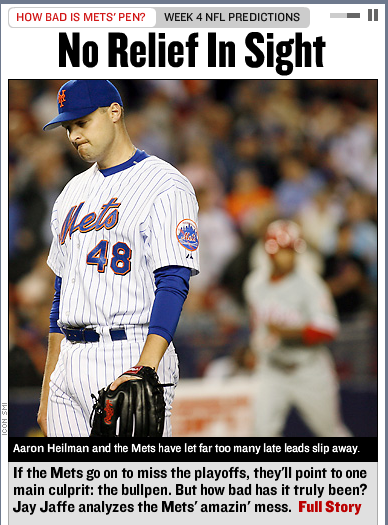
Cutting to the chase:
The sad fact is that through the first half of the season, even with [Billy] Wagner performing at a level far below his peak, the Mets actually had one of the league's better bullpens; their 6.1 WXRL through the All-Star break ranked third in the NL behind the Phillies and Dodgers. Since then, they've been a league-worst 1.4 wins below replacement level as a unit. Fill-in closer Luis Ayala (-0.04 WXRL since coming over from the Nationals on Aug. 17) is an obvious culprit, but he's hardly the only offender.Like just about everyone else out there, I had the Mets pegged to win last night once Daniel Murphy led off the bottom of the ninth with a triple. My one-man Ikea furniture assembly line came to a halt to watch Bob Howry strike out David Wright, and I could have sworn one of the Mets' announcers -- Ron Darling, Keith Hernandez or Gary Cohen -- said something to the effect that "if Wright strikes out, this inning is over." That's optimism for you. Of course, Wright did strike out, and Howry escaped by intentionally walking Carlos Delgado and Carlos Beltran, getting a forceout at the plate, and then blowing away Ramon Castro. Unbelievable. I'm reminded of an expression by my friend and former coworker Lillie, a Brooklyn gal whose capacity for amazement at the ways she could be tortured by the Mets never ceases: "This fuckin' team!" she'd say, drawing the F-bomb out until it's longer than a mid-inning pitching change.
A quick peek at the individual numbers informs us that it's not hard to recognize a systemic combination of overuse and ineffectiveness. Of the six relievers whom Jerry Manuel has called upon most frequently, five have second-half ERAs above 4.90: Ayala (5.54, including his Washington stint), Pedro Feliciano (6.38), Aaron Heilman (6.75), Duaner Sanchez (6.00), and Joe Smith (4.91); Scott Schoeneweis (4.50) is the exception. Excluding the late-arriving Ayala, that bunch has combined for 152 appearances in 63 games since the break, a breakneck 78-game pace for each over the course of a season. Feliciano (83 games), Ayala (80) and Smith (79) represent three of the six major league pitchers stretched to that exhausting plateau over the full season, with Heilman (77) not far behind. Overall the Mets rank second in the league since the break with 227 relief appearances, an average of 3.6 per game.
Driving such a frenetic pace is a massive platoon split that has Manuel chasing the "right" matchups, following a single-minded La Russa-style tactical orthodoxy at the expense of more important strategic imperatives such as conserving bullpen arms over the course of the long season. When they have the platoon advantage (righty on righty or lefty on lefty), Mets relievers have limited hitters to just .225/.299/.325; ranked by OPS, that's an impressive fourth in the majors. However, when they don't have the platoon advantage, they've been tagged at a .294/.375/.479 clip, worst in the majors. The 227-point OPS difference between situations is the highest by a wide margin; second-highest are the Brewers at 188 points, and they just whacked a manager over his platoon-related shenanigans and bullpen mismanagement. The take-home message is yet another reminder that chasing matchups can easily backfire on a skipper, either by exposing lefty specialists such as Schoeneweis (.333/.421/.509 versus righties) or Feliciano (.357/.453/.561) to the point where they face more righties than lefties, or by shunting a heavier workload to the second- or third-tier pitchers in a bullpen.
Yet for all of those woes, things might be different if Wagner were still around. Despite a superficially tidy 2.30 ERA, the five-time All-Star had accumulated just 1.5 WXRL in about two-thirds of a season, after compiling 3.8 last year and 5.9 in 2006 (second in the league). Depending upon which model of Billy Wags you use as a benchmark, that's anywhere from one to four wins missing from his ledger. Even at its lowest, that margin may easily be the difference between a club playing its way into October and adding another season like their now-infamous 2007 collapse to give them a matched pair of late-season meltdowns.
Meanwhile, the Brewers won behind a gritty effort by CC Sabathia, pitching on three days' rest and striking out 11 Pirates over seven innings and 108 pitches. The race for the two NL spots tightened even more with a Phillies loss. The Postseason Odds Report says:
Thru 9/24 Div WC TotClay Davenport, who runs the Odds Report, published an estimate of the various tie-related scenarios:
Phillies 87.4 11.1 98.5
Mets 12.6 59.6 72.1
Brewers 0.0 29.3 29.3
Thru 9/25 Div WC Tot
Phillies 85.0 12.4 97.5
Mets 15.0 39.6 54.5
Brewers 0.0 47.9 47.9
The Mets and Phillies finish in a tie, ahead of the Brewers - 8.89% chance. If this happens, the Mets win the division and the Phillies win the wild card. No playoff.So if you're simply a fan of entropy rather than any of these specific teams, today's math says you've got about a 29 percent chance of some extra baseball before the playoffs begin.
Phillies and Mets tie for the division, Brewers win the wild card - 1.12% chance.
The Mets and Brewers tie for the WC, behind the Phils - 23.92%.
The Phillies and Brewers tie for the WC, behind the Mets - 1.29%.
Three-way tie for the WC - 3.13%.
Labels: Brewers, Hit and Run, Mets
Wednesday, September 24, 2008
I Don't Think Either of Them Can Win
The struggles of both teams remind one of the immortal words of sportswriter Walter Brown. In analyzing the war-depleted rosters of the Cubs and Tigers before the 1945 World Series, he famously quipped, "I don't think either of them can win." Observers of this year's NL races can certainly relate.Flipping around between six games last night (thank you, Extra Innings package, and thank you, iPhone) as I assembled Ikea furniture, I watched considerable portions of both the Mets and Brewers wins while the Phillies lost, results that shifted the article's cited Postseason Odds -- the estimated percentage chance that they could gain entry to the playoffs -- a bit; even with Prince Fielder's walk-off homer, the Brewers lost gound:
Thru 9/23 Div WC TotOf course, those numbers can change dramatically. As of September 1, the Brewers were at 14.8/81.2/96.0, and of course last year the Mets were at 98.8 overall prior to their collapse. Until they clinch, there's no such thing as a lock -- just ask the 2007 Rockies.
Phillies 95.5 4.1 99.6
Mets 4.5 60.9 65.3
Brewers 0.0 34.0 34.0
Thru 9/24 Div WC Tot
Phillies 87.4 11.1 98.5
Mets 12.6 59.6 72.1
Brewers 0.0 29.3 29.3
As for the Dodgers, they dodged a bit of a bullet last night. They came into the game against the Padres with a two-game lead over the Diamondbacks and a 91.5 percent shot at the division title, and while they were initially scheduled to face Jake Peavy, the ace's absence from the team over the weekend to attend the birth of his son compelled Pad skipper Bud Black to push him back until Thursday. Instead the Dodgers scored six first-inning runs off replacement starter Your Name Here and rolled to a 10-1 win while the D-bags lost, raising the Dodgers' odds to 98.0 percent and cutting their magic number to three. Aw yeah, baby.

Labels: Brewers, Dodgers, Mets, New York Sun
Archives
June 2001 July 2001 August 2001 September 2001 October 2001 November 2001 December 2001 January 2002 February 2002 March 2002 April 2002 May 2002 June 2002 July 2002 August 2002 September 2002 October 2002 November 2002 December 2002 January 2003 February 2003 March 2003 April 2003 May 2003 June 2003 July 2003 August 2003 September 2003 October 2003 November 2003 December 2003 January 2004 February 2004 March 2004 April 2004 May 2004 June 2004 July 2004 August 2004 September 2004 October 2004 November 2004 December 2004 January 2005 February 2005 March 2005 April 2005 May 2005 June 2005 July 2005 August 2005 September 2005 October 2005 November 2005 December 2005 January 2006 February 2006 March 2006 April 2006 May 2006 June 2006 July 2006 August 2006 September 2006 October 2006 November 2006 December 2006 January 2007 February 2007 March 2007 April 2007 May 2007 June 2007 July 2007 August 2007 September 2007 October 2007 November 2007 December 2007 January 2008 February 2008 March 2008 April 2008 May 2008 June 2008 July 2008 August 2008 September 2008 October 2008 November 2008 December 2008 January 2009 February 2009 March 2009 April 2009 May 2009 June 2009 July 2009 August 2009 September 2009 October 2009 November 2009 December 2009 January 2010 February 2010 March 2010 April 2010 May 2010

Subscribe to Posts [Atom]