The Futility Infielder
A Baseball Journal by Jay Jaffe I'm a baseball fan living in New York City. In between long tirades about the New York Yankees and the national pastime in general, I'm a graphic designer.Wednesday, March 10, 2010
Clearing the Bases: While I Was Out
• Last week, I noted the introduction of the ESPN Insider TMI blog. Today I've got another piece there, this one on Ozzie Guillen's stated desire for the 2010 White Sox to be more aggressive on the basepaths. There's a longer version over at Baseball Prospectus. Here's a taste:
Despite the coupling of his predilection for smallball tactics (bunting, base stealing, and manufacturing runs) with a desire to call attention to them that's so outsized you'd think these were the 1959 Go-Go Sox, [Guillen's] teams have been overly reliant on the longball in recent years. So reliant that colleague Joe Sheehan christened the Guillen Number, which measures the percentage of a team's runs derived from homers. Last year, the White Sox ranked third in the majors at 41.0 percent, trailing only the Yankees (45.1 percent) and the Phillies (42.1 percent). They've been among MLB's top four during every year of Guillen's tenure...The piece concludes with a link to former Orioles manager Earl Weaver's famously blue comment (NSFW; see here for those with more sensitive ears) on the relative merits of team speed and team power, which should tickle Guillen's funny bone even if it doesn't change his philosophy. If I am confident of one thing about Ozzie, it's that he's got a legendary tirade just waiting to be recorded.
Over the winter, Guillen pressed Williams to provide him with a more flexible roster, one which offered more speed than he had in the past. In reacting to the team's shedding of sluggers Jim Thome and Jermaine Dye and the addition of Juan Pierre, he declared that aggressive baserunning would be a major point of emphasis this spring. While the Sox have stolen 10 bases through their first five exhibition games, the skipper's statement highlights the fact that they've been hemorrhaging runs on the basepaths, according to our Equivalent Stolen Base Runs (EqSBR) and Equivalent Base Running Runs (EqBRR) metrics, the latter of which incorporates not only steals and caught stealing but also advancement on hits and outs:Year EqSBR Rk EqBRR RkUnder Guillen, the Sox have failed to break out of the bottom half [of the 30 teams' rankings] in EqSBR, and they've done so only twice in EqBRR. In all, team has cost itself between four and five wins via baserunning over the past six years, which at least explains why Guillen thinks it's an area where the team needs improvement.
2004 -14.2 29 -2.1 12
2005 -7.4 19 -2.0 11
2006 -7.1 22 -22.3 30
2007 -6.5 24 -7.0 22
2008 -4.6 21 -3.2 14
2009 -4.1 16 -9.2 25
Tot. -43.8 27 -45.8 24
Still, that won't mean a whole lot more runs scored, particularly if the Sox can't rise above last year's measly rankings of 20th in OBP (.328) and 27th in True Average (.249).
• Baseball Prospectus has launched a handful of new blogs over the last several days, with some of the posts available for all readers and others behind the subscription wall. Yours truly is heading up a new one called "One-Hoppers." A version of the Clayton Kershaw piece is here, and I've also got a more recent freebie on last week's Barry Zito versus Jeff Suppan "showdown," a matchup initially notable for Zito's plunking of Prince Fielder in retaliation for what the Giants felt was an overly excessive home run celebration from last September. Had Suppan, whose fastball is almost as slow as Zito's, attempted to further the hostilities, "A beanball war between those two hurlers would be like watching a pair of elderly men spar with sporks," I wrote.
What piqued my interest beyond zingers like that was the fact that the game in question paired two of the more dubious contracts given out to pitchers in recent years:
Zito is in the fourth year of a seven-year, $126 million deal, one which represented the largest contract ever signed by a pitcher at the time (it's since been surpassed by Johan Santana and CC Sabathia). Suppan is in the fourth and final year of a $42 million deal. Check the tale of the tape across the first three years of their deals (all dollar amounts in millions):Ouch.Pitcher IP K/9 ERA WARP Sal MORP NetMORP is Marginal value Over Replacement Player, a measure which was originally introduced by Nate Silver back in 2005, and is currently under revision by our own Matt Swartz. What MORP does is place a dollar value on a marginal win (i.e., a Win Above Replacement-level Player) which is based upon the actual behavior of recent free agent markets. That dollar value changes from year to year as baseball's economy expands and contracts, but for this back-of-the-envelope calculation, I've substituted a 2007 value of $4.5 million per win, and increased it by five percent in each of the past years.
Zito 568.2 6.4 4.56 3.1 $43.0 $14.0 -$29.0
Suppan 546.0 5.0 4.93 0.5 $26.5 $1.5 -$25.0
...Zito has provided the Giants with about $1 worth of value for every $3 spent, while Suppan has given the Brewers $1 worth of value for every $18 spent.
• Speaking of the Brewers, I pinch-hit for BP colleague Will Carroll to do their Team Health Report, which classifies every lineup regular, rotation member and closer according to a red light/yellow light/green light system which based upon a player's history and some actuarial tables tells you roughly how likely they are to serve a stint on the disabled list; a red means at least a 50 percent chance, a green is less than 33 percent (Rickie Weeks is red, Prince Fielder is green). For the THRs we also focus on a couple of the big issues a given team faces.
The Cost: The "Brew Crew" put up another successful season in regards to injuries last year. Milwaukee lost $10.3 million to injuries in 2009 and had a total loss of just $29.8 million over the last three seasons. The biggest hits to their day and dollar counts came from David Riske, who lost the entire year due to elbow woes culminating in Tommy John surgery in June, and Rickie Weeks, who played just 37 games due to a wrist injury; those two combined to miss over 300 days and cost Milwaukee $5.7 million. Even with that, Milwaukee found itself in the black when compared to the rest of the league, losing almost $4 million less than the league average. The front office was busy in the offseason, spending nearly $30 million on Wolf, and bringing in Doug Davis, LaTroy Hawkins, and Gregg Zaun to fill holes. In total, the $47.65 million Milwaukee spent on the free-agent market was no doubt helped by their low injury costs over the last few years.• Still in Brewer country, I covered the National League Central in the latest installment of my number-crunching series on competitive ecology. Here's the Brew Crew:
The Big Risk: Wolf enjoyed something of a career year with the Dodgers in 2009, posting a 3.23 ERA in a career-high 214 1/3 innings. That's roughly 100 more than he'd averaged per year from 2004-08 due to a variety of elbow and shoulder problems, including 2005 Tommy John surgery and 2007 labrum surgery. After finishing last in the NL in rotation ERA (5.37) and SNLVAR (8.0), the Brewers had little choice but to invest in starting pitching, even during a winter where the market was thin. Wolf was the second-best starter available after John Lackey. The Brewers' signing suggests a confidence that they can keep Wolf in working order.
The Comeback: Weeks' season ended prematurely due to a torn tendon sheath in his left wrist, the latest in a litany of injuries to both wrists. From right wrist surgery in 2006 to tendonitis in the same wrist the following year — not to mention a torn ligament in his thumb which required surgery, and couple of other sprains along the way — his injuries have prevented him from playing more than 129 games in a single year, and he's topped 100 just twice in five years. While Craig Counsell, Felipe Lopez, and Casey McGehee actually hit quite well in Weeks' absence last year, the team lacks a fleet top-of-the-order threat when he's not in the lineup, and they can't always count on such similar good fortune in filling in for him.
Among the litany of unhappy stories in this series, the Brewers rate among the happier ones. Throttled by a combination of ineptitude and political point-scoring, the team posted losing records during the last 12 years of the Selig family's regime, inducing the good fans of Milwaukee to stay away in droves despite a new ballpark. Since purchasing the team in September 2004, new owner Mark Attanasio has helped turn over a new leaf. The 82 wins the Brewers have averaged during his five years of ownership is their highest since the 1988-1992 era.That ought to give my people in the dairy state enough to ruminate on for a little while.
Reaping the benefits of groundwork laid by since-departed scouting director Jack Zduriencik (who drafted Corey Hart, J.J. Hardy, Prince Fielder, Rickie Weeks, Yovani Gallardo, and Ryan Braun in consecutive years), the Brewers broke their skid of sub-.500 seasons in 2005, crossed the .500 threshold in 2007, and then went for broke in 2008, with general manger Doug Melvin making a well-timed move by trading prospects for CC Sabathia, who practically carried the team on his back to the postseason. Over that four-year span, Attanasio let Melvin double the team's payroll, and luckily, the long-starved fans rewarded such aggressiveness at the gate. Attendance increased 49 percent from 2004 to 2008 as the team crossed the three million mark despite playing in the game's smallest market — a remarkable achievement. That they ranked ninth in attendance over the 2007-2009 period only underscores the fact that the Brewers are punching well above their weight.
The bounty of homegrown talent — particularly Fielder (16.7 WARP over the last three years) and Braun (15.3 WARP) — helped the Brewers rank 11th in Non-Market WARP, ninth in MP/MW [Marginal Payroll per Marginal Win, a measure of economic efficiency; the Brewers spent $2.06 million per win above replacement level from 2007-2009], and eighth in PER' [Payroll Efficiency Rating, a measure of the money the team spends to gain extra wins with what we'd expect them to generate given their market size; the Brewers were 16 percent better than average] over the past three years, though the times they are a-changin'. Fielder is in the second year of a two-year, $18 million deal, and as his final pre-free agency year looms, the question of whether the Brewers can afford to keep him looms as large as the slugger himself. It's not entirely out of the question, particularly with the horrendous Jeff Suppan contract coming off the books, Braun locked into an eight-year, $45 million deal through 2015, and just $22 million committed for 2011. But like any small-market team, the Brewers will need to catch a few breaks.
Labels: Brewers, ESPN Insider, Hit and Run

Friday, February 26, 2010
Area Man to Answer Questions: The BP 2010 Promo Tour
On Monday, March 1, the law firm of Goldman, Goldstein, Kahrl and Jaffe will be at the Barnes & Noble at 18th Street and 5th Avenue in Manhattan starting at 6 PM. We'll answer questions and sign anything except veal cutlets, because as Casey Stengel liked to say, his ballpoint pen slips on veal cutlets. Me, I'll be packing a Sharpie in an attempt to surmount such obstacles.
Also, on March 9 Steve, Kevin and I will be appearing at Washington, DC's legendary Politics and Prose bookstore. More details on that one as the date near; see BP's events page for further details.
• • •
Saturday's radio hits:
• Another Wisconsin hit, this one on WFAW 940 AM at 8:30 AM Central, streaming here.
• Out in Dodger country, I'll be appearing on KCAA 1050 AM at 8:40 AM Pacific, streaming here.
More to come on Monday. I'm also booked for another appearance on the Fox Strategy Room streaming webcast at 1 PM Eastern that day. I'll be working overtime to get my mustache in shape for all of this action.
Labels: BP10, Brewers, Dodgers, promotion, radio
Wednesday, September 23, 2009
Kiss 'Em Goodbye
I've contributed to two of these thus far, last week covering the Brewers, and this week the Indians. Interestingly enough, both teams had something in common: rotations that outside of one guy, largely stunk on ice. Here's my take on the Brewers:
Despite reaching the postseason last year for the first time since 1982, PECOTA pegged them for an 83-79 season, with an 18.5 percent chance at winning the division and a 10 percent shot at the NL Wild Card. Interestingly enough, even given the free-agency departures of [CC] Sabathia and [Ben] Sheets, the team projected to be stronger on the run prevention side (sixth in the league) than on the scoring side (ninth), a counterintuitive forecast given the fact that six of the lineup's eight projected regulars are between the ages of 25 and 29 — or in their statistical prime as far as their expected production. Fielder and Ryan Braun have certainly lived up to expectations, ranking third and eighth in the league in EqA, respectively. Although Rickie Weeks suffered a season-ending injury in May, and J.J. Hardy, Corey Hart, and Bill Hall all disappointed, the team got solid enough work from the likes of Mike Cameron, Craig Counsell, Casey McGehee, and Felipe Lopez that they actually rank third in the league in team EqA. On the other hand, the rotation has been an utter disaster.As for the Indians...
Key stat: 5.59
That's the ERA of all of the Brewers' starting pitchers aside from Gallardo, whose 3.84 mark is the only one that's better than the park-adjusted league average. Braden Looper (4.77) has eaten innings but done little else worthy of note. Jeff Suppan (4.87) and David Bush (5.85, including 8.24 since the end of May) have combined injury and ineffectiveness, while Manny Parra (6.42) has been dreadful. Fill-ins Carlos Villanueva, Seth McClung, and Mike Burns combined for a 7.25 ERA as starters, not only revealing the organization's sheer lack of rotation depth, but also compromising their bullpen depth via their absence from the relief corps (in the cases of the first two) and their short starts. As a unit, the Brewers rank 15th in the league in Support-Neutral Winning Percentage (.444), and dead last in rotation ERA (5.19).
The fault here lies with Melvin for his failure to replace Sabathia and Sheets with anything approaching adequacy. Getting a full season out of Gallardo, who was limited to just four starts in 2008 due to a torn ACL, was enough to partially offset those front-end losses from the rotation, but when it came time to open the wallet last winter, the best the Brewers could do was to sign Looper to a one-year, $4.75 million deal with incentives and an option. The bigger problem, of course, is the four-year, $42 million deal they're still paying to Suppan, who's rewarded the Brewers with a Looper-like 4.80 ERA through 91 starts thus far. Freed of that obligation, they might have been able to afford another midrotation starter who could have helped keep them afloat
Key Stat: 5.75Definitely a pair of disappointments, though I'm more optimistic about the Brewers' chances of rebounding than I am of the Indians, who appear headed for a very lean year, with or without the braintrust that got them into this mess.
That's the ERA of the starting pitchers aside from [Cliff] Lee, who was traded to the Phillies on July 29. The only starter besides Lee with at least 10 starts and an ERA below 4.92 is Aaron Laffey, for whom the team didn't even have space in the rotation until the season was already going down in flames. Laffey's also the only starter this side of Lee with a Support-Neutral Winning Percentage above .500. For all of the bullpen's woes, the starters simply didn't give the Indians a chance to win; aside from Lee, their combined SNWP is just .431.
In retrospect, it's clear that the cast that GM Mark Shapiro assembled behind Lee offered too much risk. Shapiro's plan hinged on rebounds from mostly-lost 2008 seasons by Carl Pavano, Anthony Reyes, and [Fausto] Carmona — with a comeback from Tommy John surgery by Jake Westbrook supposed to provide a mid-season lift. None of those pitchers miss many bats, so it's not terribly surprising that the Tribe staff is last in the league in strikeouts. Pavano was erratic and homer-prone; the team eventually dealt him to the Twins in early August. Reyes made just eight starts before needing TJ surgery. Carmona put up a 7.42 ERA through 12 starts before being sent all the way down to A-ball to iron out the mechanical problems which first took hold last year. Despite an initially promising return, he's been pummeled for a 10.72 ERA over his last five starts. To that unhappy brew, add a parade of lefties (Zach Jackson, Jeremy Sowers, David Huff) each more hittable than the last, and rough introductions for a couple of mid-season acquisitions (Justin Masterson, Carlos Carrasco), and you've got a rotation whose ERA bests only Baltimore's, but without the high-upside prospects which mitigate the Orioles' showing.
Labels: Brewers, ESPN Insider
Friday, July 31, 2009
Deadline Day Drama
Shopping at V-Mart: The Sox land Victor Martinez at the deadline at a time when their offense appears to be emerging from its July funk via 42 runs in seven games, and they manage to hold onto Clay Buchholz in the process. They'll need him to step up, with John Smoltz being smoked for a 7.04 ERA through his first six starts, Tim Wakefield and an unhappy Daisuke Matsuzaka on the DL, and Brad Penny backsliding (5.07 ERA, .445 SNWP after Wednesday's debacle). Meanwhile, the Leak Fairy outs David Ortiz and Manny Ramirez as two of the 104 players who tested positive in the supposedly anonymous 2003 survey test, which should put a sock in the mouths of those so sanctimonious as to claim that the Sox had the high moral ground on the Yankees—or any other team—when it came to performance-enhancing drugs.V-Mart killed the previous lead, involving Adam LaRoche, who was flipped to the Braves for Casey Kotchman less than a week after being acquired, as did a larger bit about Buchholz. All of that's small beer compared to the bigger news therein, the sad but hardly surprising note regarding Ortiz and Ramirez being on the 2003 list.
I like Big Papi more than most Sox haters, having written a chapter about him for Baseball Prospectus' Mind Game back in 2005; one SABR member suggested via my Facebook page that the revelations now explain why the Twins non-tendered him back in late 2002, but I'm not sure I buy that; they were awash in left-spectrum hitters at that point, they considered Ortiz out of shape, and they always discouraged his power tendencies, trying to make him hit "like a little bitch" (his words). Anyway, schadenfreude is a bitch, ain't it? I suspect he'll survive much as Manny has, with fans ultimately at least somewhat forgiving, and I think the headline to Tyler Kepner's New York Times piece ("If Every Team Was Doping, Why Use Asterisks?") speaks volumes. Also, a tip of the cap to Craig Calcaterra; just when I was starting to buy the idea -- or at least considering setting aside some time to think about possibly looking into the feasibility of potentially purchasing that cup of Kool Aid -- that the list should be released, the Shystermeister weighed in with some well-reasoned perspective.
Enough of that. A few of my pre- and post-trade takes from the BP Hot Sheet over at ESPN Insider:
TRADES: RED SOX GET VICTOR MARTINEZNow: rest for the weary. And beer. Lots of beer.
Baseball Prospectus: There will be rest for the weary
The Sox made by far the best move among the three AL East contenders, acquiring a potential difference-maker who's hitting .284/.368/.464. The switch-hitting 30-year-old provides the lineup with flexibility, as he can catch or play first base, allowing the Sox to rest Jason Varitek, Kevin Youkilis, or Mike Lowell (with Youkilis shifting to third) -- a major boon given Lowell's fragility. --Jay Jaffe
TRADES: REDS GET SCOTT ROLEN
Baseball Prospectus: We're scratching our heads here
Rolen's having a fantastic season (.320/.370/.476 with defense about five runs above average), but even assuming he has waived his no-trade clause, this one's a puzzler. The remaining money on Rolen's deal (about $3.5 million this year, and $11 million for next) represents a substantial burden for a notoriously cost-conscious team, and given that the Reds have lost 18 of 26, they're hardly contenders -- fifth in the NL Central at 9.5 out, ninth in the Wild Card at 10.5 out. --Jay Jaffe
TRADES: WHO WILL REPLACE SUPPAN?
Baseball Prospectus: Injury won't force Milwaukee's hand
It's somehow fitting that Jeff Suppan hit the disabled list the day before a trade deadline at which the Brewers didn't make a splash. The Brewers' highest-paid player ($12.5 million, with another $12.5 million due next year) is currently putting up a 5.27 ERA and .415 support-neutral win percentage. He is a major reason the team ranks second-to-last in the league in support-neutral value and didn't have the financial flexibility to replace the losses of CC Sabathia and Ben Sheets with a front-line starter this past winter. It appears that because the Brewers were not willing to part with a top prospect such as Mat Gamel or Alcides Escobar -- or alternatively, to trade J.J. Hardy so the latter could play -- they'll likely do little more than play out the string over the final two months of the season. And the right move was probably no move, if the best they could have obtained via one of those two highly regarded youngsters was Doug Davis. --Jay Jaffe
OLNEY/STARK: YANKEES EYED BANNISTER
Baseball Prospectus: Bannister reinvents himself on the mound
Brian Bannister quietly has had a very solid season for the Royals. In one of the more fascinating little stories of 2009, he has remade himself as a pitcher by studying the pitch f/x data provided by Major League Baseball Advanced Media and abandoning his four-seam fastball in favor of a cutter to generate more ground balls [see here]. Mission accomplished: His ground-ball percentage has risen from 38 percent last season to 46 percent this season, his home run rate has fallen from 1.4 per nine innings to 0.9, and he has shaved almost two runs off his ERA. He'd be a solid No. 5 starter for a contender, and for the Yankees to balk at such a minimal price tag might rate as one of their dumber [non]moves this season. --Jay Jaffe
Labels: Brewers, Hit List, Red Sox, Yankees
Friday, June 19, 2009
The Week's Work
• In "Conquering the Cubs," the latest edition of my "Pair Up in Threes" series, I examine the Brewers, Cardinals and Reds, all of whom are atop the Cubs in the NL Central race, a major surprise given that our PECOTA projection had the Cubs at an NL-best 95 wins. Here's a bit on the Brew Crew:
The Brewers stumbled to a 4-9 start, but since then, they've put up the league's second-best record even with a recent 2-6 skid. Their turnaround largely coincides with the arrival of 41-year-old Trevor Hoffman, the former Padres closer who spent the season's first three weeks on the disabled list. Since returning, he's yielded one run in 20 innings, converting all 16 save opportunities while allowing just 13 baserunners, a performance good enough for seventh in the league in WXRL. LOOGY Mitch Stetter and a pair of free-talent pickups who've worked their way into meaningful roles, Todd Coffey and Mark DiFelice, are in the league's top 30 as well. As a unit, the Brewers' bullpen fourth in the league in that category, a major reason why they've exceeded their third-order Pythagenpat record by 4.8 games, the league's second-best mark. Though they've lost five straight one-run games to fall to 10-12 in that category, they're 16-8 in games decided by two or three runs.• In "Another Mile-High Miracle?" (which also ran at ESPN Insider), I examine the Rockies' 14-5 surge under interim skipper Jim Tracy, and whether the Rockies have enough to contend that they should consider buying instead of selling:
While the rotation's been shaky (more on that momentarily), the staff as a whole is getting plenty of help from a defense which two seasons ago ranked third-to-last in Park-Adjusted Defensive Efficiency. Their impressive ranking is nothing new, actually; they were 10th last year with virtually the same lineup, the outcome of a chain of events which saw the arrival of center fielder Mike Cameron, the move of Bill Hall from center to third base and of Ryan Braun from third to left field. The sudden loss of Rickie Weeks for the season hasn't changed things much; this remains a quality unit that's been helped by the fact that the pitchers are allowing the league's third-lowest line drive rate as well as the third-highest groundball rate. Whether they can keep that up remains to be seen, but it's certainly easier to do so than maintaining a high Defensive Efficiency in conjunction with a high line drive rate.
Only a week ago, the rumor mill was abuzz with the future destinations of Brad Hawpe, Jason Marquis, Ryan Spillborghs and Huston Street, but the streak has allowed the Rockies to defer such decisions. To the credit of Tracy and GM Dan O'Dowd, they've quickly made moves which help their chances of sustaining some momentum, starting with the replacement of third baseman Garrett Atkins with Ian Stewart, who's now out of the way of Clint Barmes at second. In a lineup that's second in the league in scoring but just seventh in EqA (.262) — taking stock of the Rox starts always starts with letting the air out of their offensive stats — Atkins (.210 EqA) has been the lineup's only real sinkhole; he recently went five weeks without a homer or a multi-hit game, a tough task for an everyday player. Barmes (.270) has been the team's hottest hitters over the past month (.345/.405/.560). Stewart (.262 with a team-high 12 homers) is hitting .314/.357/.667 this month after fighting through a prolonged slump.As an aside, I was sorry to see Clint Hurdle's recent firing. While by no means a great skipper, he showed a ton of class in leaving the stage, reminding me that the former phenom is the author of one of baseball's great quotes: "There's two kinds of people in this game — those that are humbled and those that are about to be."
As Joe Sheehan pointed out recently, the Atkins shuffle should bear fruit for a team that's 10th in the league in Park-Adjusted Defensive Efficiency (-1.05 percent below average) and last in raw DE (.677); Atkins is a lousy third baseman, Stewart a natural one, and Barmes is better at the keystone than the latter. Also helping the defense is the recent promotion of Carlos Gonzalez, a toolsy former top prospect with the ability to play center field. He spent the first two months of 2009 in a Triple-A refresher course following his acquisition in the Matt Holliday trade and a none-too-impressive half-season in Oakland (.242/.273/.361 with an 81/12 UIBB ratio). Tracy's slotted him in left, previously the domain of an unstable but not wholly unproductive cast of righty Spillborghs, lefty Seth Smith and redheaded stepchild Matt Murton.
...When it comes to making any deals, thanks to their streak the team has the luxury of playing both sides of the fence in the six weeks between now and the trading deadline. If they continue to play well, they should have few glaring weaknesses to shore up aside from their bullpen, and may have a spare outfielder to deal if Gonzalez clicks. If this latest burst is simply a mirage, they can gain salary relief and/or restock their larder by flipping Street, and selling high on the none-too-cheap Marquis ($9.875 million this year) and the relatively affordable Hawpe ($13 million total in 2009-2010). Perhaps they can even offload Atkins ($7.05 million); as discussed yesterday, the Cardinals need a third baseman, and the Reds could use one as well to hedge against Edwin Encarnacion's continued wrist problems.
• And in the spirit of former Dodger manager Tracy's revival, I'll stick with the (ex-)LA theme in excerpting this week's Hit List:
[#1 Dodgers] The Dodgers continue to sit pretty even as their offense has cooled off in Manny Ramirez's absence thanks to the strong performance of their bullpen. They're 37-8 when leading or tied after five innings, second in WXRL and first in Fair Run Average, with Jonathan Broxton leading the league and Ramon Troncoso — who's saved four games while giving Broxton the night off — ranked fourth. The team is winning more than its share of the close ones: 16-6 in one-run games and 10-7 in two-run games.
[#2 Red Sox] Penny for Your Thoughts: Brad Penny tosses 11 innings against the Yankees and Marlins without allowing an earned run, but even so, he's only put up a 4.94 ERA and a .465 Support-Neutral Winning Percentage. That's mainly due to his 40.5 percent groundball rate, about 10 percent lower than last year. With the June 15 deadline for trading last winter's free agents without their permission having passed and John Smoltz slated to debut next Thursday, Penny's the subject of trade rumors, but for the moment, the team will cycle through a six-man rotation.
[#8 Rangers] Ruw the Day? Released by the Dodgers in the spring, Andruw Jones exacts a modicum of revenge by homering twice against them — one less than his 2008 total — though the Rangers drop both games and thus the series. Jones is hitting .245/.355/.504 but is just 4-for-30 in June; he's started in the field just 12 times, none in center, even with Josh Hamilton missing so much time.
Labels: Brewers, Dodgers, Hit and Run, Hit List, Red Sox
Saturday, May 23, 2009
Joy in Mudonna-Ville
The Saints, an independent team in the independent American Association, won behind a couple of long home runs, but I didn't actually pay too close attention to the game, even failing to notice former big-leaguer Kerry Ligtenberg closed the door with the save. In addition to my own beverage and pork consumption, I was busy shelling peanuts and otherwise playing with five-year-old Kate and two-year-old Jackie, the daughters of our hosts, who also had a one-month-old infant son in tow. This was the kids' first baseball game, and while they weren't overly interested in the proceedings, they were thoroughly sugared up and entertained by the between-innings shenanigans, particularly the mascot Mudonna, a bright pink pig who alternately scared and fascinated my new buddy, Jackie, who understandably had trouble figuring out exactly what she was looking at: "Where pink bear go now? Where pink bear go now?"
I'd read about the Saints years ago in Neal Karlen's excellent Slouching Towards Fargo, a book that chronicled life in the independent Northern League during the mid-90s. The Saints, owned even to this day by a group that includes actor Bill Murray as well as baseball's Barnumesque scion, Mike Veeck, featured Darryl Strawberry on his way back to the majors as well as Jack Morris on his way out of baseball, along with a whole bunch of other characters just happy to be playing ball anywhere for a living. Anyway, more than a decade after reading Fargo, I was glad to finally get a chance to attend one of their games, a particularly welcome antidote to Epic Fail Stadium in the Bronx. Tomorrow, I'll pay a visit to the Metrodome (another first) for a Twins-Brewers game, but I'll be hard-pressed to top the fun I had here.
• • •
This week at Baseball Prospectus, I wrote a "Pair Up in Threes" piece about a trio of teams whose overall showings were in marked contrast to the performance of their rotations. Both the Red Sox and Phillies continue to contend despite abysmal 6.00+ ERA showings from their starters, while the Diamondbacks are deep into the second division despite strong showings from their starters even with Brandon Webb sidelined. Here's part of what I wrote about the D-Bags:
What's Happened: After lasting just four innings on Opening Day, Webb was pushed to the Disabled List due to bursitis in his shoulder. He was expected only to miss a few weeks, but since suffering a setback in late April, he's been limited to playing catch and won't be back until sometime in June. While Yusmeiro Petit has pitched poorly in his place (8.03 ERA, -0.2 SNLVAR, .367 SNWP), Haren leads the league in SNLVAR, [Doug] Davis is 11th, and [Max] Scherzer is 26th.As for the Hit List, the Dodgers continue to hold onto the top spot, the Brewers are third despite some bad news, and Yankees are 10th. Here's a taste:
Alas, Webb's absence has been the least of the club's problems; right now this may be the unhappiest team in the majors. Manager Bob Melvin was fired on May 8 with the team a disappointing 12-17, 8½ games out of first. They've gone just 2-6 under replacement A.J. Hinch, whose lack of managerial experience has drawn fire from the media as well as departed pitching coach Bryan Price. Last Friday, upon pulling Davis for a pinch-hitter, the pitcher — who had thrown just 80 pitches but trailed by a run in the seventh — confronted his new skipper in full view of the TV cameras, never a good sign.
The real problem isn't a lack of respect for the manager's authoritah, it's a snake-bitten offense that's scraping together just 3.9 runs per game, which ranks 15th in the league; their .236 EqA is the NL's worst. Three lineup regulars (Chad Tracy, Conor Jackson, and Chris B. Young) are below the Mendoza Line, and Stephen Drew and Eric Byrnes aren't much above it. As well as Haren and Davis have pitched, both rank in the league's bottom 10 in run support, well under three runs per game; Haren is second-to-last at 2.3. Meanwhile, the bullpen's been pretty lousy (12th in the league in WXRL and 13th in Fair Run Average), but most of the damage has been done in lower-leverage situations. Closer Chad Qualls and set-up men Tony Pena and Juan Gutierrez, the only relievers with Leverage scores above 1.00, are all in the black, WXRL-wise, while the mop-and-bucket patrol has sloshed kerosene around during their aisle nine cleanups.
What Will Fix It: Even if Webb returns at full strength, the Diamondbacks have dug themselves a huge hole. The PECOTA-based version of our Playoff Odds Report puts their chances at reaching the postseason at just 9.3 percent, down from 45.0 percent to start the year. The suspension of Manny Ramirez won't do very much to bring the Dodgers back to the pack; in fact, the Diamondbacks have lost three games in the standings since then. If they don't start scoring runs soon, it's going to be a long summer in the Arizona heat.
[#1 Dodgers] Life Without Manny: Clayton Kershaw no-hits the Marlins for seven innings; he's allowed just six runs and 13 hits and zero homers over his last four starts, and batters are hitting just .205/.313/.333 against him overall. The Dodger rotation has picked up the slack since Manny's suspension via a 2.81 ERA and just three homers in 80 innings despite the presence of both Jeff Weaver and Official Hit List Whipping Boy Eric Milton, two pitchers who survived the fly-ball pitcher's hell of Albuquerque to return to the majors.That last entry came out of an on-air conversation with WLQR-Toledo radio host Norm Wamer during my weekly spot, while the Ortiz one was something I made light of during my WWZN-Boston spot on the Young Guns (audio link hopefully forthcoming).
[#3 Brewers] Weeks, Months, Year: Amid a seven-game winning streak, the Brewers incur a loss of a different sort, as Rickie Weeks suffers a torn tendon sheath in his left wrist, ending his season at a point when he was hitting .272/.340/.517 while tied for the team high with nine homers. Given that the injury is in the opposite wrist as his 2006 season-ender, this only perpetuates the concern that he'll never be durable enough for full-time duty; he's topped 100 games only twice in five years. For the moment, the Brewers will patch from within via Craig Counsell, Casey McGehee, Hernan Irribaren, and perhaps Alcides Escobar.
[#21 Astros] Ortiz Finally Homers! Russ Ortiz beats Big Papi to the punch by a day with a two-run shot, his first homer since 2003. With a 5.81 ERA and a 21/22 K/BB rate, he ought to consider a career move, as he hit .252/.301/.403 with four homers in 2002-2003, numbers that outdo more than one current Astros lineup regular. On the other side of the coin, Wandy Rodriguez allows his first home run since last August 10, a span of 88 1/3 innings. He's second in the league in ERA and fourth in SNLVAR; the Astros are 7-2 in his starts.
[#23 Marlins] Crouching Tiger, Rotting Fish: Andrew Miller returns from the disabled list and notches his first win in 11 months, but it's the Marlins' only victory in an eight-game span. The Miguel Cabrera/Dontrelle Willis deal hasn't turned out well for the Fish thus far, as Miller's put up a 5.88 ERA in 124 innings, Cameron Maybin's been sent back to Triple-A after a .202/.280/.310 start, and Mike Rabelo, Burke Badenhop, and Eulogio de la Cruz have all been below replacement level as well.
Meanwhile, I've got one more article in the pipeline, an ESPN Insider/BP piece related to Randy Johnson's pursuit of his 300th win that will be held until he finally reaches the milestone. I hope it happens soon — he took a no-decision on Friday night, keeping him at 298 — because I gots to get paid.
Labels: books, Brewers, Dodgers, Hit and Run, Hit List, radio
Tuesday, March 10, 2009
Radio Free Wisconsin
Thursday, December 11, 2008
The Big Man Hits the Big Town
In all, Sabathia led the majors in games started, innings pitched, complete games, and shutouts, and was fourth in ERA, second in strikeouts, fifth in strikeout rate, and eighth in strikeout-to-walk ratio.A spirited dicussion of Sabathia's injury risk took place on BP's internal mailing list last week, and apparently I convinced Joe Sheehan of something, which is no small task. As he writes of the deal:
Those last numbers are very important. Strikeout rate is the key indicator of a pitcher's future success because it provides the window into his ability to fool hitters with his offerings; a pitcher's strikeout rate generally declines as he ages, but a high strikeout rate gives him more headroom before he does so. Furthermore, the more strikeouts a pitcher can notch, the less reliant he is upon his defense, which can vary in its ability to convert balls in play into outs. On that note, the Yankees were one of the majors' least efficient teams in the field, ranking 25th out of 30 teams in both raw Defensive Efficiency (.682) and Park Adjusted Defensive Efficiency (2.42 percent below average). According to PADE, that's about 30 runs—three net wins—below average, thanks in large part to poor up-the-middle defense by indifferent second baseman Robinson Cano, aging shortstop Derek Jeter (who's always been overrated by the media for his abilities in the field but near the bottom of the pile in any advanced statistical system), and rag-armed center fielder Johnny Damon. Cano and Jeter are still in place, and while Damon may move back to left field, the Yanks still need to upgrade in center field.
Back to Sabathia's numbers, his strikeout-to-walk ratio doesn't just indicate excellent control (a pitcher's ability to throw strikes) but excellent command—his ability to throw good strikes, to put the ball where he wants to with consistency. It's generally an indicator of sound mechanics, because without those, a pitcher won't be able to hit his spots with that level of consistency. That's important when it comes to gauging the risk of a pitcher of Sabathia's stature. He may be 6-foot-7 and pushing 300 pounds, but he's very athletic, and his ability to repeat his motion ranks with anyone. Baseball history is full of oversized pitchers who have been able to succeed despite their girth, with names like Mickey Lolich, Rick Reuschel, Bartolo Colon, and David Wells coming to mind. All had excellent strikeout-to-walk ratios.
...Sabathia has managed to avoid arm troubles in his career, and over the last three years he's become extremely efficient; his 15.1 pitches per inning last year ranked 75th-highest among ERA qualifiers. On the other hand, he's coming off by far the two heaviest workloads of his career, and his only two years above 200 innings. His early 2008 problems were believed to be linked to his combined 256-inning 2007 workload extending deep into October, where he exhibited the rare struggle with his command. His combined 256 2/3 innings with an early exit in his only post-season start this year was more of the same, though at least he'll have a couple of extra weeks' rest this time around.
Concern about Sabathia's fitness for this kind of contract have nothing to do with whether his established level is good enough, but rather with how much longer he'll be able to pitch this well. Above and beyond the standard concerns that come with any pitcher — his arm, his performance, the inscrutability of player performance more than a few years out — there's the issue of Sabathia's physique. I've said repeatedly that I don't think a pitcher with Sabathia's size is a good investment. We had a great discussion about this on the BP internal list, with Jay Jaffe getting in the final word:As it stands, the deal is for seven years and $161 million, an extra year and $21 million beyond what the Yankees reportedly offered in their initial deal. Later in the day, it also emerged that the contract contains an opt-out clause: after three years and $69 million, Sabathia can choose to re-enter the market if he so desires. That didn't sit well with ESPN's Keith Law, who was the first source that I saw reporting the clause:You've already decided that Sabathia won't be a good investment due to his size (as you just wrote and as you've written before) and look to be reaching for something to support that beyond your gut instinct about his gut.Jay is correct. I cannot back up my conservative opinion of Sabathia with data, in part because Sabathia is a rare case in baseball history, an ace pitcher of his size in the prime of his career. Most heavyweight pitchers have been softer and shorter than Sabathia is, with almost no pitchers tipping the scales at Sabathia's listed 290, or whatever number pops up when he takes his physical in February. He is unique, and in evaluating him, I'm personally weighing what I know about weight's effect on the back and on joints in deciding that he's too big a risk. His performance level, durability, and athleticism argue for the signing, though I've become fond of noting that you're never signing a free agent's past. Put it all together, and what you have is an opinion — Sabathia won't be durable enough over the length of his deal to make his signing for six years or more a sensible decision — that there aren't enough facts to support.
On the face of it, no pitcher is a good investment due to the injury risk, so you're at least half right, but it's important to separate skittishness about giving a long-term contract to any pitcher from the specifics of Sabathia's case. All we really know is that Sabathia is very good now, with a strong track record of successful performance — including an impressive uptick over the past three years—and a negligible history of injuries, particularly arm injuries. Despite his immense size, he's a very good athlete, and unless I'm wrong he doesn't have any red flags regarding his delivery.
The problem for the Yankees is the so-called "opt-out clause," better understood as a player option. The Yankees gave Sabathia a three-year deal, and Sabathia then has a four-year option worth roughly $100 million. Player options are universally awful for the signing clubs: They cede control of a big portion of a team's payroll to the player, and they represent a pure downside play, since the player will choose to stay only if he isn't performing well or if he gets injured. There's never a good reason to give a player an opt-out clause, and giving a player one as long as four years is (I believe) unprecedented and (I know) a terrible idea.While I understand some of Keith's reservations, I disagree. So far as I can recall, all of the big-name players with opt-out clauses that come to mind (Alex Rodriguez, J.D. Drew, A.J. Burnett) have exercised that option when it came up because the market for annual salaries has risen faster than the general rate of inflation. It would seem to me that the likelihood of Sabathia going back to market in three years means a more favorable economic climate than the current global crisis, if nothing else.
Furthermore, any guaranteed contract is a sunk cost from the moment it's signed; whether the player performs to expectation or not, that money is spent unless the guy pulls a Denny Neagle and gets caught with a surly hooker. Having already acknowledged that, the fact that there's a non-zero chance that some 60 percent of that contract may not come to pass — may not be a sunk cost — increases my esteem for the deal. If Sabathia gets hurt and forces the Yanks to eat the back end of the deal, that's no different than if he'd gotten hurt within a standard long-term contract. If he takes his ball and goes back to California after three years, the Yankees will get the two draft picks (since offering him arbitration is a no-brainer because he won't accept) and have an additional $92 million to spend on the next big free agent. Yes, it may be a drag for the Yankees to be faced with renegotiating a deal with him (à la A-Rod) or losing him, but by that point they'll be able to make a decision informed by their firsthand experience with him as a Yankee, from his performance to his medical reports to the way he handles the move to the big media market. I don't see the opt-out as a downside.
That said, I have VERY mixed emotions about the deal, first based on my view that it's the Yankee offense that needs shoring up via Mark Teixeira more than the staff needs Sabathia, and second based on how much fun it was watching the big man's impact on Milwaukee, because I married into a family of Brewers fans and took a special joy at watching their first run to the playoffs in 26 years. The Brewers made a spirited five-year, $100 million bid to keep Sabathia, and the Dodgers even briefly flirted with him last week. While they'l get the Yankees' first-round draft pick it's a rough outcome for Milwaukee, but then they knew this might be the price when they traded for him last July.
Speaking of the Brewers, there's word this morning that they're working on a swap with the Yanks, one that would send 36-year-old center fielder Mike Cameron to New York in exchange for 24-year-old Melky Cabrera, who hit only .249/.301/.341, including a pathetic .235/.280/.286 after May 6. The deal isn't official, and I have to assume there's a pitcher thrown in to sweeten the deal for Milwaukee. With plenty on my plate at the moment, I'll withhold judgment here.
Beyond that, yesterday brought one other very big and emotional piece of news, but I'll have to save that until my next post.
Labels: Brewers, SI.com, Yankees
Wednesday, October 22, 2008
Triple Threat
The idea was to illustrate Tampa Bay's edge in depth, and I think we did that. The first 21 picks featured 11 Rays and 10 Phillies, but of the next 19 picks, 13 were Rays, and the last 10 picks were all Phillies. In general, Rays were chosen ahead of their Philly counterparts, with Chase Utley, Jimmy Rollins, Cole Hamels, Brad Lidge and Ryan Madson rating as the exceptions. The lower portions of Philadelphia's lineup, bench and bullpen, in our consensus, simply don't match up to those of the Rays. That said, our agreement to avoid positional hoarding within the closed system of the draft meant that one person's choice often dictated another, and a straight reading of the picks as overall, objective rankings is likely to be misread. Speaking for myself, I chose strategically, focusing on choices where the gap between the players at the two positions was the widest and deferring ones where it wasn't as clear (see the Ryan Howard/Carlos Pena bit below).
Also up is today's column, examining the Rays' historic turnaround in Defensive Efficiency, a topic I first addressed in the spring with a healthy dose of skepticism.
Back in mid-April, when PECOTA's forecast for an 88-win season for the Rays still rated as outrageous, I dug deep to expose an underlying assumption of that projection which seemed even more outrageous. Namely, the Rays' rise was predicated on a record-setting year-to-year improvement in Defensive Efficiency, the ability of their fielders to convert batted balls into outs. As with the bullpen, the 2007 Devil Rays' defense had a claim as the worst in history via the lowest Defensive Efficiency since 1954, the earliest year of our database. Crunching the numbers, I concluded that PECOTA was predicting a 46-point DE improvement for the 88-win Rays, a jump that would rank as the second-greatest of all time. I remained skeptical:Rather than embark on another lengthy history lesson involving other teams who improved dramatically from year to year, I added a handful of World Series notes. Many of them are Rays themed, not because I have anything against the Phillies (despite their having steamrolled my two favorite NL teams on their way to the pennant) but because between the my previews for the Division and League Championship Series and articles covering the latter I've got at least 10,000 words about the Phillies under my belt this month. No disrespect, all due respect, fugeddaboutit, howyadoin'...The take-home message here is that the magnitude of the defensive jump that stands as part of the foundation of this year's Rays forecast is virtually unprecedented over the last half-century. The franchise has plenty of reasons for optimism, both for the 2008 season and in the years beyond, and if nothing else they should be a damn sight more appealing than the eyesores of yesteryear. But at the moment, the case for their sudden rise into contention appears to be overstated, and we'd be well served to temper our expectations.Holiday bird-feasting is still about a month away, but it's time to eat some crow here, since the Rays not only surpassed the 88 wins but also the 46-point jump. As with the bullpen's WXRL total and Fair Run Average, they set a record for the largest year-to-year improvement in our database, and they led the majors in that category as well. Nate Silver's roll continues.
Here's a taste:
The Rays' hitting is better than most people thinkIf that's not enough, I'll also be partaking in BP's Game One roundtable, with a chat of my own scheduled for Friday. Better go ice my shoulder...
There's a popular misconception that the Rays aren't a great-hitting team, one borne of the fact that they finished just ninth in the AL in runs per game, fourth in on-base percentage, and eighth in slugging percentage. They had some injuries which affected those rankings — Evan Longoria's wrist, Carl Crawford's hamstring, B.J. Upton's shoulder — but as the ALCS showed, all of those players appear to be in working order right now, to say the least. That trio alone combined for 26 hits, eight homers and 23 RBI in the seven-game series, and Carlos Pena and Willy Aybar added another 15 hits, five homers and 12 RBI between them. These guys have some punch.
What the regular-season numbers ignore is the fact that the Rays play in very pitcher-friendly park. According to the five-year park factors on our Equivalent Average page, Tropicana Field has the fourth-toughest park for offense in the league behind Seattle, Oakland and Minnesota, depressing scoring by about three percent. Equivalent Average adjusts for that, and the Rays' .265 EQA actually ranks third in the AL behind only Texas and Boston:Team PF EQA EQR RunsSpeaking of adjusting for offensive context and clearing up misconceptions, it's worth noting that Citizens Bank Park isn't exactly Coors Field East; its 1006 Park Factor means that scoring is inflated there by less than one percent. Once you adjust for that, the Phillies' .267 EQA ranks fourth in the league behind the Cardinals, Mets and Cubs. They certainly have more raw power than the Rays, but this isn't a mismatch.
Rangers 1018 .278 857.9 901
Red Sox 1049 .270 787.5 845
Rays 972 .265 766.4 774
Twins 961 .264 755.4 829
Tigers 1029 .264 758.1 821
Yankees 1019 .262 731.9 789
Indians 1009 .261 733.9 805
Orioles 1023 .259 716.5 782
White Sox 1039 .259 720.6 811
Angels 1016 .254 678.2 765
Blue Jays 990 .253 672.8 714
Mariners 953 .250 662.7 671
Royals 1013 .246 629.4 691
Athletics 957 .244 619.5 646
Labels: Brewers, chat, Hit and Run, postseason
Thursday, October 09, 2008
Preview Redux
In my last post, I picked the Phillies to beat the Dodgers.I'll spare you the odd self-referentiality of quoting him quoting me on the Dodgers' lefty splits, and instead cut to the end of the piece. Referring to the headline of his previous post, he closes with the following: "The Dodgers are the trendy pick, and the Phillies are the better team. But sometimes being better isn't good enough. There seem to be some pretty good reasons for Jaffe to pick the Dodgers in six, and for Diamond Mind to make the Dodgers overwhelming favorites."
Then I read about the Diamond Mind simulation, in which the series was played 2,000 times and the Dodgers won 62 percent of them. Then I read Jay Jaffe's in-depth (5,408 words!) analysis of the series and learned some things I didn't already know.
For one thing, the Phillies depend on home runs for their offensive punch. Actually, I knew that already. What I didn't know is that the Dodgers are exceptionally skilled at preventing home runs, giving up only 123 all season, fewest in the majors. And it's across the board. All three of their top starting pitchers gave up only 13 or 14 homers this year. The Phillies won't find a soft underbelly until Game 4, when they face Greg Maddux or Clayton Kershaw; Maddux gave up 21 homers in 194 innings this season, Kershaw 11 in 108.
...Meanwhile, the Phillies' top two starters -- Cole Hamels and Jamie Moyer -- are lefties. Who do the Dodgers want to face?
Lefties.
Very cool.
Meanwhile, there were plenty of Dodger-flavored questions in my chat at BP today, and also some good ones on the Brewers and on pitching prospects:
pestevez (Miami): Do you see Dewitt as a semi long term answer at 2B for the Dodgers? I don't recall their having an upcoming 2B in the system.As usual, there's plenty more where that came from -- each of those topics had at least one follow-up in the chat, but rather than spoil the fun here, please go read for yourself.
JJ: Gonna double up this question with one my friend Nick keeps trying to submit: "Who is the real Furcal? The .814 OPS from 2006? The .688 in 2007? Should this year's injury issues give the Dodgers pause about resigning him?"
[Rafael] Furcal is a fantastic, MVP-caliber player when healthy, which is about two months a year lately. I think his injury should definitely make the Dodgers think twice about signing him. I'm not opposed to it (perhaps overly jazzed about what he's shown in the last three games) but if they do I'd like to see another shorter-term deal (3 years max) with some incentive clauses or vesting options in there.
As for [Blake] DeWitt, the Dodgers have him, Chin-Lung Hu and hopefully Tony Abreu as up-and-comers, and as I said in last week's roundtable, that leaves them many options to fill their infield in a post-Kent, post-Blake (and post-LaRoche) world. It's too obvious for them to try to let all of those young 'uns have jobs, so they're likely to sign/acquire/retain at least one of the Furcal/Kent/Blake lot and then let the others battle it out for two positions.
I'm not entirely convinced DeWitt's a good enough fielder at 2B. I'm also not convinced his bat can carry 3B yet. I think the chances of one of those two coming through in the next couple years is decent, but I don't know which one, and I'm not sure the Dodgers do either.
• • •
HRFastness (MKE): So, if your Doug Melvin, are you trading JJ? Moving him to 2B and Weeks to Center? Essentially, the question is this: If you're Dough Melvin, what trades and positional moves are you making for the Brewers this winter?
JJ: I'd think about moving Hardy to 2B or 3B to accommodate Escobar (or maybe he moves, I don't know without talking to somebody more knowledgeable about his defense), I'd think about moving Weeks to CF or another team.
I think Prince Fielder may be a more tradable/replaceable commodity than Hardy. I know one of the big media wags proposed a Fielder/Matt Cain swap, which makes sense given the Brewers' need for pitching in a post-Sheets, post-Sabathia world. The Brewers would hear about it from their fans, though.
• • •
mattymatty (Philly): Going into this season Phil Hughes and Clay Buchholz were widely considered to be two of the best young pitchers in the game. Both had what might kindly be termed lost seasons. Were we wrong to think they were so good? What do you think about them going forward? Thanks!
JJ: As we like to say around these parts: TNSTAAPP. There's no such thing as a pitching prospect, because pitchers don't develop in orderly fashion. Injuries happen, mechanical flaws manifest themselves, crises of confidence occur, hitters adjust, and suddenly guys don't look like the ones in the catalog.
Both Hughes and Buchholz had lost years, but it's way too early to give up on them given the promise they've shown and the health of their arms. Most pitchers who are anointed top prospects have faced little adversity over the course of their careers to get to that point - they've dominated just about every level. Figuring out how to cope with failure, adversity and opponents' adjustments is all part of the learning curve, and some guys take longer to do that than others.
Go Dodgers!
Labels: Brewers, Chats, Dodgers, SI.com
Sunday, October 05, 2008
A Nice Saturday
I was a college freshman when Orel Hershiser struck out Tony Phillips to complete one of the biggest World Series upsets in history. As upsets go, these Dodgers' sweep of the 97-win Cubs, owners of the NL's best record, rates pretty highly on the Upset-O-Meter as well. I don't know of anyone who predicted it, but via a discussion with a few of my Baseball Prospectus a quiet consensus emerged about the Dodgers' sleeper potential given their revamped lineup and the two teams' late-season play.
If Hershiser and company beating the A's seems like more than half a lifetime a go (and for me, it is), it makes my head spin even more to think that when Harvey's Wallbangers went up 3-2 at old County Stadium to send the 1982 World Series back to St. Louis, I was still about two months shy of my bar mitzvah. My brother-in-law and sister-in-law, Aaron and Jame, not only managed to snag a pair of tickets for the first postseason game in Miller Park history, they wound up on TV thanks to the TBS-friendly sign they made (picture 1, picture 2). Not a bad memento.


The season's final Hit List is up today; glad to retire that wordy beast for another winter. Thanks to my editors for their eternal patience with it, and to my readers for making the column such a popular one.
Labels: Brewers, Dodgers, Hit List
Wednesday, October 01, 2008
Short Rest
Like the other BP series previews (Christina Kahrl on Dodgers-Cubs, Joe Sheehan on Red Sox-Angels, with White Sox-Rays still pending) it's mirrored over at SportsIllustrated.com. For those of you that simply want to cut to the chase and avoid the numbers, here's the payoff. I don't think it'll make my in-laws happy, but I gotta call 'em like I see 'em in this racket, and anyway, I hedged my bets:
This is a more even series than it might appear to be at first glance given the state of the Brewers' pitching staff. That the Brewers might face southpaws three times in a five-game series helps their cause just a hair due to two of those starts being taken by Hamels. The biggest difference between the two clubs appears to be at the front end of their bullpens, where the Phils enjoy a considerable advantage, and the feeling here is that unless the Brewers can find a way to get Sabathia a second turn on the hill for a Game Five, that bullpen edge may prove decisive. I'm predicting the Phillies in four, but if the Brewers can force a rubber game, my money's on the big man.Also, the flip side of my not-so-happy take on the closing of Yankee Stadium is up at Bronx Banter. It's a top ten countdown of my favorite memories of attending games at Yankee Stadium. A small taste that won't give away too much:
7. The sweltering Sunday afternoon in the summer of 2000 when my friend Julie and I practically peed ourselves laughing at the sight of a young Hasidic Jewish man who somehow fell out of the stands, far enough down the left field line to where the wall starts to slant upwards, a good six or eight foot drop onto the field. Visibly dazed and confused, perhaps even with a broken arm, he was escorted off the premises. His pain was our comedic gain, an eternal reminder of the rough justice of the Bronx.I could easily have expanded the list to 20, and once things cool off, I'll run a countdown of the best of the rest here.
6. The night of August, 8, 2000, when Oakland closer Jason Isringhausen came on to protect a 3-2 lead in the ninth inning but lasted only two pitches, surrendering solo homers to Bernie Williams and David Justice. The Yankees of the Joe Torre era made routine sport of snatching victory from the jaws of defeat, but never did they do so with more surgical precision than that.
Moving along:
• The New York Sun, an occasional outlet for my writing via a syndication deal with BP, has closed up shop. I won't miss their neoconservative politics at all, but their baseball coverage was something else entirely, with Steven Goldman and Tim Marchman appearing regularly, and several BP authors (myself included) getting their first chance to reach the daily newsstands. Christina Kahrl eulogized the sports page.
Apparently, my piece from last week was the final one from our BP syndication agreement. When you folks and your robot monkeys get around to building me the Wikipedia fan page I so richly deserve, please be sure to include that tidbit.
• Alex Belth had something to add about the Sun as well, along with discussing Goldman's last piece and the latest Neyer-Jaffe throwdown. On the latter, so did the good folks at YanksFanSoxFan. Thanks, guys.
• Finally, I haven't had time to write about it anywhere, but I'm elated to hear that Brian Cashman has decided to remain with the Yankees for another three years. I suspect that the dearth of job openings had something to do with that; currently the Mariners have the only GM vacancy. The Dodgers, whom Cashman grew up rooting for and who might be an attractive destination given their payroll and the obvious Joe Torre link, are likely to keep Ned Colletti on after winning the division; that Manny Ramirez trade saved his hide.
Interesting in its own right is that former Yankee and current Dodger assistant GM Kim Ng appears to be the leading contender for the Mariners job. She was the first woman ever to interview for a GM job back in 2005 when the Dodgers tabbed Colletti (ugh) and she's held in such high esteem within the game that it's likely only a matter of time before she lands in the big chair.
Labels: Brewers, New York Sun, Yankee Stadium, Yankees
Thursday, September 25, 2008
Front Page News
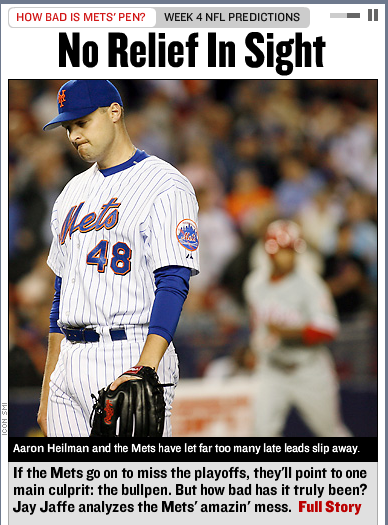
Cutting to the chase:
The sad fact is that through the first half of the season, even with [Billy] Wagner performing at a level far below his peak, the Mets actually had one of the league's better bullpens; their 6.1 WXRL through the All-Star break ranked third in the NL behind the Phillies and Dodgers. Since then, they've been a league-worst 1.4 wins below replacement level as a unit. Fill-in closer Luis Ayala (-0.04 WXRL since coming over from the Nationals on Aug. 17) is an obvious culprit, but he's hardly the only offender.Like just about everyone else out there, I had the Mets pegged to win last night once Daniel Murphy led off the bottom of the ninth with a triple. My one-man Ikea furniture assembly line came to a halt to watch Bob Howry strike out David Wright, and I could have sworn one of the Mets' announcers -- Ron Darling, Keith Hernandez or Gary Cohen -- said something to the effect that "if Wright strikes out, this inning is over." That's optimism for you. Of course, Wright did strike out, and Howry escaped by intentionally walking Carlos Delgado and Carlos Beltran, getting a forceout at the plate, and then blowing away Ramon Castro. Unbelievable. I'm reminded of an expression by my friend and former coworker Lillie, a Brooklyn gal whose capacity for amazement at the ways she could be tortured by the Mets never ceases: "This fuckin' team!" she'd say, drawing the F-bomb out until it's longer than a mid-inning pitching change.
A quick peek at the individual numbers informs us that it's not hard to recognize a systemic combination of overuse and ineffectiveness. Of the six relievers whom Jerry Manuel has called upon most frequently, five have second-half ERAs above 4.90: Ayala (5.54, including his Washington stint), Pedro Feliciano (6.38), Aaron Heilman (6.75), Duaner Sanchez (6.00), and Joe Smith (4.91); Scott Schoeneweis (4.50) is the exception. Excluding the late-arriving Ayala, that bunch has combined for 152 appearances in 63 games since the break, a breakneck 78-game pace for each over the course of a season. Feliciano (83 games), Ayala (80) and Smith (79) represent three of the six major league pitchers stretched to that exhausting plateau over the full season, with Heilman (77) not far behind. Overall the Mets rank second in the league since the break with 227 relief appearances, an average of 3.6 per game.
Driving such a frenetic pace is a massive platoon split that has Manuel chasing the "right" matchups, following a single-minded La Russa-style tactical orthodoxy at the expense of more important strategic imperatives such as conserving bullpen arms over the course of the long season. When they have the platoon advantage (righty on righty or lefty on lefty), Mets relievers have limited hitters to just .225/.299/.325; ranked by OPS, that's an impressive fourth in the majors. However, when they don't have the platoon advantage, they've been tagged at a .294/.375/.479 clip, worst in the majors. The 227-point OPS difference between situations is the highest by a wide margin; second-highest are the Brewers at 188 points, and they just whacked a manager over his platoon-related shenanigans and bullpen mismanagement. The take-home message is yet another reminder that chasing matchups can easily backfire on a skipper, either by exposing lefty specialists such as Schoeneweis (.333/.421/.509 versus righties) or Feliciano (.357/.453/.561) to the point where they face more righties than lefties, or by shunting a heavier workload to the second- or third-tier pitchers in a bullpen.
Yet for all of those woes, things might be different if Wagner were still around. Despite a superficially tidy 2.30 ERA, the five-time All-Star had accumulated just 1.5 WXRL in about two-thirds of a season, after compiling 3.8 last year and 5.9 in 2006 (second in the league). Depending upon which model of Billy Wags you use as a benchmark, that's anywhere from one to four wins missing from his ledger. Even at its lowest, that margin may easily be the difference between a club playing its way into October and adding another season like their now-infamous 2007 collapse to give them a matched pair of late-season meltdowns.
Meanwhile, the Brewers won behind a gritty effort by CC Sabathia, pitching on three days' rest and striking out 11 Pirates over seven innings and 108 pitches. The race for the two NL spots tightened even more with a Phillies loss. The Postseason Odds Report says:
Thru 9/24 Div WC TotClay Davenport, who runs the Odds Report, published an estimate of the various tie-related scenarios:
Phillies 87.4 11.1 98.5
Mets 12.6 59.6 72.1
Brewers 0.0 29.3 29.3
Thru 9/25 Div WC Tot
Phillies 85.0 12.4 97.5
Mets 15.0 39.6 54.5
Brewers 0.0 47.9 47.9
The Mets and Phillies finish in a tie, ahead of the Brewers - 8.89% chance. If this happens, the Mets win the division and the Phillies win the wild card. No playoff.So if you're simply a fan of entropy rather than any of these specific teams, today's math says you've got about a 29 percent chance of some extra baseball before the playoffs begin.
Phillies and Mets tie for the division, Brewers win the wild card - 1.12% chance.
The Mets and Brewers tie for the WC, behind the Phils - 23.92%.
The Phillies and Brewers tie for the WC, behind the Mets - 1.29%.
Three-way tie for the WC - 3.13%.
Labels: Brewers, Hit and Run, Mets
Wednesday, September 24, 2008
I Don't Think Either of Them Can Win
The struggles of both teams remind one of the immortal words of sportswriter Walter Brown. In analyzing the war-depleted rosters of the Cubs and Tigers before the 1945 World Series, he famously quipped, "I don't think either of them can win." Observers of this year's NL races can certainly relate.Flipping around between six games last night (thank you, Extra Innings package, and thank you, iPhone) as I assembled Ikea furniture, I watched considerable portions of both the Mets and Brewers wins while the Phillies lost, results that shifted the article's cited Postseason Odds -- the estimated percentage chance that they could gain entry to the playoffs -- a bit; even with Prince Fielder's walk-off homer, the Brewers lost gound:
Thru 9/23 Div WC TotOf course, those numbers can change dramatically. As of September 1, the Brewers were at 14.8/81.2/96.0, and of course last year the Mets were at 98.8 overall prior to their collapse. Until they clinch, there's no such thing as a lock -- just ask the 2007 Rockies.
Phillies 95.5 4.1 99.6
Mets 4.5 60.9 65.3
Brewers 0.0 34.0 34.0
Thru 9/24 Div WC Tot
Phillies 87.4 11.1 98.5
Mets 12.6 59.6 72.1
Brewers 0.0 29.3 29.3
As for the Dodgers, they dodged a bit of a bullet last night. They came into the game against the Padres with a two-game lead over the Diamondbacks and a 91.5 percent shot at the division title, and while they were initially scheduled to face Jake Peavy, the ace's absence from the team over the weekend to attend the birth of his son compelled Pad skipper Bud Black to push him back until Thursday. Instead the Dodgers scored six first-inning runs off replacement starter Your Name Here and rolled to a 10-1 win while the D-bags lost, raising the Dodgers' odds to 98.0 percent and cutting their magic number to three. Aw yeah, baby.

Labels: Brewers, Dodgers, Mets, New York Sun
Friday, September 12, 2008
Three Quick Shakes
Back in the swing of things, I've pretty much given up the Yankees for dead. Instead my focus has been on the NL West. I watched some of last weekend's key series against the collapsing Diamondbacks and marveled at the unstoppable force that is Manny Ramire - two topics that each provided me with enough fodder for Prospectus Hit and Run pieces:
• Snakes Down a Drain:
This past Saturday, the Arizona Diamondbacks did what they've been threatening to do for the better part of the last four months: they surrendered first place in the NL West, a position they had held at least a share of since April 6. Back in April, they appeared poised to build on last year's league-best record and run away with the division flag. Since then, they've been an adventure in mediocrity. On the heels of a three-game sweep by the Dodgers, Monday night's loss even knocked them below .500. If you were in an airplane with their Postseason Odds, you'd have strapped on your parachute, unbolted the door, and checked the crossbreeze by now.• The Manny Show
Before peering too deeply into the abyss, a brief refresher course is in order. Recall that the Diamondbacks finished with a 90-72 record but became just the sixth team to make the postseason with a negative run differential. They wound up 12.2 games above their third-order projection, the third-highest mark of all time. It wasn't hard to envision the old Bill James Plexiglass Principle coming back to swat them on their collective derriere; exceeding expectations two years in a row is a very tough act. Nonetheless, the addition of Dan Haren to the rotation via a blockbuster trade with the A's, the return of Randy Johnson from injury, and steady improvement by a nucleus of players 25 or under—Stephen Drew, Mark Reynolds, Justin Upton, and Chris B. Young—figured to make the Diamondbacks at least co-favorites in the NL West. PECOTA forecasted an 87-75 finish and a +58 run differential (821 runs scored, 763 runs allowed). Not thrilling, but nice.
That forecast looked to be well on the low side through the first month of this season. The Diamondbacks compiled the best record (20-8) and run differential (+56) through April 30 while opening up a 5½-game lead in the division. They scored 5.9 runs per game to that point, second best in the majors. Even more impressively, they allowed just 3.9 runs per game (third best in the majors), a Herculean feat given that they play half their games in the second-best hitters' park in the bigs. But since that sprint out of the gate, the D'backs have gone just 51-65 while wheezing their way to 4.2 runs per game (24th in the majors) and yielding 4.6 per game (14th).
Earlier this summer, I had occasion to review the career of former Dodger slugger Pedro Guerrero, a favorite player of my youth, for a research project. Guerrero spent the first few years of his major league career--1978-1980, for those too young to remember--waiting for Steve Garvey and company to grow old. In the interim, he was forced to learn other positions, playing every spot except for catcher and shortstop, finally cracking the Dodgers' lineup as a right fielder for a couple of years. When Ron Cey was traded to the Cubs following the 1982 season, Guerrero began a nasty, short and brutish war of attrition with third base, where his range was above-average and his arm was strong, but his footwork was lousy. The media tended to focus on his errors (46 in 1983-1984) rather than the plays he made, but Guerrero paid his critics no mind. "I can f---ing hit" was his refrain, and brother, he could. Guerrero finished in the top three in Equivalent Average three times over the 1982-1985 span, often carrying a meager Dodger offense on his back for weeks at a time.And with no time to spare, I put together this week's Hit List in a manner that I've never done before in the 90+ I've banged out over the last four years: I wrote the team comments in order from top to bottom, 1 to 30, just to see if I could finally do it. I'm not sure it will mean much to the reader, but as an exercise in quickly assembling some "talking points" about each team, it was a productive one, and I'm proud that it came out as well as it did.
I'm reminded of Guerrero because I swear I'm seeing the reincarnation of that one-man Dodger blue wrecking crew in the form of Manny Ramirez right now, night after night after night. Ladies and gentlemen, in case you haven't been paying attention, know this: Manny Ramirez can f---ing hit. Since coming to the Dodgers in a three-way deal consummated just moments before the July 31 trading deadline, he's batting .396/.498/.776 with 14 homers in 166 plate appearances while helping his new club climb from two games behind the Diamondbacks in the NL West to 3 1/2 ahead of them. On the heels of his controversial exit from Boston, he showed up in Tinseltown, chose jersey number 99, promised to cut his dreadlocks in due course but barely obliged, ignited a merchandising craze and charmed his fans, teammates and even his stony-faced manager with his between-innings misadventures. Amid all of the distractions, he's simply beaten the tar out of the ball, and the Dodger offense has started to click. On Wednesday night, he crushed a pair of opposite field home runs in Petco Park, one of the majors' least homer-friendly venues.
As I write this I've got one foot out the door. I'm headed to Philadelphia tonight for a Phils-Brewers game, my third Brewers game in three cities this year and my first trip to Citizens Bank Ballpark. Tomorrow morning I've got to turn that around to get back to the Bronx for my final game at Yankee Stadium. I'll be writing that one up for Baseball Prospectus next week, and rest assured, it won't be the kind of weepy nostalgia piece that's going around like a bad cold given recent events.
Labels: Brewers, Dodgers, Hit and Run, Hit List, Yankee Stadium
Monday, July 07, 2008
Very Big Man, Very Big Deal
With the Yankees-Red Sox drama well off my radar, I soaked up the Brewer buzz, particularly the CC Sabathia-to-Milwaukee rumors which lingered in the air all weekend. On July 4, I had a few moments to pick the brain of Joe Zidanic, the Brewers exec who made my Sausage Race adventure possible a few years back. He's on the money side, not the player personnel side (officially Vice President-Controller), but he knew his way around most of the prospects we discussed, even if he understandably played his cards close to the vest. After talking to him, I'm not surprised that the Brew Crew managed to pull off the big deal for the big man, sending four prospects to Cleveland for Sabathia. The team's farm system may be a bit down after graduating so many young players to the big club's roster, but it remains deep.
More importantly, the Brewers' status as contenders has been restored. A little over six weeks ago, it looks as though their playoff hopes might already be dashed. They stumbled to a 23-27 start while their bullpen smoldered and their ace-in-the-making Yovani Gallardo was lost to an ACL tear. Even last week some Brewers fans at the Baseball Prospectus "Pizza Feed" were giving me stick for having touted them this spring. However, the team is on a 26-12 run -- best in the majors in that span -- over which they've outscored opponents by just over a run per game, and they now claim the second-best winning percentage in the league. "We're going for it," said GM Doug Melvin of the deal for the 2007 Al Cy Young winner, noting that the pressure for the Brewers to get back to the postseason for the first time since 1982 is countered by an outpouring of support at the box office. Despite playing in the league's smallest media market, they're a respectable 12th in the majors in attendance, and they have a shot at bettering last year's franchise record of 2,869,144. For that, the Brewers, who for years under the inept Selig regime lined their pockets with revenue sharing money, feel as though they owe their supporters a run. "This is a huge boost to the fans, who have had a long drought here," said Melvin. "Maybe they never thought that this kind of thing could happen."
Gambling the future on this year's playoff berth may seem like a reckless strategy, particularly as Sabathia is almost certain to test free agency at the end of the year with an asking price more suited to the budget of the Yankees than the Brewers. But it's worth nothing that his departure would net the Brewers two first-round draft picks, a significant asset in the hands of scouting director Jack Zduriencik, Baseball America's 2007 Executive of the Year. Add the two picks the Brewers might get if Ben Sheets walks as well, and they could have five picks in the first 35 to 40 of next year's draft. That ain't hay. Furthermore, research by my Baseball Prospectus colleague Nate Silver for Baseball Between the Numbers shows that a single trip to the playoffs can have a decade-long bounce in media rights fees. That bounce is now about a decade and a half overdue.
Sabathia's overall numbers aren't superficially impressive (6-8, 3.83 ERA), but he was getting just 4.38 runs per game of offensive support from the hapless Indians; in exactly half of his starts, the team had scored two runs or less. He leads the AL in strikeouts (123 in 122.1 innings), and after compiling a grisly 13.50 ERA over his first four starts, has put up a 2.09 ERA over his last 14 starts, with a stellar 109/20 K/BB ratio in 104.1 innings. The dude can pitch, and for all of the concern about his oversized frame, his history of stellar strikeout-to-walk ratios is evidence that his mechanics are pretty sound; you don't put up 5-to-1 ratios without the ability to repeat your motion time after time after time. That's how David Wells did it, and Sabathia does it with considerably more heat via a mid-90s fastball and a plus slider. He's big but athletic, and it's not a coincidence that he's shown some prowess with the stick (.300/.317/.475 with two homers in 40 at-bats) during his limited opportunities in interleague play.
The Brewers rotation needs a horse like Sabathia. Though they're actually third in the league in innings per start (5.93), most of that is a product of Sheets and his three complete games; take him out of the equation and they'd be 11th in the league. Two starters, Jeff Suppan and David Bush, are carrying ERAs above 4.70; Suppan just went on the DL with an elbow problem, and his spot would have fallen to bullpen exile Carlos Villanueva if this deal hadn't been made. The other two starters, rookie Manny Parra and reclamation project Seth McClung, have both shown promise but don't exactly have track records of reliability. Parra is notoriously injury-prone, while McClung is still the owner of a career 5.77 ERA owing to years of futility in Tampa Bay. Adding Sabathia gives the front of the rotation a 1-2 punch that can match up with just about any in the game.
What does surprise me abou this deal is that the centerpiece was Matt LaPorta, the Brewers' 2007 first-round pick. Drafted as a first baseman but converted to right field, the 23-year-old LaPorta has clubbed 32 homers in his first 112 pro games and is hitting .291/.404/.584 with 20 jacks this year at Double-A Huntsville. With power like that, he appeared to be the heir apparent to Fielder, who is arbitration-eligible next year but thought to be on the outs with the club after they unilaterally renewed his contract this spring. Perhaps this move is a portent of a long-term deal with Fielder similar to the one Ryan Braun signed earlier this season.
In any event, the trade doesn't guarantee the Brewers anything. It's sure to be countered by the Cubs, who lead the Brewers by 3.5 games in the NL Central and are said to have their sights on Oakland's Rich Harden. The Cardinals, also 3.5 out and mere percentage points behind the Brewers, may have a trade up their sleeves as well. But it's the Brewers who have struck first, at a time when they're already hot, and if you're somebody who's got a stake in their season, as I and all of my Milwaukee peeps do, that's something to be excited about.
Update: Over at SI.com, my boy Cliff Corcoran thinks the Brew Crew "have all but guaranteed themselves their first playoff berth since 1982." He's also got some input from BP's Kevin Goldstein regarding the prospects headed to Cleveland.
Labels: Brewers
Archives
June 2001 July 2001 August 2001 September 2001 October 2001 November 2001 December 2001 January 2002 February 2002 March 2002 April 2002 May 2002 June 2002 July 2002 August 2002 September 2002 October 2002 November 2002 December 2002 January 2003 February 2003 March 2003 April 2003 May 2003 June 2003 July 2003 August 2003 September 2003 October 2003 November 2003 December 2003 January 2004 February 2004 March 2004 April 2004 May 2004 June 2004 July 2004 August 2004 September 2004 October 2004 November 2004 December 2004 January 2005 February 2005 March 2005 April 2005 May 2005 June 2005 July 2005 August 2005 September 2005 October 2005 November 2005 December 2005 January 2006 February 2006 March 2006 April 2006 May 2006 June 2006 July 2006 August 2006 September 2006 October 2006 November 2006 December 2006 January 2007 February 2007 March 2007 April 2007 May 2007 June 2007 July 2007 August 2007 September 2007 October 2007 November 2007 December 2007 January 2008 February 2008 March 2008 April 2008 May 2008 June 2008 July 2008 August 2008 September 2008 October 2008 November 2008 December 2008 January 2009 February 2009 March 2009 April 2009 May 2009 June 2009 July 2009 August 2009 September 2009 October 2009 November 2009 December 2009 January 2010 February 2010 March 2010 April 2010 May 2010

Subscribe to Posts [Atom]