The Futility Infielder
A Baseball Journal by Jay Jaffe I'm a baseball fan living in New York City. In between long tirades about the New York Yankees and the national pastime in general, I'm a graphic designer.Wednesday, October 01, 2008
Short Rest
Like the other BP series previews (Christina Kahrl on Dodgers-Cubs, Joe Sheehan on Red Sox-Angels, with White Sox-Rays still pending) it's mirrored over at SportsIllustrated.com. For those of you that simply want to cut to the chase and avoid the numbers, here's the payoff. I don't think it'll make my in-laws happy, but I gotta call 'em like I see 'em in this racket, and anyway, I hedged my bets:
This is a more even series than it might appear to be at first glance given the state of the Brewers' pitching staff. That the Brewers might face southpaws three times in a five-game series helps their cause just a hair due to two of those starts being taken by Hamels. The biggest difference between the two clubs appears to be at the front end of their bullpens, where the Phils enjoy a considerable advantage, and the feeling here is that unless the Brewers can find a way to get Sabathia a second turn on the hill for a Game Five, that bullpen edge may prove decisive. I'm predicting the Phillies in four, but if the Brewers can force a rubber game, my money's on the big man.Also, the flip side of my not-so-happy take on the closing of Yankee Stadium is up at Bronx Banter. It's a top ten countdown of my favorite memories of attending games at Yankee Stadium. A small taste that won't give away too much:
7. The sweltering Sunday afternoon in the summer of 2000 when my friend Julie and I practically peed ourselves laughing at the sight of a young Hasidic Jewish man who somehow fell out of the stands, far enough down the left field line to where the wall starts to slant upwards, a good six or eight foot drop onto the field. Visibly dazed and confused, perhaps even with a broken arm, he was escorted off the premises. His pain was our comedic gain, an eternal reminder of the rough justice of the Bronx.I could easily have expanded the list to 20, and once things cool off, I'll run a countdown of the best of the rest here.
6. The night of August, 8, 2000, when Oakland closer Jason Isringhausen came on to protect a 3-2 lead in the ninth inning but lasted only two pitches, surrendering solo homers to Bernie Williams and David Justice. The Yankees of the Joe Torre era made routine sport of snatching victory from the jaws of defeat, but never did they do so with more surgical precision than that.
Moving along:
• The New York Sun, an occasional outlet for my writing via a syndication deal with BP, has closed up shop. I won't miss their neoconservative politics at all, but their baseball coverage was something else entirely, with Steven Goldman and Tim Marchman appearing regularly, and several BP authors (myself included) getting their first chance to reach the daily newsstands. Christina Kahrl eulogized the sports page.
Apparently, my piece from last week was the final one from our BP syndication agreement. When you folks and your robot monkeys get around to building me the Wikipedia fan page I so richly deserve, please be sure to include that tidbit.
• Alex Belth had something to add about the Sun as well, along with discussing Goldman's last piece and the latest Neyer-Jaffe throwdown. On the latter, so did the good folks at YanksFanSoxFan. Thanks, guys.
• Finally, I haven't had time to write about it anywhere, but I'm elated to hear that Brian Cashman has decided to remain with the Yankees for another three years. I suspect that the dearth of job openings had something to do with that; currently the Mariners have the only GM vacancy. The Dodgers, whom Cashman grew up rooting for and who might be an attractive destination given their payroll and the obvious Joe Torre link, are likely to keep Ned Colletti on after winning the division; that Manny Ramirez trade saved his hide.
Interesting in its own right is that former Yankee and current Dodger assistant GM Kim Ng appears to be the leading contender for the Mariners job. She was the first woman ever to interview for a GM job back in 2005 when the Dodgers tabbed Colletti (ugh) and she's held in such high esteem within the game that it's likely only a matter of time before she lands in the big chair.
Labels: Brewers, New York Sun, Yankee Stadium, Yankees

Wednesday, September 24, 2008
I Don't Think Either of Them Can Win
The struggles of both teams remind one of the immortal words of sportswriter Walter Brown. In analyzing the war-depleted rosters of the Cubs and Tigers before the 1945 World Series, he famously quipped, "I don't think either of them can win." Observers of this year's NL races can certainly relate.Flipping around between six games last night (thank you, Extra Innings package, and thank you, iPhone) as I assembled Ikea furniture, I watched considerable portions of both the Mets and Brewers wins while the Phillies lost, results that shifted the article's cited Postseason Odds -- the estimated percentage chance that they could gain entry to the playoffs -- a bit; even with Prince Fielder's walk-off homer, the Brewers lost gound:
Thru 9/23 Div WC TotOf course, those numbers can change dramatically. As of September 1, the Brewers were at 14.8/81.2/96.0, and of course last year the Mets were at 98.8 overall prior to their collapse. Until they clinch, there's no such thing as a lock -- just ask the 2007 Rockies.
Phillies 95.5 4.1 99.6
Mets 4.5 60.9 65.3
Brewers 0.0 34.0 34.0
Thru 9/24 Div WC Tot
Phillies 87.4 11.1 98.5
Mets 12.6 59.6 72.1
Brewers 0.0 29.3 29.3
As for the Dodgers, they dodged a bit of a bullet last night. They came into the game against the Padres with a two-game lead over the Diamondbacks and a 91.5 percent shot at the division title, and while they were initially scheduled to face Jake Peavy, the ace's absence from the team over the weekend to attend the birth of his son compelled Pad skipper Bud Black to push him back until Thursday. Instead the Dodgers scored six first-inning runs off replacement starter Your Name Here and rolled to a 10-1 win while the D-bags lost, raising the Dodgers' odds to 98.0 percent and cutting their magic number to three. Aw yeah, baby.
Labels: Brewers, Dodgers, Mets, New York Sun
Thursday, May 22, 2008
Cubs' Chances and Chamberlain's Change of Pace
It's been a rough century for the Cubs. They haven't won a World Series since 1908, and they haven't captured a pennant since 1945 despite the best efforts of superstars like Ernie Banks, Ryne Sandberg, and Sammy Sosa. They've punctuated that dry spell with agonizing collapses — their late-season fade in 1969, a squandered 2-0 lead in a best-of-five Championship Series in 1984, and the Steve Bartman debacle in 2003 — and watched as the Red Sox and crosstown White Sox have overcome similarly epic championship droughts. History has not been kind, but at long last, this may finally be the Cubs' year.The race appears tight at the moment, but the two teams hanging with the Cubs, the Cardinals and Astros, were forecast for just 75 and 72 wins, respectively, and the adjusted run differentials suggest a three- and five-game gap between the Cubs and those two teams. Meanwhile, the Brewers, who were forecast for 86 wins, appear dead in the water at the moment, their bullpen frightful and their rotation depth squandered. So my money's on the Cubs.
On the surface, the team simply appears to be solid contenders, perhaps a bit improved off of last year's NL Central-winning 85-77 record. Their two-game lead in the division isn't overly generous, and at 28-18, they trail the Diamondbacks by half a game in the race for the league's best record. However, thanks to a recent 9-2 tear in which they outscored opponents 67-35, they have the majors' best run differential through Tuesday, at +76 runs. It's not like they're playing far above their heads, either. This spring, Baseball Prospectus' PECOTA forecasting system tagged the Cubs for 93 wins, tops in the division and second only to the Mets among NL teams.
Leading the way for the Cubs is an offensive juggernaut that's scoring a major league-best 5.7 runs per game while hitting .285 AVG/.371 OBP/.448 SLG, tops the NL in the first two categories, and second in the latter. Left fielder Alfonso Soriano has powered the recent streak with a 21-for-44 tear that included seven homers in six games, but he's had plenty of help. Indeed, the Cubs are getting above-average production at every position except center field, with first baseman Derrek Lee, second baseman Mark DeRosa, third baseman Aramis Ramirez, right fielder Kosuke Fukudome, and shortstop Ryan Theriot all getting on base above a .400 clip.
On-base percentage is the offensive statistic which best correlates with run scoring, and historically, it's been an Achilles heel for the Cubs. Former manager Dusty Baker showed a maddening tendency to favor free swingers over disciplined hitters; as a result, the Cubs never placed higher than 11th in OBP during his four-year tenure (2003-2006), but it wasn't all Baker, as the problem goes back much, much further. The team hasn't led the league in OBP since 1972, and has only placed in the top three four times - 1972, 1975, 1984 and 1989, the latter two playoff seasons - since 1945, when the club ranked second.
Under new skipper Lou Piniella, last year's unit ranked ninth in the league with a .333 OBP, up from a dead-last .319 mark in Baker's final year. This year's offense has been bolstered by the additions of Soto, a top catching prospect who hit a searing .353/.424/.652 at Triple-A Iowa last year, and Fukudome, an import who topped a .430 OBP in the Japanese Pacific League in each of the last three years while drawing comparisons to Bobby Abreu and J.D. Drew for his moderate power/high-OBP skill set.
Meanwhile, I missed Tuesday evening's Yankee debacle but caught some of last night's rout, when recently returned Alex Rodriguez turned Yankee Stadium into his own personal pinball game, going 3-for-4 with two doubles and a homer, a tally that should have been the other way around were it not for a blown home run call, the second in a Yankees game this week. Bigger than that, however, was the fact that Joba Chamberlain threw two innings of scoreless ball to close out Darrell Rasner's fine seven-inning shutout effort. According to Brian Cashman, Chamberlain is beginning the process of being stretched out to join the rotation. Amid all the misdirection the Yankees have been running on this, I'm going to claim victory for having anticipated this the last time I wrote about the pinstripes and talking about it during my two radio hits yesterday. In some quarters this may be spun as a panic move, a reaction to Hank Steinbrenner's recent outbursts, but this isn't Cashman's first rodeo. The math regarding Joba's innings pace suggests that this was the plan all along. Pete Abraham, who agreed with that assessment when I bounced it off him this past weekend, has a trio of good blog entries covering the angles related to this move. Go.
The Hit List beast beckons...
Labels: New York Sun, Yankees
Friday, April 11, 2008
Friday Doubleheader
In a season of great divisional and wild-card races, last year's NL West scramble may have been the best of the bunch. The Dodgers, Padres, and Diamondbacks all spent at least six weeks in first place, and by the end, just one full game separated the top three teams in the standings after the Rockies beat the Padres in a Game 163 playoff to decide the wild-card. The West looks similarly wild this year, as Baseball Prospectus's PECOTA projection system forecasts the Dodgers, Diamondbacks, and Rockies to finish with 87, 87, and 82 wins, respectively, the tightest three-team cluster in any division. As with last year, the outcome may well rest on the shoulders of young, homegrown talent. The Dodgers, Diamondbacks, and Rockies have earned reputations as three of the game's top player development machines, offering a pipeline of top prospects to combat the ever-rising cost of signing free agents - especially important for the small-market Rockies and Diamondbacks. All three are poised to augment their lineups and pitching staffs with even more prized prospects as the year goes on.I've remarked before about the prescience of Goldstein's ranking of the Rockies' org, but left on the cutting room floor was Tulowitzki's role in helping the Rox lead the NL in Park-Adjusted Defensive Efficiency. I had plenty to say about the D-backs and Dodgers, of course, particularly with regards to the latter's new skipper:
Hardly anyone predicted the Rockies could win the NL pennant last year, and nobody foresaw their season-ending 14–1 dash. However, BP prospect guru Kevin Goldstein ranked the Rockies' minor-league system the game's second-best at the outset of the season, noting their ability to provide instant help in the form of 22-year-old shortstop Troy Tulowitzki, who hit .291 AVG/.359 OBP/.479 SLG with 24 home runs while anchoring the league's best defense. The system also produced a pair of hard-throwing hurlers -— 23-year-old right-hander Ubaldo Jimenez and 21-year-old lefty Franklin Morales -- who patched a rotation wracked by injuries in time for their amazing stretch run. Meanwhile, 24-year-old Manny Corpas, a second-year reliever, took over the closer role from Brian Fuentes by midyear, saving 19 games after July 6.
Strong player development is hardly a new thing for the Rockies; it's arguably the only area in which the team (once notorious for a $172 million binge on free-agent busts Mike Hampton and Denny Neagle) has ever excelled. Their 2008 Opening Day lineup featured seven homegrown players, including five-time All-Star Todd Helton, 2007 MVP runner-up Matt Holliday, and former first-round draft picks Tulowitzki (2006), Jeff Francis (2002), and Jayson Nix (2001). Three days later, with Chris Iannetta behind the plate, and Ryan Spilborghs in center field, they featured an all-homegrown nine. Nix, 25, is a late-arriving, good-field/no-hit rookie; PECOTA forecasts him for a .245/.300/.379 showing but defense at second base that's nine runs above average. Iannetta, also 25, was expected to win the starting catcher job last year, but a .158 AVG in April coupled with a solid performance from Yorvit Torrealba consigned him to the backup backstop role. Still, Iannetta forecasts as the better hitter, and he may yet claim the job.
Even more tantalizing [than third base prospect Andy LaRoche] is 20-year-old southpaw Clayton Kershaw, a blue-chip pitching prospect. Despite less than 25 innings above A-ball under his belt, he spent most of March in the big-league camp and drew raves for his poise and his arsenal. Though sent to Double-A to start the season, he's poised for a midsummer promotion, either as the fifth starter or -- of particular interest given new manager Joe Torre's experience last year -- in a Joba Chamberlain-esque setup role.Given the Sun's space constraints, I didn't even have room to tackle the Padres, whom PECOTA forecast for a paltry 78 wins on the heels of their agonizing near-miss last year. As noted in my essay for Baseball Prospectus 2008, the Pads are at a real disadvantage against those divisional talent factories. They ranked 24th in Opening Day payroll last year, with the Rockies 25th and the Diamondbacks 26th; furthermore, Forbes.com's 2007 estimates show them second-to-last in Operating Income. Their farm system has improved in a year's time; Goldstein ranked them 29th in 2007, but they've risen all the way to 12th thanks to strong seasons from Matt Antonelli and Chase Headley and a stockpiling of free-agent compensation picks. Still, Antonelli's a year away and Headley, farmed out to begin this year, figures to help only so much once he arrives. PECOTA has him at .231/.316/.388 due to a shaky track record; an equivalent translation of his searing season in Double-A is .255/.356/.474, but he'd have to surpass his 90th percentile projection to reach that.
It's Torre who may draw the most scrutiny of any newcomer in the division. As the Yankee skipper, he often drew criticism for preferring marginal veterans over untested prospects, but his latter-day ability to integrate Robinson Cano, Melky Cabrera, Phil Hughes, and Chamberlain into the mix mitigated that somewhat. Already he's drawn fire for juggling Kemp with expensive, unproductive Juan Pierre in the outfield, and if Garciaparra and LaRoche are ever healthy at the same time, all eyes will fall on that choice, too. Given a slim margin for error, nothing less than a playoff spot may ride on Torre's willingness to choose youth over experience.
Back to Torre and the Dodger outfield, here's what I had to say in the Hit List, where they ranked 19th:
Ding-dong, Juan Pierre's consecutive game streak is dead at 434, but the early returns on Joe Torre's ability to manage the crowded outfield are less encouraging. Thus far, Andre Ethier's started nine times, Andruw Jones eight, Pierre and Matt Kemp five apiece, and the four outfielders are hitting a barren .204/.241/.301. On a more positive note, Rafael Furcal looks like the 2006 model as opposed to the 2007 one, and Jeff Kent has been solid despite missing most of spring training.That's not very encouraging so far, particularly when it appeared towards the end of spring training that Torre had let go of the idea that Pierre would be a regular. It does appear I missed one significant choice, via this article: when Torre sat Jones on Wednesday, Kemp started in center field -- where he played just 17 innings last year -- instead of Pierre, with Torre again kicking the latter in the head: "I'd much rather have someone with the confidence and aggressiveness that [Kemp] has... I'd rather have his arm in center field." Thunk.
Elsewhere on the Hit List, the Yankees were just above the Dodgers at #18 (that's what happens when your offense is down to 3.1 runs per game) and the Brewers were fourth thanks to the anomalies of a Ben Sheets complete-game shutout (his first since his rookie year in 2001) and a sizzling start from Jason Kendall (.538/.567/.731). Most importantly, this week's pop-culture cameos include The Hitchhiker's Guide to the Galaxy, Keith McCready, the Capital Punisher, David Bowie and the former Attorney General, the latter of which should (and does) come with a suggestion to try the veal.
One brief but neat aside about the Hit List: Baseball Prospectus has long had a function called "Audit Team" available via a drop-down menu in the upper righthand corner throughout most of its site. They function as team-at-a-glance pages, handy to have up while watching a ballgame or mulling your local nine's lineup, but recently, they've received a massive and very cool overhaul, adding headshots, graphics, links to the oft-cited PECOTA projections, and a whole slew of BP-flavored sortable stats, including current Hit List ranking and recent Transaction Analysis entries. Here's what the Yankees page looks like -- if you're not familiar with their predecessors, let's just say that the new ones are like stepping into Technicolor. As I found while putting together this week's piece, this is a great resource that's worth taking advantage of, and you can't beat the price (free).
Hat tip to Dave Pease, not only for his hard work on this, but also for eliminating the single most painful hour of my week, the agonizing mad dash to finish each week's list that involved hand-coding each player mentioned in the Hit List with opening and closing < player > tags in order to link them to their BP player cards, often upwards of 100 per week. A very clutch performance.
Labels: Dodgers, Hit List, Joe Torre, New York Sun, Yankees
Thursday, September 13, 2007
Three and Out
• In Wednesday's New York Sun, I wrote about the demise of the Mariners. A couple of early paragraphs were apparently cut, one for space reasons, the other because the transition kinda sucked. Warts and all, here's the director's cut of the relevant portions, with the excised paragraphs in brackets:
When the sun rose on August 25, the upstart Mariners were sitting pretty. Thanks to a streak in which they won 13 out of 17, they were 73–53, one game behind the Angels in the AL West, and three ahead of the Yankees in the wild card race. According to Baseball Prospectus' Playoff Odds report — which uses a team's run-scoring and run-preventing proclivities in a Monte Carlo-simulation that plays out the rest of the season one million times — the M's held a 29% shot at winning their division, and a 30% shot at the AL Wild Card.More after the jump.
Less than three weeks later, the Mariners' ship has all but sunk. A 1–13 skid helped knock them 8.5 games back in the division, and 5.5 back in the wild card, plunging their Playoff Odds down below 2%. In terms of raw wins and losses, they've set a dubious record — no team so far above .500 so late in the season has ever collapsed so quickly. What went wrong?
[In the grand scheme, the Mariners simply regressed to the mean. Studies have shown that run differentials are better predictors of future performance than past won-loss records. At the point when they were 20 games above .500, the Mariners had outscored opponents by just 28 runs, with rates that projected to a far less impressive and contention-worthy 66-60 record. Call their recent plunge a market correction, a brutal one at that.]
In retrospect, it's surprising the Mariners contended at all this year. The team that made the playoffs four times between 1995 and 2000, and averaged 98 wins a year between 2000 and 2003, has fallen on hard times, with four straight losing seasons and a slew of questionable free-agent signings by general manager Bill Bavasi. Back in the spring, Baseball Prospectus projected the Mariners to finish 73–89, last in the AL West, with the third-worst mark of any AL team.
[Even in surpassing that projection, the team has ridden an emotional rollercoaster. Amid an eight-game winning streak in late June, manager Mike Hargrove resigned abruptly to spend more time with his family. Three weeks later, replacement John McLaren navigated the club through a seven-game losing streak that foreshadowed their late August troubles. Stability is not among the 2007 Mariners’ limited virtues.]
• The Mariners were also the focus of Tuesday's Hit and Run; you'll see some crosover between that and the Sun piece, but the emphasis was on the bullpen's second-half decline. After posting a 3.72 Fair Run Average (accounting for their performance of inherited and bequeathed runners via the good old run expectancy tables; here is a good layman's explanation) in the first half, they've ballooned to a 5.30 FRA in the second half, the fourth-highest jump in the majors. Several contenders have had similar troubles; the Red Sox, Dodgers, Yankees, Brewers, and Padre join the Mariners in the bottom 10, with the Padres dead last, jumping from 2.51 to 5.45.
Also in that Hit and Run is a quick look at Pedro Martinez's JAWS case for the Hall of Fame, and a comparison between his case and that of Sandy Koufax:
Coming into the year, Martinez's JAWS score (113.7 career WARP3/75.3 peak/94.5 JAWS) was well above the Hall standard for starting pitchers (99.0/62.7/80.9). His JAWS score ranks 20th all-time, and his peak score ranks 14th. As I noted in Mind Game, his 2000 season ranks as the best ever in terms of RA+ (293) for any pitcher with at least 150 innings.• Finally, I'm honored to be the author whose It Ain't Over 'Til It's Over chapter has been chosen for excerpting on the BP site. "The Summer of Loving Carl Yastrzemski" is a supporting chapter for my narrative on the 1967 American League race between the Red Sox, Twins, Tigers, and White Sox, which leads off the book. Here's the intro; you can read the rest at BP, where it's free:
Compare that to Koufax; as impressive as the Dodger lefty's stats were, his best seasons were achieved under some of the most favorable conditions of any pitcher, and his JAWS score (70.7/60.3/65.5) is miles behind Pedro, ranking 80th of all time. He was basically a league-average pitcher from 1955-1960 before taking a big step forward in 1961 (the year before the team moved into Dodger Stadium), but he's only got three seasons above 9.0 WARP3. In comparison, Pedro has six. Koufax's best RA+ was "just" 196. But before anybody gets the pitchforks out to either run him out of the Hall (or me out of the field of baseball analysis), as one Schmuck tried to do to BP alum Dayn Perry, let's not forget that Koufax's Hall of Fame case also includes three Cy Youngs, an MVP award, gallons of black ink, three World Series rings, an 0.95 postseason ERA, and the enigmatic glow that comes from retiring while at the pinnacle of success.
Glow aside, Martinez isn't lacking in any of those categories, with three Cys, a ring of his own, and even more black ink in an era where the increased player pool makes it much harder to come by. His JAWS score and other Hall of Fame credentials are so rock solid that he stacks up pretty well with 300-game winning teammate Tom Glavine (129.4/61.4/95.4 coming into the year). He's my lock of the week, and it's a pretty big lock.
In the simplified narratives that our sports media produce, the notion of one player’s carrying a team is a popular and appealing one. It puts a human—even superhuman—face on a disparate collection of players, emphasizing the strengths of one hitter’s or one pitcher’s accomplishments while glossing over his own weaknesses and those of his teammates. Who cares about Babe Ruth’s lousy baserunning, or who was riding shotgun to Joe DiMaggio in 1941, or even Barry Bonds’s peevishness unless it actually cost his team a game? Can one player carry a team? Performances like Carl Yastrzemski’s final two weeks of September 1967, when he hit a jaw-dropping .523/.604/.955, certainly suggest it’s possible for a short time. In the longer term, the nature of baseball would suggest not. Aside from the obvious—the simple unlikelihood of one player’s maintaining such a high level of performance over a larger time frame—there’s the inherent structure of the game. The best hitter can only bat once every nine times, the most durable pitcher needs a few days’ rest between starts, and even the best fielder (beyond catchers) handles the ball only a handful of times each game, making it extremely unlikely that a team could keep relying on the same player over and over again for that extra boost.While I could quibble with the choice of chapters -- this wasn't my personal favorite even among the ones I contributed, but nobody asked me -- I'm honored to be chosen to represent BP for this. The findings here aren't revolutionary, but they do quantify some answers to questions that are often debated on a more abstract level.
As superficial as the notion of one player’s carrying a team may be, our ability to quantify the contributions of each player via an all-encompassing value metric like wins above replacement player (WARP) lends itself well to exploring the limitations of this concept as it applies to a full season. WARP measures each player’s hitting, pitching, and fielding contributions against those of a freely available reserve or waiver-wire pickup. The metric calculates these contributions in terms of runs and then converts those runs into the currency of wins. Park and league contexts are built right into WARP, so that, for example, a player in a barren offensive environment such as mid-1960s Dodger Stadium and another player in a bountiful one such as turn-of-the-century Coors Field can be measured on the same scale. With WARP in hand, we can answer questions such as the following:1. How much impact does the presence of one great player have on a team’s chances?
2. How much impact does the presence of one great player have on a team’s chances if he’s head-and-shoulders above all his other teammates?
I actually applied a couple of the take-home lessons to this chapter in other BP work, one for the Angels' entry here, countering the notion that they lacked enough star power in support of Vlad Guerrero, and the other to answer a Keltner Test question -- If this man were the best player on his team, would it be likely that the team could win the pennant? -- on Jeff Kent. Yes, the Keltner is largely qualitative, not quantitative, but I like to ground my Hall of Fame arguments in numbers and facts before tackling the more subjective elements.
Anyway, I'm off to Switzerland and Austria for the next two weeks, leaving Marc Normandin in charge of the Hit List and my bobblehead collection in charge here. Here's hoping the Yankees can hold onto their playoff spot and that the Dodgers can mount a great comeback while I'm gone.
Labels: Hit and Run, It Ain't Over, JAWS, New York Sun
Wednesday, August 01, 2007
Deadline City
Somewhere amid our internal roundtable on Monday, in dissecting the initial announcement of the Mark Teixeira-to-Atlanta trade, BP intern/FI research assistant Peter Quadrino summoned forth the study I did of Braves GM John Schuerholz's track record in dealing prospects (former colleague Dayn Perry recalled it, too). I quickly decided that updating it would make for an appropriate lead for this week's Prospectus Hit and Run:
While Jason Schmidt and Jermaine Dye remain the cautionary tales, they're the exceptions rather than the rule when it comes to Schuerholz's track record. In my study, I found that only six out of the 80 traded prospects (arbitrarily defined as having not accumulated 502 plate appearances or 162 innings in the bigs) had thus far managed 10.0 WARP post-trade, a "career of consequence."As it is, the deal looks a bit better for the Rangers, given that it expanded to five prospects for Tex and lefty reliever Ron Mahay: catcher Jarrod Saltalamacchia, shortstop Elvis Andrus, and pitchers Matt Harrison, Neftali Feliz, and Beau Jones, the latter two apparently added to mitigate Harrison's sore shoulder. The Baseball America Prospect Handbook has Salty, Andrus, and Harrison 1-2-3 among the Braves prospects, with Jones 14th and Feliz 18t; Salty was 36th overall, Andrus 65th, and Harrison 90th. At BP, Goldstein's Top 10 Prospects had Salty, Harrison and Feliz 1-2-3 and Andrus 5th, with Salty 51st, Harrison 79th, and Feliz 98th overall.
Revisiting those numbers two years later, Dye and Schmidt have distanced themselves from the pack, even though they've fallen on hard times in 2007. Meanwhile, Wes Helms and Jamie Walker have crossed the 10.0 WARP threshold, the latter as a rather wealthy man but nonetheless a situational reliever, bringing our running total to eight careers of consequence.
...[Wilson] Betemit and [Adam] Wainwright look like reasonable bets to make the grade, but even if they do, that would make 10 careers of consequence out of a new total of 87 (the aforementioned plus Max Ramirez and a few others, but not the ones in the Texeira deal). As good a deal as the Teixeira one looks for the Rangers right now, those are steep odds to beat.
I've been pretty critical of Rangers GM Jon Daniels in recent weeks, but I dished out a reasonable amount of praise for his deadline work in a piece I did for today's New York Sun:
Most intriguing is Saltalamacchia, a 6-foot-4-inch switch-hitter who projects as one of the game's top-hitting catchers. Already boasting an elite backstop in 23-year-old Brian McCann, the Braves found at-bats for "Salty" at first base; after a hot start, a slump dragged his numbers down to .284 AVG/.333 OBA/.411 SLG. That's light for a first sacker, but solid for a catcher, particularly on a team getting considerably less from incumbent Gerald Laird. Andrus is years away from the majors, but he's been playing against competition that's three years his senior, and with Young signed through 2013, time is on his side. Harrison's a big strike-throwing lefty with solid control and good velocity; his recent shoulder soreness prompted the inclusion of the other two pitchers as insurance.The Gagne move was a big one around these parts, even bigger than the Scott Proctor/Wilson Betemit move that had me gnashing my teeth in disgust for both of my teams. In talking to Steven Goldman last night, the bearded one offered an interesting take that he replicates in today's Sun: the Gagne move actually helps the Yankees because it prevented him from going to the Tigers or Indians, since it's more likely the Yanks are challenging for the Wild Card instead of the division:
In shipping Gagne to the Red Sox, Daniels acquired immediate help and future promise. Southpaw Kason Gabbard, 25, has filled in admirably for the injured Curt Schilling, putting up a 3.73 ERA through seven starts. His ability to induce ground balls by the dozen will aid a rotation that's giving up the league's highest slugging percentage. Outfielder David Murphy, 25, is a card-carrying member of the Future Fourth Outfielders of America; he's a good enough defender to handle center field, and while his plate discipline improved markedly over the past year, his power remains middling. The key to the deal is 17-year-old Dominican Engel Beltre, a toolsy outfielder with good speed, a good arm, and power that's evoked comparisons to Barry Bonds and Darryl Strawberry from scouts. It may take a decade to see who came out ahead here.
Daniels made one other solid move prior to that pair, shipping Lofton back to Cleveland for another catching prospect, Max Ramirez. Thanks to a refined approach, the 22-year-old is hitting .306/.420/.500 in High-A, but his defense is suspect, he's undersized (5-foot-11, 170 lbs), and he joins a farm system already stocked with the highly-regarded Taylor Teagarden behind the plate. A shift likely looms, though a bat of his caliber won't go to waste.
These moves won't turn the Rangers' 2007 around, but they've gone a long way toward restocking a system whose minor league talent ranked among the game's bottom ten. For doing that, Daniels may just have earned his extension.
...the Yankees are in the wild card business, the Red Sox are on their victory lap, and the two aren't in any kind of direct competition except when they're playing head-to-head, something that happens just six more times this season. The Yankees can worry about what should be a deadly back end of the bullpen for Boston with Gagne, Hideki Okajima, and Jon Papelbon when and if they make the postseason and have to play them.As for the Proctor deal, the interesting point is the Yanks' avoidance of the relievers on the market in favor of a plan to promote heat-throwing Double-A prospect Joba Chamberlain and perhaps also Ross Ohlendorf (acquired in the Randy Johnson deal): "There are certain guys in my system right now that I have people telling me could replace Scott Proctor," GM Brian Cashman told the New York Times. "And if that’s the case, that’s what made me consider the opportunity for Wilson Betemit. We have needs, there’s no doubt about that. But there’s a belief that some of those needs might very well be met from within."
Until then, Theo Epstein and pals have given the Yankees a huge break. The Yankees are competing with the Indians for the wild card, and the Tigers could be in the mix should the Indians pass them for the AL Central lead. Even if they don't, the Yankees have eight games remaining with the Tigers and three with the Indians, which is to say that the Yankees will be spending 20% of their remaining time in 2007 playing exactly who they need to be playing. Both of those teams, particularly the Tigers, have had problems in the bullpen. When the Red Sox stepped up to the plate on Gagne, they prevented the Yankees' real rivals from getting an upgrade they desperately needed.
...For either of these clubs, acquiring Gagne would have been a season-altering event. After 105 games, the two teams are one game apart. In broad terms, they are equals. The reasons for their record may differ, but neither is the superior of the other. Had either team improved their bullpen, the stalemate might have been broken. For the Yankees, who need both teams to be weak, that would have been disastrous.
Betemit, as I pointed out in the Hit and Run, got the screw job from the Dodgers; batting average aside, he's been a much more productive hitter than Nomar Garciaparra, though the latter's timely hitting with runners in scoring position has given him the "clutch" tag. While Betemit's versatility and ability to come off the bench are assets sorely missing on the current Yankee roster, I don't particularly trust Joe Torre to integrate him into the mix. And for all the sense it makes to have Betemit as a fallback option in case Alex Rodriguez departs, if the Dodgers didn't see it then the Yankees certainly won't; they'll be under far too much pressure to Do Something Big if A-Rod leaves and will have to get a Name Player there, even if said Name Player is actually more expensive and less productive.
Anyway, I've got plenty more to say on the topic of the deadline, but I've got to bang on the Hit List for a few hours before I head to Yankee Stadium to boo what's left of the ever-charming Kyle Farnsworth. Five 1-2-3 innings this year in 45 appearances -- not to mention working back-to-back days just five times as well -- and he's complaining? Grab drink, dude.
Labels: Hit and Run, New York Sun, Yankees
Wednesday, June 20, 2007
Yo, Baby!
It didn't take genius to foresee the collapse of the World Champion Cardinals. With a poorly-executed off-season plan and a nearly barren farm system, general manager Walt Jocketty did little to upgrade a club that limped into last year's playoffs with an 83–78 record before their unlikely title run. With ace Chris Carpenter sidelined by bone spurs in his elbow since Opening Day, plus sluggers Albert Pujols, Jim Edmonds, and Scott Rolen all off to slow starts, it's been clear for weeks that a repeat performance just isn't in the Cards.That ought to make the in-laws happy. I didn't see more than brief highlights of Gallardo's start, but by all accounts he's the real deal. After leading the minor leagues with 188 strikeouts in 155 innings last year, he had put up a 2.90 ERA with a 110/28 K/BB ratio in 77.2 innings at Triple-A Nashville before his recall. My BP colleague Kevin Goldstein ranked him 14th in his Top 100 Prospects list, while Baseball America had him 16th. Here's Goldstein's tale of the tape from his Top 10 Brewer prospects piece last December:
Filling the power vacuum in the NL Central so far have been the upstart Brewers. Storming out to a 24–10 record behind the potent 1-2 punch of first baseman Prince Fielder and shortstop J.J. Hardy, the Brewers opened up a 6.5-game lead on the retooled Cubs before the latter's irascible new manager, Lou Piniella, had earned his first ejection. Even when gravity brought the Brewers back to earth — they lost 19 of their next 28 games — neither the Cubs nor any other Central team seized the initiative; Milwaukee's lead never dwindled below 4.5 games.
That lead is back up to seven games, and if you were in the vicinity of Miller Park Monday night, you may have heard the window of opportunity slam shut on the rest of the division. Yovani Gallardo, considered one of the top 20 prospects in the minors by both Baseball Prospectus and Baseball America, put together an impressive major league debut, limiting the Giants to four hits and three runs over 6.1 innings. Rickie Weeks doubled twice in his return from the disabled list, and Fielder socked his NL-best 26th homer to give the Brewers their sixth win in eight games.
Yovani Gallardo, rhpThe bottom line is that Brewers fans have every reason to be as excited about him as Yankee fans are about Philip Hughes, with the bonus that Gallardo's actually healthy, and his team is in first place. Can't beat that with a baseball bat.
DOB: 2/27/86
Height/Weight: 6-3/215
Bats/Throws: R/R
Draft: 2nd round, 2004, Texas HS
What He Did In 2006: 2.09 ERA at High A (77.2-54-23-103), 1.63 ERA at AA (77.1-50-28-85)
The Good: Very good stuff plus excellent command equals outstanding pitching prospect. Pitches off a heavy 91-93 mph fastball that touches 96, as well as two plus breaking pitches – a hard-sweeping slider and a downer curveball. Throws strikes and has advanced polish well beyond his years.
The Bad: Changeup is an average pitch, but that's nitpicking. Body doesn't offer the same projection as other top pitching prospects. That's nitpicking as well.
The Irrelevant: Are groundball ratios fluky? Gallardo was nearly 2 to 1 (83-43) in the Florida State League, yet gave up more flyballs (79) than grounders (61) at Double-A.
In A Perfect World, He Becomes: A No. 2 starter and occasional All-Star.
Gap Between What He Is Now, And What He Can Be: Low – Gallardo will turn 21 in Spring Training, yet he's ready for Triple-A, and the Brewers don't think he'll need a full season there in preparation for the big leagues.
• • •
With the next installment of our Spirit of '77 series stuck in the pipeline, my partner in correspondence Alex Belth pitched in with his poignant Bombers Broadside 2007 memoir, "Dad, Reggie and Me." You don't need me to tell you it's a must-read.
Labels: Brewers, New York Sun, Yankees
Friday, May 25, 2007
Busy, Busy, Busy
Somewhere in there I found time to take in the Yankees-Red Sox series, albeit with my thumb pumping the Tivo remote's fast-forward button. I've literally become tired of watching Yankee games; the combination of the team's recent mediocrity and typical plodding pace is a total drag when on a given night you can watch about a dozen other games moving along at a more sprightly pace (offer not valid in Boston). Even with the Tivo, watching Kyle Farnsworth endlessly fidget outside the strike zone is no fun.
Nonetheless, it was good to see a bit of energy flowing through the Yankees as they beat up on Tim Wakefield and Curt Schilling; the benefits of time-shifting allowed me to pause after Hideki Matsui's home run in the latter to cue Blue Oyster Cult's "Godzilla" for an impromptu celebration of the team's 3-0 first-inning lead against the Tubby Bitch. And then to see Doug Mientkiewicz upper deck Schilling, both literally and figuratively, aw yeahhh. Derek Jeter passing Joe DiMaggio for fifth place on the Yankee hit list in the midst of a streak of his own added icing to the cake, as did watching Alex Rodriguez get his groove back with homers in three consecutive games, not to mention a nasty take-out slide of Dustin Pedroia that drew words from Boston. Hey, when Jason Varitek takes off his mask to fight A-Rod instead of hiding behind it like a pussy, the latter can send flowers to Pedroia.
Nonetheless, it was a bit of a dark week in Yankeeland for the off-the-field stuff. Jason Giambi's steroid-related comments drew an audience with Bud Selig, not to mention talk of a voided contract (no chance, and given the Yanks' cynical contract concessions none deserved) and a failed amphetamine test (quite likely a smear job from within MLB offices; Peter Gammons says that Giambi hasn't been asked to take follow-up tests, which would have occurred after a positive). My BP colleague Joe Sheehan had an excellent column (free, not subscription-only) on the Giambi situation:
The specifics of Giambi’s point can be debated, but the central idea here, the one that blame for the nominal Steroid Era lies with personnel both in and out of uniform, cannot. The players who took performance-enhancing drugs shoulder the majority of any responsibility, but to absolve non-uniformed personnel, up to and including the ones on Park Avenue, is folly. We live in an era in which the idea of “clubhouse chemistry” is considered a tangible thing that can be manipulated and monitored. With that the case, it’s silly to think that front offices, spending all kinds of time looking for the right mix of personalities, could not be aware of a different sort of chemistry making the rounds.Also weighing in with a must-read is The New York Times' Harvey Araton:
Fourteen months ago, Commissioner Bud Selig drafted George Mitchell to investigate the use of PEDs in baseball during the pre-testing era. I said at the time, and I believe now, that the Mitchell Commission is a cynical exercise in public relations, designed to turn up no surprises. What I didn’t see coming was how the Commission would be used to focus blame for the era exclusively on uniformed personnel. Every time the Commission makes the news, it’s in some way reflecting badly on the players: they won’t talk, they won’t give up medical records, they won’t cooperate. If the Commission isn’t going to make any new findings along the way, it will certainly make sure to establish in the public eye who the villains are.
To which I say, “enough.” The Mitchell Commission isn’t going to—and isn’t designed to—make any discoveries about the nominal Steroid Era. It has neither the authority nor the gravitas to do any real work. It exists merely in the hopes that it will provide a veneer of credibility to official disdain and/or condemnation of the media-approved bad guys of the timeframe.
The Mitchell Commission should be disbanded. It should be disbanded because all it’s doing is extending the shelf life of a story that does the game no good. MLB isn’t going to get anywhere by trying to figure out who was doing what five to 10 years ago; there’s nothing that can be done, and no credible way or sorting out the impact of PEDs on gameplay, wins and losses, or statistics. If the evidence in Game of Shadows isn’t enough for the Commissioner to come down on Barry Bonds — and no, it’s not — then no amount of paper-shuffling and stern questioning is going to produce actionable information.
The Commission isn’t helping baseball. It’s only keeping a dead story alive, while shifting focus from the evidence we have from three years of testing, from MLB’s toughest-in-sports PED policy, from the great storylines created by the players on the field. In four seasons of testing, going back to the survey year, the number of positives has dropped from the high 80s in survey testing down to a single-digit number. Of the players who have tested positive, we’ve seen a mix of pitchers and hitters—putting the lie to the idea that steroids were responsible for the raised offensive levels of the 1990s—and the entire list has a Q rating comfortably behind your average “Dancing With the Stars” cast.
Imagine if Jason Giambi had gone to the House Government Reform Committee hearing in March 2005 and said what he told a USA Today reporter last week.Meanwhile, it appears Carl Pavano's tenure in pinstripes is mercifully over, as the various big-name surgeons consulted confirmed that Pavano is a candidate for Tommy John surgery. As I said in the Hit List, here's hoping Dr. Octagon — or Dr. Nick Riviera or Dr. Leo Spaceman, depending which flavor of pop-culture quack you prefer — performs the operation, preferably after some Yankee official slips the guy a $20 and tells him to take a detour through the abdominal cavity. After drinking a six-pack, preferably.
Imagine if, after Mark McGwire had ceased stammering and Rafael Palmeiro stopped grandstanding and Sammy Sosa was done pretending he couldn’t understand English, it was Giambi’s turn and this is what he said:
“I was wrong for doing that stuff. What we should have done a long time ago was stand up — players, owners, everybody — and said: ‘We made a mistake.’ We should have apologized back then and made sure we had a rule in place and gone forward.” In that setting, that context, can’t you hear the politicians and reporters gushing over Giambi, saluting him for setting a standard of accountability for the rest of baseball to follow?
Can’t you picture the commissioner, Bud Selig, thanking Giambi for placating the pols instead of summoning him to meet with baseball officials — as Giambi did Wednesday — and perhaps considering punitive action?
I did a quick bit of figuring on Pavano's contract, comparing it to the infamous Darren Dreifort deal (five years, $55 million) the Dodgers handed out back in 2000. Using BP's marginal dollars per marginal win formula, Dreifort netted the Dodgers one extra win for every $13.1 million of the deal. Pavano blows that away, with one extra win for every $35 mil. It may take BP's equivalent of the Warren Commission to find a worse contract.
On the topic of marginal dollars per marginal win, do check out Maury Brown's tribute to the late Doug Pappas, the originator of that formula. It was three years ago this week that the game lost its foremost expert on financial matters and one of the biggest bees in Bud Selig's bonnet, a sad day indeed.
• • •
A bit more about those off-site articles of mine. The most interesting facet of the JAWS piece, to me at least, was the impact of Frankie Frisch on the Veterans' Committee from 1967-1973. Frisch led the way in the election of some of the Hall's most dubious members, particularly with regards to my methodology:
To give an idea of just how far off the mark these candidates — Frisch's Follies, if you will — are, [Chick] Hafey (CF), [Fred] Lindstrom (3B), [George] Kelly (1B), and we'll-include-him-anyway [post-Frisch honoree and former teammate Travis] Jackson (SS) rate as dead last among Hall of Famers at their positions according to JAWS, which makes them the players that I drop when I compute the positional averages (as explained here). [Jess] Haines is the second-to-last pitcher, which puts him in the same category (I drop four pitchers). [Ross] Youngs is second-to-last in rightfield,[Jim] Bottomley is third-to-last at first base. [Dave] Bancroft, sixth-to-last at shortstop (one hair ahead of Phil Rizzuto), is the closest thing to a defensible pick here.Along with that, a look at the cases of Jeff Kent and Bobby Grich, the all-time ranking of Roger Clemens, I also found time to add JAWS to BP's glossary, a long-overdue move that can provide a quick reference for anyone looking for the system's explanation and standard numbers.
...Bancroft aside, none of these players are within 25 JAWS points of the average Hall of Famer at their positions. Furthermore, out of the 138 hitters with a JAWS score, Bancroft ranks 100th, Jackson 119th, Youngs 126th, Lindstrom 134th, Kelly 136th, and Hafey 137th — that's right, three of the bottom five. To borrow a phrase suggested by Derek Jacques, these guys should pack their plaques.
At the Sun (which is now free as well), I examined the likelihood that the AL Wild Card would come out of the Central division, as it did last year:
When the Red Sox went into a tailspin last August, the collapse hastened an end to their threeyear monopoly on the AL Wild Card. Confusion reigned, as though birthright and expense guaranteed playoff spots for the AL East's top two teams, the Sox and Yankees. That breach was filled by a thrilling AL Central race, as Minnesota overcame the upstart Tigers' early lead and fought off a late challenge by the defending World Champion White Sox. Though the Twins won the division, Detroit's wild card winners ultimately snagged the pennant.Three days and a series win for the Yankees later, those odds are more or less unchanged: Red Sox 93.6 percent, Indians 57.5, Tigers 51.2, Yankees 27.5, White Sox 16.3, Twins 9.0. Further sobering news comes in the form of my quick hit at Unfiltered: "During the Wild Card era, just three teams have come from at least 10 [games] back to win a division flag, including last year’s Twins. However, 11 out of the 24 Wild Card teams have come back from double digits to make the playoffs. Five of those teams had fallen to 10 back by the 41-game mark [as this year's Yanks did], including the pre-Joe Torre 1995 Yankees, not to mention the 2002 Angels and 2003 Marlins, both of whom went on to win the World Series."
With the Yankees currently limping along below .500 and nine games behind the sizzling Red Sox, the Central again appears poised to send two teams to the playoffs. This time it's a four-team race, with the Indians joining the White Sox, Tigers, and Twins. But which two teams will win out? Baseball Prospectus's Postseason Odds report uses a team's run-scoring and run-preventing proclivities, adjusted for park effects and quality of competition, in a simulation which plays out the rest of the season one million times. Run the numbers, and the Tribe (67%) and Tigers (47%) have the best shot at October, with both teams' chances dwarfing those of the Yankees (26%), though both are also well behind the Red Sox (93%).
Rest easy on that one.
Labels: Hit List, New York Sun, radio, Red Sox, steroids, Yankees
Thursday, April 26, 2007
All A-Rod, All the Time
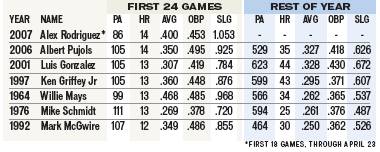
Before A-Rod this spring, only three hitters have hit more than 11 homers in April — Pujols, Luis Gonzalez, and Ken Griffey Jr. That number is partially a product of scheduling — Opening Day now arrives about a week earlier than it did prior to 1993, and two weeks earlier than it did in the late 1950s. Given that the Yanks still have six games to play before the calendar flips to May, setting the bar at 24 games provides a better gauge to measure Rodriguez against other hot starters in baseball history. Since 1957 (the earliest year for which game logs are continuously available), just six other players have managed 12 or more homers in the first 24 games:I followed that up with an expanded chart and an extensive set of A-Rod-related links in an Unfiltered post. The must-read is Tyler Kepner's New York Times piece discussing Rodriguez's work with new hitting coach Kevin Long, who's encouraged the slugger to swing at the first pitch more often, concentrate on the opposite field, and focus on keeping his head stationary.
As a group, this sextet averaged 35.2 homers the rest of the way, but none of them broke any records, and only two, Gonzalez and Griffey, are among the select group who have topped 50 homers in a year. However, the record-setters weren't too far off this pace — Mark McGwire hit 10 of his record-breaking 70 homers in the first 24 games of the 1998 season, while Barry Bonds hit 11 homers through 24 games in 2001, on his way to the current single-season standard of 73. (Previous recordholder Roger Maris had just three through 24 games in 1961, proving that a hot start isn't a necessity).
In all, 51 players besides Rodriguez have hit at least 10 homers in the first 24 games, including two others — Willie Mays in 1965 and Brady Anderson in 1996 — who hit at least 50. As a group, this bunch averaged 28.4 homers the rest of the way, with Bonds (62 in 2001) and McGwire (60 in 1998) pacing the field.

Like every Yankee fan, I'm excited to but guardedly optimistic about phenom Philip Hughes' debut tonight. One of my Baseball Prospectus colleagues was quite critical about the way the Yanks have handled this, charging that the Yankees were reacting rather than acting by noting that Chase Wright was recalled to prevent Hughes from being rushed. Said colleague came around to my way of thinking when I noted that in the time between Wright's recall and his four-homer drubbing, two things had happened. First, Hughes had put forth his best start in Triple-A (striking out 10 in six innings), washing away the mixed results which had preceded it. Second, the Yanks had been able to add him to the 40-man roster -- where Wright already resided, dictating the team's earlier choice -- without exposing another player to waivers. Humberto Sanchez's Tommy John surgery, lamentable though it is, allowed him to be shifted to the 60-day disabled list, which doesn't count in terms of roster slots. Got that?
In any event, as the roster arcana which has surrounded Hughes all year -- I'm one of those who advocated him not breaking camp with the club so as to prevent his service clock from starting, potentially giving him an extra winter under club control -- recedes into the distance, we'll get to watch perhaps the best pitching prospect in the minors take it to the grand stage of Yankee Stadium tonight. Here's hoping it lives up to the hype.
Labels: New York Sun, Unfiltered, Yankees
Friday, September 22, 2006
The Sox Come Unraveled, and Other Tales From the Bullpen
As September dawned, the Sox and Twins were running neck-and-neck for the Wild Card, apparently the only postseason vacancy remaining in the AL. Chicago held a half-game lead, but the [Baseball Prospectus Postseason] Odds report showed both teams holding a 50% shot of reaching October, either via the Central crown or the Wild Card. The remaining schedules favored Minnesota, with three more home games than the Sox and thehome-field advantage for a season-ending three-game series between the two clubs; at the imposing Metrodome, the Twins had gone 45–22.What happened is that both the offense and the pitching went down the tubes. Specifically, those injuries to Thome and Crede turned out to be much more detrimental than expected, helping the team's scoring rate fell off 36 percent this month (more than that, actually, since the Sox were shut out last night; Crede's slump has expanded to 0-for-25. The bullpen fell apart as well, yielding a 6.58 ERA (that increased last night, too) this month as Bobby Jenks (10.12 ERA, scored upon in four straight appearances) and Brandon McCarthy (19.29 ERA, scored upon in six out of seven appearances) dropped the ball. And while GM Kenny Williams did some good work over the winter in acquiring Thome, he tabbed the wrong rookie centerfielder to replace him, trading Chris Young to Arizona while keeping Brian Anderson, who's hit just 231/.301/.368. He passed up a deadline trade for Alfonso Soriano that would have cost them McCarthy but given the team the option of sliding slumping Scott Podsednik over to centerfield, where the offensive bar was lower.
Nonetheless, conventional wisdom showed reasons to favor the Sox. Not only did they have experience and the championship imprimatur on their side, they held a significant advantage at the training table.
In August, the Twins suffered a pair of devastating blows to their rotation. Brad Radke, who'd battled a torn labrum all season, left his August 25 start against Chicago after just two innings and was subsequently discovered to have a stress fracture in his shoulder. Worse, rookie Francisco Liriano, arguably the best pitcher in the league this year (even better than teammate Johan Santana), was limited to one start in August because of elbow soreness. By comparison, the defending champs were fairly healthy, save for a recent hamstring injury to slugger Jim Thome and intermittent problems with Joe Crede's back.
Yet the Sox are the ones who unraveled. Despite the Twins' injuries — Liriano is done for the year after an abortive return, while Radke may get one more start — Minnesota has raced to a 13–6 record this month, while Chicago has stumbled along at 7–12. What happened?
Anyway, the article is free, so don't be shy.
Meanwhile, I've got a couple of links to point out, stuff that's slipped through the cracks recently. First, there's my much-promised "Prospectus Hit List: A Brief History", which ran... wow, two weeks ago. Thanks to the number-crunching of Clay Davenport, BP now has Adjusted Standings data going back into the 19th century, data that will hopefully find its way to the site in due time. I had the pleasure of sifting through it to answer some of the burning questions readers have had: who's finished first most often (the Yanks, 22 times but not since 1998), what's the longest consecutive run at #1 (four years, by three different franchises, two of them Yankee dynasties), how often does #1 win the World Series (about half the time), how often does #1 miss the postseason completely, as the Indians did last year (just five other times), what the best and worst single-season marks of all time are, and what a composite all-time ranking of the 30 franchises would look like (a whole lot of New York at the top).
One issue my astute readers raised was that when I tallied how often various rankings reached the postseason and won the World Series, I lumped the three eras coinciding with different postseason structures (1901-1968, 1969-1993, and 1995-2005) together, generating some results which muddied up the picture. I'll be attempting to clear that up -- and getting to some of the other interesting facets about the data -- in an article to be named later, so to speak. Big thanks to Clay for running those numbers and to my trusty research assistant, Peter Quadrino, for his help.
Second, Alex Belth cited an old BP piece of mine, "The Claussen Pickle" in his examination of the current state of the Yankee farm system:
Instead of developing their own talent, they returned to the tactics that characterized George Steinbrenner during the '80s: trading their best chips for big-name, top-dollar veterans while breaking the bank in their pursuit of glitzy free agents. At the start of the 2005 season the Yankees' farm system was considered to be underwhelming, with no clear help in sight.The difference these days is due to GM Brian Cashman's consolidation of power in the front office, lessening the influence of Steinbrenner's Tampa mafia and exerting more control over scouting and player acquisition.
But nearly two seasons later, thanks to the breakout successes of Robinson Cano, Chien-Ming Wang and Melky Cabrera and a budding crop of farmhands, that perception couldn't be any more different from the truth.
"A year ago at this time, these Yankees seemed to be in a 'win now with this group' mode," says Pete Abraham, who covers the Yankees for The Journal News. "Now they have Cano, Cabrera and Wang as transition players with right-hander Philip Hughes, outfielder Jose Tabata and others on the way. There may be no letup."
Jay Jaffe wrote about the Yankees' farm system two summers ago in an article for Baseball Prospectus titled, "The Claussen Pickle," the upshot of which was that while the Yankees lost some good young players from 1994 to 2004, they didn't lose any Hall of Famers. Mike Lowell is the best position player the Yankees have traded in the past 10 years; perhaps Nick Johnson will surpass him one day.
Eric Milton, a No. 1 draft pick, helped land Chuck Knoblauch; Jake Westbrook and Zach Day fetched David Justice. However, "in the two years since that article was written," Jaffe explained recently, "it's even clearer that they've traded away players that were better than what they came up with for their secondary players. Juan Rivera, Marcus Thames or even Wily Mo Peña would have been superior to Ruben Sierra or Bubba Crosby on last year's team."
On that note, last week the New York Post's Joel Sherrman had a complimentary article on Cashman and his crosstown counterpart Omar Minaya's strong work in the dumpster-diving department this year. For the Yankees, that's included picking up OF-1B Aaron Guiel (let go by the Royals), starting pitcher Darrell Rasner (waived by the Nationals) and reliever Brian Bruney (cut by the Diamondbacks), who's pitched so well that he's a lock for the playoff roster. Bruney, who can hit 97 on the gun but had an ERA above 6.00 in his Arizona tenure (the Times has an excellent piece on his saga today), has given the Yanks the fresh power arm that they thought they were getting when they signed Octavio Dotel coming off of Tommy John surgery, but the performances are night and day:
IP H ERA K/9 K/BB WXRLThat fresh arm is crucial to the Yanks because Scott Proctor leads the AL in relief appearances (79) and innings (98), Mariano Rivera has missed the past three weeks, and overall, the Yankee bullpen has been worked much harder than any of the other AL contenders. From Buster Olney's piece on Wednesday:
Bruney 17 11 0.53 12.71 2.40 0.374
Dotel 8 13 10.13 7.88 0.70 -0.462
B2B #PThe first column is the number of times the Yanks have run a pitcher out there in back-to-back games. The second is the total number of pitches thrown by the bullpens this season (both figures through Tuesday). As you can see, it isn't even close; Yankee relievers have been ridden harder. Not surprisingly, they've performed worse as well. Baseball Prospectus' WXRL stat (Reliever Expected Wins Added), which measures the increment by which a pitcher increased (or decreased) his team's chances of winning in each plate appearance, shows the A's bullpen leading the AL with 14.345 wins, the Twins a close second at 14.216 (the two have flip-flopped since I wrote that Sun piece), the Tigers fifth (10.257) and the Yanks sixth (9.706). The Yankee bullpen has tossed 478.1 innings, 19 more than the Twins, and 50 more than the TIgers and A's, and their Fair Run Average (which divvies up responsibility for inherited runners according to a run expectancy table) is 4.81, considerably higher than the A's (4.43), Twins (4.34) and Tigers (4.11) as well.
Yankees 128 8078
Oakland 110 7128
Minnesota 79 6954
Detroit 57 6713
As past experience has shown, a sharp pen is a key to October. Ask the soon-to-be-former champion White Sox about that when you get a chance.
Labels: New York Sun
Tuesday, October 25, 2005
Rocket Redux Revisited
It's a topic I've addressed before, first in response to a column by Salon's King Kaufman back in the summer of 2004. Kaufman and I went a couple of rounds on the topic and while we never did reach complete agreement, our exchange was friendly enough that he kept me in mind to pinch-hit for him back in August.
Since our sparring, Clemens has lengthened his list of postseason lowlights, capping it with Saturday night's start, which saw him pulled after two innings and three runs allowed, the strained hamstring he's been dogged by over the last two months aggravated by running to cover first base. Here are the greatest misses I included for the article (the first of which was edited out due to space reasons):
• 1986 World Series Game 6 (Red Sox-Mets): One win away from Boston’s first championship since 1918, Clemens pitched solidly and held a 3-2 lead through seven innings. Sox manager John McNamara pinch-hit for him with one out and a man on second in the eighth, later claiming that Clemens asked out due to a blister (a charge Clemens denied). The Sox bullpen, with an assist (or rather a lack of one) from Bill Buckner, lost the game and the Mets took Game Seven.Of course, Clemens does have his October successes, such as the 1999 World Series clincher (a game I attended), the pair of thorougly dominant starts in the Yanks 2000 title run which sent Alex Rodriguez sprawling and Mike Piazza ducking for cover via a combined 24 strikeouts, three hits and no runs allowed over 17 innings, and his dramatic three-inning relief stint to close out that 18-inning epic and the Braves season. But on the whole, his postseason stats don't measure up to his regular season record. In 33 starts -- a season's worth -- here's the comparison:
• 1990 ALCS Game 4 (Red Sox-A’s): A flustered Clemens is ejected in the second inning for swearing at the home-plate umpire after loading the bases with a walk. At the time, Oakland leads the series 3–0; Clemens’s replacement, Tom Bolton, is greeted with a two-run double as the A’s complete the sweep and the Rocket takes the loss.
• 1999 ALCS Game 3 (Yankees-Red Sox): Returning to Fenway in the enemy’s pinstripes, Clemens is hammered for five runs in two-plus innings, much to the Boston boo-birds’ delight. The Yankees lose 13–1, their only postseason defeat en route to their second straight World Championship.
• 2003 ALCS Game 7 (Yankees-Red Sox): Having already announced his retirement, Clemens looks headed for the showers for good after being battered for four runs in three-plus innings. But the Yankees wait out Pedro Martinez, tie the game in the eighth after Sox manager Grady Little leaves his tired ace in too long, and the Yanks win the pennant in the 11th inning on Aaron Boone’s home run.
• 2003 World Series Game 4 (Yankees-Marlins): Boone’s homer earns Clemens another chance that he nearly blows, yielding a three-run homer to Miguel Cabrera in the first.Clemens guts out seven innings without allowing another run; the Yanks tie the score but lose the game in 12 innings and the series before Clemens can get another shot.
• 2004 NLCS Game 7 (Astros-Cardinals): Taking a 2–1 lead into the sixth, the Rocket runs out of fuel as the Cardinals rally for three runs, snatching Houston’s first-eve pennant out from under them.
GS W-L IP IP/GS K/9 K/BB ERA Lg R/GOn the whole, Clemens has allowed more runs in a lower-scoring environment, lasted fewer innings, and showed decidedly less dominance. "Lg R/G "in the chart is the unadjusted, unweighted scoring level of the leagues he's been in (1984-2003 AL, 2004-2005 NL, and all games from the eleven postseasons in which he's participated). In retrospect that number probably should have been weighted by Clemens' innings, but the Sun editor cut it anyway.
reg. season* 33 17-8 231.1 7.0 8.6 2.9 3.12 4.75
postseason 33 12-8 196.2 5.9 7.9 2.5 3.71 4.31
*per 33 starts
In any event, despite the spotty track record, Clemens has performed particularly well in the World Series, even including Game One: a 2.37 ERA in eight World Series starts, with 49 strikeouts, 12 walks and just two homers allowed in 49.1 innings. That he's got only a 3-0 record to show for his trouble is the real issue: he doesn't last very long, firing his bullets early and leaving the rest of the work to the bullpen. As with Mariano Rivera in Game Seven of 2001 World Series, that doesn't always work out for the best.
The other myth to dispel about Clemens is that at least for the Yankees, his postseason record was better than his regular-season accomplishments. In 17 pinstriped starts, he allowed a 3.24 ERA and an 8.82 K/9, winning two World Series rings; with the other two teams, his ERA is 4.19, his K rate is 6.89, and he's still looking for a championship. Note that the bulk of complaints about his playoff shortcomings come from aggrieved Boston fans (such as this sniveler) amid the Red Sox 86-year wait for a championship, and entitled Yankee fans expecting no less than one per year. Note also that 38 percent of his postseason innings have come after his 40th birthday, and that Clemens has often hit the postseason at well less than 100 percent; recall the groin problems which dogged him in 2001 and of course, this year's hammy woes.
None of which exactly an excuse; the objective record shows that one of the all-time greats hasn't been so great in the postseason. What Clemens has been is decidedly human, a more sympathetic figure than the adrenalized intimidator who's racked up 341 wins (ninth all-time), 4,502 strikeouts (second all-time), and a record seven Cy Young Awards (with an eighth a legitimate possibility after his league-leading 1.87 ERA). There are worse lessons to be drawn from our superstars than that.
• • •
Even with Clemens' abbreviated start, Game One turned out to be a tight contest, with the Astros clawing back to tie the game after both of the Rocket's less-than-spotless innings. It was something of a miracle that despite reliever Wandy Rodriguez -- the poster child of a replacement-level pitcher -- allowing four hits and five walks over 3.1 innings, the White Sox could only add a single run on Joe Crede's homer, keeping the game close until the late innings.
But that's where the Astos' plan broke down, and it's the reason I told anyone who asked me that I was picking the White Sox to win the Series in six games (a length it may not achieve). The Astros have a good bullpen, but it's not a deep one, and manager Phil Garner is too rigid in his roles. Closer Brad Lidge, though still smarting from Albert Pujols' game-winning monster shot in Game Five of the LCS, should have been on hand to protect that 4-3 deficit rather than Chad Qualls and Russ Springer, the latter of whom yielded the Sox a fifth run. But since it wasn't a save situation, Garner went with his lesser relievers, and he paid the price.
The same thing happened in Game Two, which was a bona fide fall classic befitting the Fall Classic. With a 4-2 lead but two men on base in the seventh inning, 'Stros setup man Dan Wheeler got jobbed when an inside pitch that deflected off of Jermaine Dye's bat was ruled a hit-by-pitch -- yet another example of the shoddy umpiring that's been all-too-common in the postseason -- to load the bases with two outs. For the game's most important situation -- nay, the season's most important situation -- Garner shifted from his second-best reliever to his third-best in Qualls, and Qualls' first pitch traveled over 400 feet off the bat of Paul Konerko for a grand slam. Here's what Baseball Prospectus' Joe Sheehan had to say:
Konerko hit a first-pitch cookie from Chad Qualls, who you could argue was only in the game because 35 years ago, a scoring rule was invented to credit relief pitchers who got the last out in wins. With the bases loaded, a two-run lead and the other team's best hitter up, you would think you'd want your best reliever in the game. Phil Garner--who'd used Lidge to get out of a similar seventh-inning jam in the 2004 Division Series--went with his third-best reliever, and paid the price.In spite of all that, the Astros rallied to tie the game at 6-6 on what looked like another dubious choice, when Garner tapped Jose Vizcaino, a career .271/.318/.346 hitter, to pinch-hit for Adam Everett while lefties Mike Lamb (.274/.329/.412) and Orlando Palmeiro (.277/.355/.356) sat by idly. Vizcaino drove in two runs off of Bobby Jenks, with Chris Burke boldly running on Scott Podsednik's weak arm and executing a perfect slide and hand-touch of home plate just out of reach of catcher A.J. Pierzynski.
I recognize that using your closer in the seventh inning is a highly unusual tactic, and with other effective relievers at his disposal, perhaps doing so would be too much to expect of Garner. But when you consider the leverage of the situation--not just the game, but how important this batter was to the World Series--it's hard for me to not see this as yet another example of how the save rule has corrupted bullpen usage. From the dawn of the use of relief pitchers as weapons through the mid-1980s, a team would have used their best reliever to pitch in that situation. They had it right, and we, in modern baseball, have it wrong.
Garner called on Lidge at that point, and his ace reliever took one step closer to becoming the new Byun-Hyung Kim when he allowed a game-winning shot to Podsednik, who didn't homer in 568 regular-season plate appearances but now has two dingers in October. D'oh!
It wasn't as though Garner calling on his closer at that point was the wrong move, just that he could have made a better one to protect the lead while he still had it, regardless of the inning. By contrast, Sox manager Ozzie Guillen showed more flexibility and less attachment to roles when he pulled his nominal closer, Bobby Jenks, after Vizcaino's suprising single. In came southpaw Neal Cotts, getting the platoon advantage on pinch-hitter Lamb, who flied out to end the threat. With an admittedly deeper bullpen than the Astros have, Guillen has shown himself willing to play to that strength while avoiding being typecast as a LaRussa-esque micromanager. Ultimately, that -- and four home runs accounting for seven of Chicago's 12 runs -- is a bigger part of the reason the Sox have a 2-0 Series lead than any small-ball antics.
Speaking of which, last Wednesday featured a surreal Dan Le Batard article in the Miami Herald in which Guillen revealed himself an adherent to santeria, a religion which features animal sacrifice. "You bleed, I'm there," quipped the ever-controversial Sox manager. As one BPer put it in, "Sacrifices, eh? That small-ball thing really is pervading his whole life."
I'm still laughing at that one.
Labels: New York Sun
Tuesday, September 20, 2005
Double Decker Day
In writing about the Indians, I've gotten very absorbed in their story -- the rebuilding, the low payroll, the 33-11 (or whatever) streak they've been on to cut the White Sox lead from 15 to 2.5 games in seven weeks' time, the development of Grady Sizemore, Coco Crisp, Jhonny Peralta et al. I despise Sox manager Ozzie Guillen's brand of bullshit enough that while my head tells me to root for the Sox to the Yankees' benefit, my heart tells me a Sox collapse and Indians rise is a much better outcome, both a better story and a better example to the game. That Indians' GM Mark Shapiro has done this on a $41.5 million Opening Day payroll (26th out of 30 teams) with an offense spearheaded by five players who are among the top four in the AL at their positions, VORP-wise, and make a combined total of $1,999,900 is something more people -- fans, execs and analysts -- need to recognize. Memo to Joe Morgan: stick this slice of Moneyball in your piehole, bitch.
Last night was a great time to be following all of this stuff. The Yanks came back from down 2-0 to win on a walk-off homer by Bubba Crosby, who had exactly one extra-base hit all year. With an economy and a flair for the dramatic worthy of Barry Bonds, Bubba turned on a pitch in his happy zone and crushed it about 425 feet. He stood admiring it at home plate for a long moment before raising his fist in the air and rounding the bases triumphantly. The jubilation with which he was greeted by the senior Yankees in the dugout was one of those feel-good moments that have become all too rare as the Torre dynasty creeps along on its last legs. Meanwhile, the Red Sox were falling to the Devil Rays on the GameCast, and the Indians were recovering from having blown a 4-0 lead to take one from a White Sox bullpen performance straight out of the Creeping LaRussaism handbook -- four pitchers, four outs. Even mindful of Chicago's injury woes, I can't stand seeing that kind of micromanaging rewarded, so bully for Cleveland.
At this point I have to say that I'm done kvetching about the Wild Card and its negative impact on the game. The fact that so many teams carried hope into September is a great thing even if most of them will drop an axle like the Mets or Nationals somewhere along the way. Circle of life, kids, just like when the bunny rabbit gets eaten by the mountain lion. The fact that the six-team AL race is going to end in heartbreak for at least two of those teams is great drama, even -- hell, especially, in the big picture -- if one of them is the team in pinstripes. I'm not rooting against the Yanks, who are on a 9-2 run that's cut their deficit in the AL East to a half-game, But for the next six weeks, I'm determined to enjoy this one as a baseball fan -- maniacally following three games at once -- first, and a partisan second.
Labels: New York Sun
Tuesday, August 16, 2005
Brave New World
Last week, Baseball Prospectus published my study of the Braves' track record in trading prospects, today comes my piece in the New York Sun about this year's rookie class, most notably Jeff Francoeur, the 21-year-old sensation who's hitting .382/.394/.745 with nine home runs through his first 28 games (including one in his debut) and has already reeled off an 11-game hitting streak, helping the team to snatch first place from the Washington Nationals. Francoeur was BP's 27th-ranked prospect in our annual Top 50 Prospect list, celebrated for his ample power and excellent defense but downgraded slightly for a lack of plate discipline. True to form, he has yet to draw a walk, but nobody's complaining. Instead, they're comparing his "hack and whack" approach to that of Vladimir Guerrero, the reigning AL MVP. Francoeur strikes out considerably more than Vlad the Impaler -- 76 in 84 games at Mississippi, 19 in 28 games in Atlanta, compared to 36 in 97 games for the Angels' slugger -- but it's tough to argue with the results. After a little over a month of play, his Value Over Replacement Player (VORP) now stands at 19.2 runs, second among NL rookies and fifth among Braves hitters. You might as well hand him the hardware right now.
According to VORP, the Braves are getting more production from their rookies than any other team besides Oakland (the Sun cut the chart, but I'm not about to let my data-mining go to waste):
Team Rook Hit Rook Pit Total Rook%PA and %IP are the percentages of the team's total plate appearances or innings pitched used by rookies. All told, the average team is getting 18.9 runs above replacement from their rookies. If you're looking for a reason the A's have been kicking ass instead of rolling over as the Beane-haters expected them to, look no further.
VORP %PA VORP %IP VORP
OAK 35.0 14.8% 56.5 23.2% 91.5
ATL 43.5 35.1% 22.9 17.4% 66.4
TOR 31.9 15.1% 29.0 17.0% 60.9
COL 49.8 45.2% -9.2 25.6% 40.6
TBA 34.4 15.0% 4.4 26.5% 38.8
MIN 3.9 9.6% 33.4 11.4% 37.3
PIT 23.4 21.3% 12.2 7.3% 35.6
SEA 10.4 20.4% 19.0 8.0% 29.4
ANA 8.7 9.7% 18.7 14.2% 27.4
MIL 19.2 13.3% 5.5 6.2% 24.7
NYN 10.8 3.7% 12.8 8.3% 23.6
SFN 10.2 17.0% 12.7 12.1% 22.9
WAS 12.6 8.3% 4.7 6.2% 17.3
CHN 9.9 6.5% 7.2 19.4% 17.1
CHA 19.9 13.0% -3.0 3.7% 16.9
PHI 8.0 4.6% 5.7 8.8% 13.7
NYA 7.6 10.2% 4.5 12.9% 12.1
KCA 0.7 14.5% 11.1 22.1% 11.8
DET -0.8 2.2% 11.3 5.1% 10.5
BAL -0.6 2.2% 8.4 7.8% 7.8
CLE 0.6 0.9% 7.1 2.1% 7.7
TEX 0.2 1.4% 2.9 22.9% 3.1
SDN -2.8 1.3% 5.5 12.0% 2.7
ARI -4.2 10.1% 5.8 28.7% 1.6
SLN -4.5 6.3% 3.1 8.4% -1.4
CIN -6.4 3.4% 1.8 15.4% -4.6
BOS -3.4 0.6% -4.1 1.4% -7.5
HOU -5.9 22.6% -6.0 20.0% -11.9
LAN -3.5 18.5% -9.8 20.1% -13.3
FLO -4.5 4.3% -12.1 7.6% -16.6
For the most part, the rookies, even those of the Braves, are producing at rates below other players, which stands to reason because many of them define the replacement level concept. Across the 30 teams, rookie hitters have produced 5.6 percent of the total hitting VORP in 11.5 percent of the total plate appearances, while rookie pitchers have produced 7.1 percent of the total pitching VORP in 13.4 percent of the total innings. Rookie Braves hitters have produced 29.7 percent of the team's hitting VORP in 35.1 percent of the PAs, while for rookie Braves pitchers, its 11.9 percent of the VORP in 17.4 percent of the innings. That's a significantly better yield.
Even at less-than-efficient yields, the young Braves' contributions have come in handy. From the article:
Into the breach stepped a handful of homegrown rookies, who have improbably led the team to a 32-18 record since June 16. In the outfield, Ryan Langerhans and Kelly Johnson have combined to hit 240 BA/.327 OBA/.398 SLG- hardly earthshaking, but still better than the lifeless .231/.283/.345 combined performance of [Raul] Mondesi and [Brian] Jordan. At third base, Wilson Betemit has hit .296/.355/.451 in place of [Chipper] Jones, who has missed 50 games with injuries. Catcher Brian McCann, recalled when backup Eddie Perez went on the DL, has hit .280/.350/.419, and with starter Johnny Estrada now sidelined by a cervical strain, he's the new regular. Kyle Davies has put up a 4.56 ERA in 14 starts, proving himself a reasonable stopgap for a desperate team. John Foster and Blaine Boyer have provided solid middle relief, allowing the bullpen to be reshuffled to cover for [Danny] Kolb's woes.The rotation's injuries -- to Mike Hampton, Tim Hudson, and John Thomson -- are part of the reason the team ranks fourth in salary lost to the DL, $15.6 million through last Friday, 18.4% of the team's payroll (the Giants, with Sir Douchealot sidelined, lead at $27.2 million, the Dodgers are second at $25.1 mil, the Yanks fifth at $15.4 mil). They're only 24th in days lost to the DL, with 408 (the Nationals and Mariners have both lost over 1100), so it's really been a matter of losing quality over quantity. Thanks to BP's Mike Groopman for supplying the data, which (sigh) also got left on the cutting room floor of the Sun piece.
And so long as I'm giving y'all a bonus disc of outtakes, here's how the current Braves crop stacks up against their past classes of rookies during their post-1990 run:
Year hVORP pVorp Total Top Rookie (VORP)The scary thing about that list is that not only is Francoeur going to pad that number considerably but that it includes a negligible contribution from BP's #1 top prospect, Andy Marte, who figures to take over the third base job sooner or later. The Braves are well-stocked for the future.
2005 42.3 23.9 66.2 Jeffrey Francoeur, RF (19.2)
1999 11.2 45.9 57.1 John Rocker, P (26.0)
1994 45.9 0.8 46.7 Ryan Klesko, LF (22.1)
1997 20.6 24.8 45.5 Tony Graffanino, 2B(11.5)
2002 -10.3 50.9 40.6 Damian Moss, P (28.1)
1998 -3.4 41.6 38.1 Kerry Ligtenberg, P (21.4)
1993 6.5 30.1 36.7 Greg McMichael, P (32.6)
1995 23.6 12.3 35.9 Chipper Jones, 3B (28.0)
2001 16.7 16.5 33.2 Jason Marquis, P (20.2)
1996 1.6 26.4 28.0 Terrell Wade, P (16.8)
2004 21.9 1.3 23.3 Adam Laroche, 1B (19.1)
2003 0.5 21.4 21.9 Horacio Ramirez, P (21.5)
2000 21.6 -1.4 20.2 Rafael Furcal, SS (37.0)
1992 -1.4 13.4 12.0 David Nied, P (9.4)
1991 11.3 -0.8 10.6 Brian Hunter, 1B (8.8)
Even the prospects they've traded have helped the team:
Three such trades in which Schuerholz gave up unproven talent have been crucial to patching this year's staff. Last spring, Chris Reitsma was acquired from the Reds for two pitchers, and after a year of middle relief, he's taken over the closer role from Kolb. This spring, the Braves sent second baseman Nick Green to Tampa Bay for Jorge Sosa, who had yielded a 5.14 ERA in three seasons of Devil Ray purgatory. He started the year in the bullpen, where he was issuing more walks than strikeouts. But since being forced into the rotation, Sosa has been more than solid, allowing a 2.77 ERA in 12 starts while posting a passable 1.81 K/BB ratio. And at an otherwise quiet trading deadline, Schuerholz pulled off one of the few notable deals, sending rookie pitcher Roman Colon and minor-leaguer Zach Miner to acquire hard-throwing setup man - and likely future closer - Kyle Farnsworth from the Tigers.It's actually been something of a rocky ride with Reitsma (3.56 ERA, 6 blown saves out of 21) but the larger point stands. If you want an organization that knows how to reap the rewards of its farm system, look no further than the Braves.
Labels: New York Sun
Archives
June 2001 July 2001 August 2001 September 2001 October 2001 November 2001 December 2001 January 2002 February 2002 March 2002 April 2002 May 2002 June 2002 July 2002 August 2002 September 2002 October 2002 November 2002 December 2002 January 2003 February 2003 March 2003 April 2003 May 2003 June 2003 July 2003 August 2003 September 2003 October 2003 November 2003 December 2003 January 2004 February 2004 March 2004 April 2004 May 2004 June 2004 July 2004 August 2004 September 2004 October 2004 November 2004 December 2004 January 2005 February 2005 March 2005 April 2005 May 2005 June 2005 July 2005 August 2005 September 2005 October 2005 November 2005 December 2005 January 2006 February 2006 March 2006 April 2006 May 2006 June 2006 July 2006 August 2006 September 2006 October 2006 November 2006 December 2006 January 2007 February 2007 March 2007 April 2007 May 2007 June 2007 July 2007 August 2007 September 2007 October 2007 November 2007 December 2007 January 2008 February 2008 March 2008 April 2008 May 2008 June 2008 July 2008 August 2008 September 2008 October 2008 November 2008 December 2008 January 2009 February 2009 March 2009 April 2009 May 2009 June 2009 July 2009 August 2009 September 2009 October 2009 November 2009 December 2009 January 2010 February 2010 March 2010 April 2010 May 2010

Subscribe to Posts [Atom]