The Futility Infielder
A Baseball Journal by Jay Jaffe I'm a baseball fan living in New York City. In between long tirades about the New York Yankees and the national pastime in general, I'm a graphic designer.Monday, April 19, 2010
Ballgame Barbie She Ain't: Emma Span's 90% of the Game is Half Mental
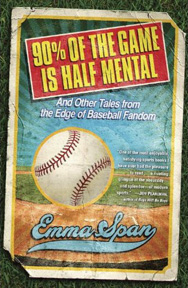
A native of suburban New Jersey who grew up a Yankees fan and came of age early in the Torre dynasty, Emma's currently a regular Bronx Banter contributor as well as the occasional keeper of her own well-named blog, Eephus Pitch (disclosure: I have been known to quaff the odd beer and/or attend the occasional ballgame with Ms. Span and am pleased to report she is delightful company for either endeavor. Also, I am partial to books which borrow their titles from Yogi Berra aphorisms).
As with most fans, male or female, working inside the game was hardly her first calling. As her story goes, after majoring in film studies at Yale, Emma faced the harsh reality of a liberal arts education that could take her only so far, in this case to a dead-end job writing blurbs for dubious direct-to-video titles like Titaboobs Paradise and Stanley the Stinkbug Goes to Camp. Her adventures inside the game began when she caught a break and had the opportunity to cover the 2006 Mets' playoff run for the Village Voice, a venerable alternative weekly rarely known for its sports coverage even as it's gone more mainstream (though Allen Barra heyday for Jockbeat was notably worthwhile). Her run at the Voice was brief — she was laid off after returning from a two-week trip to Florida to cover spring training the following year — but nonetheless long enough to confront the necessity of cultivating a sense of professional detachment from her rooting interests. Along the way she gathered some keen and often hilarious insights into working behind the scenes. Particularly notable is her jaundiced take on Shea Stadium and her introduction to the locker room etiquette of being a female sportswriter — segments of which put a recent Varsity Letters audience in stitches:
I don't really want to pile on Shea, because there's a long line. I heard at least seven or eight different sportswriters experess their eagerness to be the one pushing the plunger when demolition day finally came. (They were all disappointed, as Shea was reduced to rubble slowly and in pieces). But also because, in this age of cookie-cuter nostalgia-fest stadiums, I grudgingly admired Shea's unique ugliness. The place had character — sort of a disagreeable character, but character — and that ought to be worth something. It was a reminder of changing times; Shea was completed less than fifty years ago, in 1964, yet it is now impossible to imagine a scenario in which anyone could look at those blueprints and think, Good idea.After being laid off, Emma turned her energy towards a book project covering the Yankees' and Mets' 2007 seasons in the hope that they would culminate in a Subway Series. Her travels took her well beyond New York, most notably to Milwaukee in the hopes of witnessing Tom Glavine's 300th win as well as the famous sausage race (a topic on which I can claim expertise), and to Taiwan to investigate the state of its professional baseball league as well as the iconic status of Chien-Ming Wang, and the accompanying rabidity of the Yankees' following. Alas, while the Bronx Bombers made the playoffs for the umpteenth straight time (only to eventually be doused by a swarm of midges), the Mets' campaign ended when Glavine crashed and burned on the season's final day.
... On my first day I'd been in the clubhouse less than an hour when Pedro Martinez walked in and started changing by his locker. I wanted to go over and talk to him — ask him a question if I could get up the nerve, or at least listen in to a group session. But I figured I would wait until he got some pants on. It seemed lie the polite thing to do, probably the course of action Emily Post would suggest.
I shifted my weight from one leg to the other and fiddled with my pen; Pedro gave interviews cheerfully and joked with his teammates in Spanish. I glanced over super-briefly, so as not to get too good a look at anything, every few minutes. Pedro really not in a hurry to put on his pants, reads an exasperated scrawl in my notebook from a good twenty minutes later, really underlined three times. Eventually he wandered into the trainer's room, pants still nowhere in evidence.
Emma's plans for that book evolved into 90%, and while the effort to repurpose her tales into a first-person case study on the nature of fandom could have just as easily gone down in flames as that fateful Glavine start, it doesn't. She's a sharp, quick-witted observer with a facility for extrapolating from her own experiences into a more general contemplation of the silly and serious investments we make as fans, often with engaging amounts of self-deprecating humor. She's clear-eyed about the Yankees' excesses, sympathetic to the Mets' inferiority complex, and willing to play both sides of the fence even at the risk of committing baseball polyandry.
As a woman writing about a game played — and largely covered, and followed — by men (or perhaps more accurately, overgrown boys), Emma inevitably confronts the gender divide at several turns, but her light touch ensures that the topic hardly wears out its welcome. Nowhere does she wind up needing to apologize for any deficit of understanding on account of her femininity; she doesn't cower in fear of scorecards or Baseball Prospectus' advanced metrics, nor does she turn into Ballgame Barbie, more concerned with fashion sense and celebrity gossip than batting orders. Yet she doesn't strain to be one of the boys, either. Instead she simply turns her unique perspective into an asset, emerging with a work that's tough to put down until you've sailed through its 166 pages. Male or female, if you've had the chance to read her work at Bronx Banter, the Voice, or her own site, you know this already. If not, you're in for a treat.

Wednesday, February 17, 2010
Jim Bibby (1944-2010)
Bibby's best years came with the Pirates, particularly the "We Are Family" World Champions of 1979 with the Stargell Stars on their goofy train conductor hats. How could a nine-year-old kid not fall for that team?

Bibby's shining moment on the diamond came during Game Seven of the 1979 World Series. Pitching for the Pirates on three days' rest, he yielded just one run in four innings before nervous nellie manager Chuck Tanner pulled him for a pinch-hitter, trailing 1-0. Willie Stargell connected for a two-run homer in the sixth, and the Pirates' bullpen — Don Robinson, Grant Jackson and Kent Tekulve — shut out the Orioles for the final five innings, in marked contrast to their self-immolation during Bibby's previous start, a 6.1-inning, 3-run, 7-strikeout effort whose squandering put the Bucs in a 3-1 hole. Bibby earned his World Series ring.
Bibby had a hard road to the majors. A free agent signing by the Mets in 1965, he served a two-year stint in Vietnam and missed a year due to spinal fusion surgery before being traded to the Cardinals in an eight-player deal in 1971. He was nearly 28 years old by the time he reached the majors, but stuck around for 12 seasons with the Cards, Rangers, Indians and Pirates. Best known for his heater, of which his control was only sporadic, he threw the first no-hitter in Rangers history on July 30, 1973. His 19-19 record in 41 starts the following year certainly stands out, but it was in 1980 when he really put it all together, going 19-6 with a 3.32 ERA, earning All-Star honors and placing third in the Cy Young voting.
Bibby was the object of an unforgettable passage in Mike Shropshire's Seasons in Hell, a gonzo account of the 1973-1975 Rangers under Whitey Herzog and Billy Martin which I declared to be "the funniest baseball book of all time" a few years back. Craig Calcaterra of Hardball Talk puts it all together. Suffice it to say that Jim Bibby will be remembered.
Update: Great stuff from Joe Posnanski on Bibby here, including his remembrance of Bibby's time with the Indians, and this bit on Bibby's 1974 season:
That year, Bibby won 19 games with a horrifically bad 75 ERA+. Nobody in baseball history has ever won that many games with a sub-80 ERA+. How did he do it? Well, for one thing, he lost 19 games, too. But, more to the point, he simply was great some days, awful on others.
In his 19 victories, he had a 2.50 ERA and the league hit .194 against him.
In his 19 losses, he had a 9.23 ERA* and the league hit .359/.443/.589 against him. To give you an idea of just how awful this, the league leading core numbers were .364/.433/.563 (Carew/Carew/Allen)...
• In his first six starts, Bibby was 4-2 with a 3.05 ERA and four complete games, including a shutout.
• In his next six starts, Bibby was 1-5 with an 8.07 ERA, and in the game he won he allowed nine runs in eight innings.
• In his next six starts (you getting the pattern?), Bibby was 5-1 with a 2.44 ERA and had two shutouts.
• In his next six starts (it's amazing how this is working), Bibby was 1-4 with a 5.91 ERA -- he actually pitched well in a couple of those games, but he did not make it out of the second inning in either of his first two starts of the stretch.
• Then he threw a shutout at Yankee Stadium.
• Then he went 3-2 with a 7.86 ERA in his next five outings.
• Then he threw a shutout against Detroit.
And so on.
It's a remarkable season. The rest of his career was not quite so up and down, not quite the same blend of brilliant and disastrous. But Jim Bibby always seemed to carry a part of 1974 with him... it seemed like most days when he went out there to pitch, a team would say "Oh man, we don't stand a chance tonight." Trouble is, you never knew which team.
Thursday, February 11, 2010
Say Hey, Kid!
Though too young to have seen him play, I'd already read books about Mays, and heard stories about his legend from my father and grandfather. By then I knew that he'd hit 660 home runs in his career, less than only Hank Aaron and Babe Ruth, pretty good company, that he'd made the most famous catch in baseball history, and that he was known as the Say Hey Kid. I took the one Mays card I owned at the time, a 1973 Topps* showing an aged Mays near the end of his career wearing the foreign, pinstriped uniform of the Mets. The card was handed down from my cousin Allan, who bestowed upon me a couple thousand such cards in the 1966-1975 range, including some very valuable ones.

*Though autographed, this is not a scan of card from my collection, merely an image found on Google.
I stood in line for what seemed like an eternity to ask Mr. Mays for his autograph. When I did, he obliged disinterestedly, not even making eye contact or breaking his conversation with whichever adult it was he was talking to, barely nodding an acknowledgment when I thanked him. Honestly, I wasn't terribly bothered, though. It was WILLIE MAYS! Though none of my card-collecting peers believed the autograph was legit – "You probably just got your baby brother to scribble on your card!" — I knew that it was, and I still have that card. It's in a plastic sheet on the front page of a light blue three-ring binder in the closet of my childhood bedroom in Salt Lake City, right next to a few Hank Aarons and a Jim Bouton. The best of my best.
Mays is back in the news, making the rounds thanks to an authorized biography that just came out, Willie Mays: The Life, The Legend by James S. Hirsch, published by Scribner. The 628-page book is something of a coup, marking the first time the 78-year-old legend has ever cooperated with a biographer*. The early reviews haven't been glowing, suggesting the book gets a bit bogged down in the details, but for a player as monumental and enigmatic as Mays, a closer look is merited. Breaking into the majors in 1951, the man battled racism and brought an inimitable style to the majors, becoming arguably the best all-around player the game has ever seen. I received my review copy in the mail last week, and I'm dying to sink my teeth into it. I'll report back when I do.
*update: Allen Barra begs to differ on that score, though Hirsch defends the distinction, and Bruce Weber, who repeated the claim in long piece for the New York Times, backing him up.
In the meantime, on Wednesday night Mays made an appearance on The Daily Show with Jon Stewart. Check out Stewart and the Say Hey Kid talking about his days playing in Trenton (where he started his pro career, hitting .353 in 81 games in 1950), how many homers he might have hit if he hadn't missed two years due to military service, and how he had to room with the son of manager Leo Durocher as a rookie:
Labels: books, memorabilia
Wednesday, February 10, 2010
Some Dodger Thoughts

Earlier this month, my pal Jon Weisman migrated his great Dodger Thoughts blog from the Los Angeles Times to the new ESPN Los Angeles family. Among his first posts is one which directly involves me. Jon is the editor of the forthcoming Dodgers 2010 Annual from Maple Street Press, the same folks who publish Bombers Broadside, to which I contributed for the 2007 and 2008 editions. Here's Jon's rundown of the contents of the glossy 128-page book:
It's quite a star-studded cast, and I'm honored to be part of it. Maple Street Press is also doing annuals of the Yankees, Red Sox, Twins, Phillies, Mets, Mariners, Cubs and Cardinals, and via the Twitscape, it sounds as though at least some of those books are already shipping. Each one goes for $12.99.Amid Turmoil, Hope (2010 season preview), by Chad Moriyama of Memories of Kevin Malone So Close, Again (2009 season in review), by Eric Stephen of True Blue L.A. Manny Be Good? (What to expect from Ramirez in 2010), by Jay Jaffe of Baseball Prospectus Disorder In McCourt (an analysis of the impact of the McCourts' divorce) by Joshua Fisher of Dodger Divorce State Of The Stadium, by Eric Stephen of True Blue L.A. One Out Away (Jonathan Broxton looks to recover from another disappointing finish), by Mike Petriello of Mike Scioscia's Tragic Illness Critical Campaigns (James Loney and Russell Martin), by Mike Petriello of Mike Scioscia's Tragic Illness The Collected Colletti (a Q&A), by Josh Suchon of KABC AM 790 Aces Are Wild Cards (The last word on No. 1 starters), by Eric Enders, baseball historian Prospect Park (Top 20 prospects in the Dodger farm system), by Dodger prospect expert Richard Bostan Individually Packaged (how the Dodgers develop young arms), by Josh Suchon of KABC AM 790 No Minor Hopes (life in AAA), by Albuquerque Isotopes play-by-play announcer Robert Portnoy One In A Trillion (a Vin Scully retrospective), by Dodger team historian Mark Langill Unsung Heroes (key contributions from unexpected sources), by Bob Timmermann of The Griddle and One Through Forty-Two or Forty-Three Sweep And Low (the end of the 1980 season), by Dodger Thoughts commenter BHSportsGuy The Great Dividers (the 20 most controversial Dodgers of the 2000s), by Jon Weisman
Elsewhere at Dodger Thoughts' new home, Jon's got a lengthy, must-read piece for which he interviewed embattled Dodger owner Frank McCourt one-on-one for an hour, discussing the controversies that have embroiled the team in recent months — the divorce proceedings between the owner and wife/former team CEO Jamie McCourt, the decisions not to offer arbitration to free agents Randy Wolf and Orlando Hudson, the team's recent failures to spend in a manner commensurate with their standing in the amateur draft, their propensity for surrendering top-notch prospects in trade in exchange for holding the line on salary. I've detailed these controversies multiple times myself, so I welcome a fresh perspective, particularly from the man who signs the checks. Here's what McCourt (and Weisman) have to say about the July 2008 trade in which the Dodgers sent catching prospect Carlos Santana (no, not the guitarist) — now considered one of the game's top hitting prospects — to the Indians in a deal for Casey Blake:
If there was a moment that really seemed to call into question the Dodgers' ability to commit to prospects, it was when the team traded Carlos Santana and Jonathan Meloan in mid-2008 for a three-month test run of Casey Blake. (Blake re-signed with the Dodgers as a free agent after the 2008 season.) It was widely reported, to the point that almost no doubt remained, that the Dodgers included Santana, a catcher who was having an explosive year in A ball, so that they wouldn't have to pay approximately $2 million in Blake's remaining '08 salary.The entire piece is well worth reading, so kudos to Jon on that front. I'm not going to pick apart McCourt's replies, many of which do deserve some deeper dissection than the piece provides; Dodger Divorce's Josh Fisher is already hard at work on that front.
McCourt said in the interview that he had "no idea" about that aspect of the trade, that this was general manager Ned Colletti's territory. This is an example of the plausible deniability McCourt periodically exercises that seems not quite so plausible, given the level of detail with which he'll talk about other aspects of the Dodgers. Subsequent to the interview, neither Colletti nor anyone else with the Dodgers would comment about this on the record.
However, a source within the Dodgers organization insisted that the following was true: The Indians were not going to trade Blake to the Dodgers unless they got Santana in the deal. His inclusion had nothing to do with money.
If you know my policy on anonymous sources, you know that I always say you should take them with a grain of salt. So please do. But also realize that the original report was never confirmed on the record, either.
In any case, there's still a baseball debate to be had on the trade, even if Santana was the centerpiece for the Indians rather than a money-saving throw-in. Was Blake worth the price of a red-hot catching prospect? Blake had immediate value but was aging. Santana had all the promise in the world, though he was a 22-year-old in A ball who might end up moving out from behind the plate defensively.
Even if the original reports about the trade were true and the Dodgers did it to save $2 million, it's not like they haven't spent that $2 million and more elsewhere since then, and rather recklessly at times to boot (Guillermo Mota fits this bill rather perfectly). On the other hand, if my source is correct and the Dodgers simply believed Santana and Meloan for Blake was a smart move, was the team right to do it? It was debatable then, is debatable now even after Blake's presence on two division-winning Dodger teams, and will continue to be debatable for some time to come.
Focusing on the $2 million distracts from the real issue, which is how well the Dodgers evaluate players and needs, whether it's Santana for Blake, Andy LaRoche for Manny Ramirez, Tony Abreu for Jon Garland, and so on.
"The Santana trade is an example of ... the pressure to trade players in course of season," McCourt said. "You give up real value for that. Sometimes you're able to -- sometimes it's worth it, sometimes it's not. Sometimes what you give up is less than what you thought it was, sometimes it's more than what you thought it was. There's always pulls and tugs on this."
Elsewhere in the Dodger universe, Baseball Prospectus colleague Will Carroll created a stir with the release of the Team Health Reports spreadsheet, which shows all five of the Dodgers' starting pitchers — Chad Billingsley, Clayton Kershaw, Hiroki Kuroda, Vicente Padilla and James McDonald, though the latter is just one of a handful of fifth-starter candidates — projected as red lights, meaning they have a 50 percent chance of winding up on the disabled list due to various factors — age, past injury history, team injury history, and PECOTA attrition rate — applied to an actuarial table based upon 10 years of MLB data clustered by age and position. The Dodgers' THR itself discussing the ratings for each player hasn't been published, but the intrepid Mr. Weisman pre-emptively interviewed Will, who had this to say about the pitchers:
I doubt anyone will quibble with Kuroda or Kershaw as risks. Kuroda's a litle inflated in that he was out for something that's unpredictable [a line drive to the noggin which caused a concussion] and then going out again [due to a herniated disc in his neck] makes it look worse than I think it really was. Kershaw is young, threw a lot of innings (not outrageous, but an increase) and is expected to have another increase this year. Risky, yes. Red, yes, but my god, the upside. McDonald is a case where if he's the five starter on Day 1 and stays there all year, his innings increase will be insane. I doubt the Dodgers would ignore this, but I can't project that forward.Yikes. As noted before, McDonald has some competition among the ranks for the fifth starter job, including a couple of guys who popped up on colleague Kevin Goldstein's Top 11 Prospects list earlier this week, Scott Elbert and Josh Lindblom. The list is headed by shortstop Dee Gordon, son of former Yankees reliever Tom Gordon, and anagram for "Dodger One," for whatever that's worth (you're free to go to town on his full name, Devaris Strange-Gordon, if you like). Here's the list as well as Kevin's writeup of Son of Flash:
As for Billingsley - who I don't hate - he wore down in the latter stages of the season. He was pretty solid, but if I tell you that Dan Haren has a similar pattern, would it bother you? Risk is not reality, but the fact is that every single one of the Dodgers starters as we speak now is a demonstrable risk. All goes well, no worries and the Dodgers run away with the division. One thing goes bad? Meh, most teams can survive. Two or three ... not so much, especially if they have to start rushing some of their good young arms.
Five-Star ProspectsA five-star prospect is one which by Kevin's definition ranks among the top 50 prospects in the game in his forthcoming Top 100 Prospects list. While one might be skeptical about how raw Gordon is — he didn't commit to playing baseball until his senior year of high school — it's worth noting that the Dodgers were able to spin a similarly raw Matt Kemp into an All-Star caliber player. In the comments to the piece, Kevin elaborated on Gordon, "As you are watching a guy hit .300, steal 70+ bases and get to balls at short no human should get to, and you realize he's doing it without really having much of an idea of what he's doing out there. That creates tons of understandable excitement, but it doesn't come without its reservations as well."
1. Dee Gordon, SS
2. Chris Withrow, RHP
Four-Star Prospects
3. Ethan Martin, RHP
Three-Star Prospects
4. Aaron Miller, LHP
5. Scott Elbert, LHP
6. Trayvon Robinson, OF
7. Garrett Gould, RHP
8. Ivan DeJesus Jr., SS
9. Josh Lindblom, RHP
Two-Star Prospects
10. Kenley Jansen, RHP
11. Kyle Russell, OF
1. Dee Gordon, SS
DOB: 4/22/88
Height/Weight: 5-11/150
Bats/Throws: L/R
Drafted/Signed: 4th round, 2008, Seminole CC (FL)
2009 Stats: .301/.362/.394 at Low-A (131 G)
Last Year’s Ranking: 7
Year in Review: A highly athletic shortstop, Gordon earned Midwest League co-MVP honors in a stunning full-season debut.
The Good: Gordon's tools are the best in the system by a mile, and among the best in the game, with one scout calling him, "A Jimmy Rollins starter kit." He has outstanding hand-eye coordination and a knack for contact; he has the potential to develop enough power for 10-15 home runs annually. He's a pure burner who led the league with 73 stolen bases, and he's a quick-twitch athlete with well above-average range and arm strength.
The Bad: Gordon is quite raw, and while that creates plenty of room for excitement, as he's been able to produce big numbers on sheer athleticism, there's also concern, as he's far less refined than most players his age. He needs to improve his plate discipline and work on becoming more consistent defensively, but both of those issues saw considerable improvement as the 2009 season wore on.
Ephemera: Dodgers farm director DeJon Watson was a roommate with Gordon's father, Tom, when both were minor-leaguers in the Royals system.
Perfect World Projection: He’s an All-Star shortstop.
Path to the Big Leagues: Gordon needs at least two more years in the minors, and there's still a chance he'll need to move to center field.
Timetable: Despite his performance, most see Gordon as a one-step-at-a-time player, so he'll likely spend most, if not all of 2010 at High-A Inland Empire.
Whew. It never rains but it pours around here, right? Especially when it snows...
Friday, January 15, 2010
Friday's Child (The Return)
Today's piece is a recurring feature based upon a chapter I wrote for BP's pennant race book It Ain't Over, "The Replacement-Level Killers." It's about players whose production was so awful that it might have prevented their team from reaching the postseason, yet so easily replaced that it's more an indictment on the managers and general managers who put up with that production rather than solve the problem (though many of these teams took steps to try to address them). Since we're in the middle of the Hot Stove season, I checked in on teams' attempts to remedy these problems and found, to my surprise, that many of them had taken a half-assed approach, likely in connection to economic uncertainty. The Giants were one of two teams to actually fill multiple Killers, and since I hate the Giants, here they are as the excerpt:
Second Base:Writing about ineptitude is always one of the more fun parts of my job, and this one was no exception. Anyway, earlier in the week I wrote a piece arising from a question in last week's chat, is an attempt to answer the question — an important one popularized via Bill James' Keltner Test — of who the best player at each position is outside the Hall of Fame, using JAWS. Five of the 10 position leaders (and two runners-up) are on the current Hall of Fame ballot, and part of the JAWS ticket which went 0-for-7 on Hall of Fame election day. The rest aren't so obvious. Who would have thought I had a good excuse to write about George "Piano Legs" Gore or dust off an old comparison of Bobby Bonds to Reggie Jackson?
Emmanuel Burriss (.211 EqA, -1.1 WARP), Freddy Sanchez (.221 EqA, 0.3 WARP), Giants
The Giants finished last in the majors in EqA, and at no position did they get worse production than at second base, where five players made at least 16 starts and hit a combined .236/.281/.329; remove Juan Uribe (.274/.331/.538 in 35 games at second, less than he saw at third or short) and those numbers become .227/.269/.280. Burriss more or less held the job from Opening Day to mid-June before being sent to the minors and subsequently hurting his foot. The team then spent the next six weeks briefly trying on Matt Downs (.187 EqA, -0.1 WARP), Kevin Frandsen (.086 EqA, -0.5 WARP) and Uribe for size before trading for Sanchez, who strained his shoulder two weeks after arriving and then tore his meniscus upon returning from that injury. All told, the team finished four games behind the Rockies in the Wild Card, a gap that could have easily been narrowed with a competent solution at the keystone.
Remedy (?): The Giants didn't even wait until the World Series was done to re-sign the 32-year-old Sanchez to a two-year, $12 million deal, this despite the fact that the signing has limited them to some fairly cut-rate solutions elsewhere which cast Mark DeRosa as a corner outfielder, Aubrey Huff as a first baseman, and Night Train as the house's top red wine option. Yeah, good luck with all of that.
Right Field:
Randy Winn (.248 EqA, 2.2 WARP), Nate Schierholtz (.249 EqA, 0.4 WARP), Giants
In the final year of a three-year, $23.5 million deal, Winn hit a godawful .262/.318/.353, a performance driven — through a guardrail overlooking a cliff — by a .158/.184/.200 showing in 125 PA against southpaws, the single worst righty-on-lefty performance of the Retrosheet Era (1954 onward). With Bruce Bochy dissatisfied with left fielder Fred Lewis' production (his .348 OBP, second on the team, clashed with the sub-.300 zeitgeist the manager was trying to instill), Winn also saw significant time in left so as to allow Nate Schierholtz (.267/.302/.400) to wave a wet noodle at NL pitchers. If not for Winn's above-average defensive contributions (+15 FRAA) things would have been even worse, but as it was, this debacle and the one at second base were enough to dash the Giants' Wild Card hopes.
Remedy (?): With Winn gone and the team saving its pennies in fear of a big arbitration award for Tim Lincecum, the Giants appear to be vying for an entry on There I Fixed It by letting Schierholtz and John Bowker battle for the right to eat up more outs than necessary.
Center FieldThe leader at first base, Mark McGwire, had an eventful week, admitting during a Monday media blitz that he used steroids during his career. This was not exactly news; ever since an AP reporter named Steve Wilstein found a bottle of then-legal androstenedione in his locker, we've had plenty of clues that Big Mac was on the juice. He was named in Jose Canseco's book, involved in an FBI investigation into steroids trafficking called "Operation Equine," and last seen in public tearfully tiptoeing around his right not to self-incriminate during the 2005 dog-and-pony show in front of Congress.
JAWS Standard: 68.3/44.0/56.1
Best eligible player: George Gore (62.5/44.6/53.6)
Who? "Piano Legs" Gore was a hard-drinking, skirt-chasing character with massive calves. He played center field for Cap Anson's Chicago White Stockings from 1879 through 1886, a span during which he was a key part of five pennant winners; he went on to play for two more pennant-winning Giants clubs. He led the league in walks three times during an era where one needed six to nine balls for a free pass, and was consistently among the league's OBP leaders, hence his strong WARP totals, though they still leave him shy of the JAWS standard in center field. I don't know if the Veterans Committee ever seriously took up his case, but Lord knows there are far less accomplished VC-anointed outfielders in the Hall of Fame; his JAWS numbers crush those of Hugh Duffy, Max Carey, Earl Averill, Hack Wilson, Edd Roush, Earle Combs, and Lloyd Waner, all VC selections.
Runner up: Jimmy Wynn (57.1/47.6/52.4)
The Toy Cannon spent the first 11 years of his career playing in the Astrodome, a godforsaken hitting environment if there ever was one. Properly adjusted for context, he was a helluva hitter, topping a .300 EqA six times during that span, with a high of .348 in 1969. He had two more outstanding years with the Dodgers in 1974 and 1975 before injuries washed him out of the majors at age 35. In the New Bill James Historical Baseball Abstract, James ranks Wynn 10th all-time among center fielders, and likens him to former teammate Joe Morgan, another small, strong, speedy guy with outstanding control of the strike zone and good defense.
Right Field
JAWS Standard: 75.7/46.6/61.2
Best eligible player: Dwight Evans (59.5/37.7/48.6)
Evans spent parts of 19 seasons in the Red Sox outfield (1972-1990), during the prime of which he was overshadowed by Jim Rice and Fred Lynn. He wasn't entirely overlooked, however, cracking the AL top five in the MVP voting twice (1984 and 1987) and winning eight Gold Gloves in a 10-year span (1976-1985). Like many other players here, he was undervalued in his day because a large part of his offensive contribution came via walks; he topped 100 three times and ranked in the league's top three six times in a nine-year span. He lasted just three years on the BBWAA ballot, though, and his numbers, which were once above the JAWS standard, now come up short. They're still ahead of Rice's (34.2/28.5/31.4) by more than one win per year at their peaks.
Runner up: Bobby Bonds (55.2/41.8/48.5)
Barry's father was a pretty fair player in his day, best known for reaching the 30/30 club (homers and stolen bases) five times, an all-time record shared by father and son. A natural center fielder who got stuck in right field by the Giants because he had the misfortune of arriving when Willie Mays was still a going concern, Bonds seemed to spend much of his career under a cloud of bad luck. He and Reggie Jackson were almost exactly the same age and debuted one year apart. Both had power, considerable speed and a ton of strikeouts, and the two players finished with similar career rate stats (.268/.353/.471/.296 EqA for Bonds to .262/.356/.490/.300 for Jackson), Yet one was a superduperstar who won an MVP award and five World Series rings, and stuck around into his 40s. The other never finished higher than third in an MVP vote, played just three postseason games, left the majors at 35, and died young.
It was a dark day for baseball, of course, and an even darker day for journalism, as many of the fourth estate hacks who goaded McGwire to come clean now vilified him for doing so. Via Twitter, Craig Calcaterra, who's been killing it over at NBC's "Circling the Bases" blog, offered a dollar to the first person who caught one of the come-clean camp slamming McGwire for coming clean, and soon claimed his own reward by nailing Jon Heyman, who twattled, "If you lie for 10 years, and everyone knows you're lying, what's the value of finally telling the truth?" Craig asked Heyman directly, "On October 18th you wrote 'its time for Mark McGwire to come clean.' If you don't think there's value, why did you say that?" He got no response.
Which isn't to say that Heyman was the only egregious offender. The ever-idiotic Dan Shaughnessy shat himself in public once again by invoking Hitler, always a popular pastime among morons on the Internet. Even the more reasonable Tom Verducci and Ken Rosenthal spent their time on the MLB Network after viewing McGwire's interview by declaring that now for sure they wouldn't vote for him for the Hall of Fame, because he had removed all doubt about his involvement with steroids. Guh.
McGwire sure as hell didn't cover himself with glory with his admission, and his belief that steroids actually had no effect on his level of accomplishment was laughably self-delusional. It was also, however, a pretty typical display of the athletic mindset, the long-hardened belief in one's own abilities often in the face of directly contradictory evidence ("I still believe I can get hitters out in this league," says the pink-slipped pitcher). Nonetheless, he apologized, showed contrition, cried enough times to make even children uncomfortable, did just about everything short of committing fireside harikiri. Yet it wasn't enough for some.
As is often the case when a big steroid story breaks, I spent about three and a half hours doing morning drive time phoners — 13 in all — for the Fox News Radio network, sparring with some hosts, agreeing wholeheartedly with others and trying to put what was said into context. I found it notable that though he was hired as the Cardinals' hitting coach back in late October, his "Meet the Press" moment, which had to be a precondition for his return from oblivion, occurred after the Hall of Fame election cycle, perhaps so the slugger could avoid the accusation that he was pandering to BBWAA voters or at the very least could avoid overshadowing the other candidates on the ballot. Yet some hosts didn't seem to understand why this genie was coming out of the bottle now.
Some of the hosts were well-prepared and had the news in perspective; the guys on Louisville's WHAS and San Diego's KOGO were especially good. The poor guy on WMT in Cedar Rapids, an admitted Cardinals fan, sounded like he had contemplating throwing himself out of his office window but had realized that it being just the second story, probably wouldn't put him out of his misery. On the other hand, the host on Omaha's KFAB asked a rambling two-minute question in which he tried to connect the steroid culture with President Bill Clinton's infidelity, doing so much pontificating that I thought he was about to kiss a baby and announce a Senate bid. Being a good lefty, I called him on it, accused him of scoring political points irrelevant to the matter at hand and stuck to my talking points. This was not my first rodeo.
So how do I feel about McGwire? Disappointed and saddened but hardly surprised. He's a product of a very specific time in baseball history, one where he made some bad choices in which the MLB Players Association, the owners, the commissioner, the media and fans were quite complicit. It's the height of hypocrisy to hang him for those choices and declare that we need to expunge his numbers from the record book. Hell, if the stats from the thrown 1919 Black Sox World Series — as grievous a crime as has ever been committed against the integrity of baseball — are on the books, then a few tainted home runs can certainly stand. Records record what happened on the field; it's up to us to interpret them properly. Sadder and wiser, we move on with our lives.
Friday, October 02, 2009
Highs and Lows of 2009
A few of the high points were obvious, centered around the accomplishments of Joe Mauer (who's on his way to becoming the 16th player to lead his league in all three "triple slash" categories (batting average, on-base percentage and slugging percentage), Albert Pujols (whose greatness has become routine) and Zack Greinke (one of the finest seasons of the decade by many measures). Some were drawn from my recent work on topics such as the Angels' Pythagorean overachievement, the Nationals' underachievement, the Rangers' improved defense, and the failures of the Brewers' and Indians' rotations.
One of the items that fit neither of those descriptions was this lowlight:
Hell With the Lidge Off: One year after converting every save opportunity that came his way in the regular season and postseason en route to the Phillies' World Championship, Brad Lidge has not only blown 11 saves and posted a 7.34 ERA, but he's set a single-season record for the lowest WXRL of any reliever since 1954 (which is to say ever)... Speaking of replacements, the Phillies head into the playoffs in the awkward position of still auditioning potential successors.Due to space issues, I didn't run the table I had originally intended to. Here it is:
NAME                TEAM   YEAR   G     IP    FRA      WXRL
Brad Lidge           PHI   2009   66   57.7   8.59   -3.273
Doug Jones           CLE   1991   36   32.3   8.77   -3.183
Steve Wilson         LAN   1992   60   66.7   4.92   -2.856
Rich Gossage         CHN   1988   46   43.7   5.39   -2.738
Pete Ladd            MIL   1984   54   87.0   5.49   -2.644
Bobby Ayala          SEA   1998   62   75.3   7.31   -2.565
Ron Perranoski       MIN   1971   36   42.7   8.98   -2.531
Lindy McDaniel       NYA   1971   44   69.7   5.42   -2.448
Jason Isringhausen   SLN   2008   42   42.7   6.31   -2.342
Mitch Williams       HOU   1994   25   20.0   9.53   -2.320
Jack Baldschun       PHI   1965   65   99.0   5.90   -2.309
Dan Spillner         CLE   1983   60   92.3   5.74   -2.303
Rollie Fingers       SDN   1979   54   83.7   5.78   -2.296
Norm Charlton        SEA   1997   71   69.3   8.26   -2.276
Rod Scurry           PIT   1983   61   68.0   6.25   -2.250
Rick Camp            ATL   1978   42   52.7   6.37   -2.240
Kyle Farnsworth      CHN   2002   45   46.7   8.77   -2.229
Pete Mikkelsen       LAN   1971   41   74.0   4.62   -2.216
John O'Donoghue      MIL   1970   25   23.3   9.97   -2.211
Matt Herges          MON   2002   62   64.7   5.89   -2.194
So many memories, though I'm pleased to note that the Dodgers' Wilson isn't one of them, falling in the college-era days when I could scarcely be bothered to follow baseball. Back in a moment of pre-Futility Infielder creativity, Charlton ("The Arsonist" as I christened him) became my muse. Elsewhere on the list are atypically horrible seasons from Hall of Famers Gossage and Fingers as well as ageless relief stalwarts Jones, Perranoski, and McDaniel, all of whom appeared in over 700 games in otherwise esteemed careers, quintessential journeymen like Spillner, Camp, and Herges, and Charlton's partner in conflagration, Ayala. There's also "Wild Thing" Williams' follow-up to the 1993 World Series; in an interesting bit of irony, he was traded for Jones and the eternally unpopular Jeff Juden less than six weeks after surrendering Joe Carter's series-clinching homer. And speaking of eternally unpopular, there's Kyle Farnsworth!
• • •
Thanks to a late tip from Alex Belth, I found myself at the Gelf Magazine "Varsity Letters" night on Thursday night in Brooklyn, where authors Joe Posnanski (The Machine), Larry Tye (Satchel) and Jennifer Ring (Stolen Bases: Why American Girls Don't Play Baseball), and filmmaker Jonathan Hock (The Lot Son of Havana) held court. Hock's excerpts of his film about Luis Tiant's return to Cuba looked fantastic; his movie runs on ESPN Classic this Sunday. Ring's reading was provocative, Tye's a bit overly polished but nonetheless engaging. Batting in the cleanup spot nearly two hours into the affair, Poz's was a treat as he read excerpts from his book about the 1975 Reds and discussed Tony Perez's Hallworthiness, Pete Rose's ferocity as a player, Joe Morgan's contrarian nature, Sparky Anderson's love/hate relationship with his pitchers, and his previous book with Buck O'Neil (The Soul of Baseball). In a nice bit of synergy, he followed Tye's presentation on Satchel Paige with the infamous "Nancy" story before turning to the Reds.
The Gelf site has lengthy interviews with the aforementioned authors which more or less capture the flavor of the presentations they made. Here's Posnanski discussing Morgan at length:
Gelf Magazine: Joe Morgan is sort of inevitably a fraught character for the contemporary reader. As brilliant as he was on the field, as a broadcaster he really has made himself a villain of sorts to a certain type of sports fan, and it's hard not to try to reverse-engineer the carping, negative, revanchist mic-jockey of today in reading about the dazzling, instinctive, driven player he once was. Considering that you're in the vanguard of a style of writing and thinking about baseball that Morgan has aligned himself so decisively against, did you find it difficult to talk to Morgan? And if I could ask you to do some soothsaying, how do you think he went from being nearly the ultimate Moneyball-style player to being the chief exponent of this proudly ignorant anti-information movement?After the reading, I had a brief chat with Poz as he signed my book; I didn't get to talk to Tye because I was so busy catching up with local amigos Belth, Emma Span, and Joe Sheehan, none of whom I see often enough, and a few other acquaintances from the world of sportswriting. The conversation eventually took itself to a bar around the corner, where a handful of us knocked a few back while bullshitting about baseball and other sports well into the wee hours, with a good chunk of the conversation centered around Tom Verducci's ace cover story on Mariano Rivera in this week's Sports Illustrated. But for the morning's deadlines, I think we could have gone all night. Fun stuff.
Joe Posnanski: The disconnect between Morgan the player and Morgan the announcer is one that I'm just not sure anyone has figured. Bill James tells a great story about how one time Jon Miller showed Morgan Bill's New Historical Baseball Abstract, which has Morgan ranked as the best second baseman of all time, ahead of Rogers Hornsby. Well, Morgan starts griping that this was ridiculous, that Hornsby hit .358 in his career, and Morgan never hit .358, and so on. And there it was, perfectly aligned — Joe Morgan the announcer arguing against Joe Morgan the player.
You're right about Joe Morgan being the ultimate Moneyball-style player, too. It wasn't just his style of play, either; Joe Morgan quotes from 1975 sound like they could have gone into the book Moneyball, verbatim. He talked all the time about how batting average was overrated, and how you had to get on base, and how RBIs were just a context statistic, and how you had to steal bases at a high percentage, and so on and so on.
If I had to take a stab at what became of that Joe Morgan, I think it would be that Joe always had this belief, common among great players, that to play baseball well takes something more than athletic ability, practice, and a certain mental dexterity. He always believed that it takes moral courage, the nerves of a cat burglar, the strength of a thousand men. He believed even then that the people who played baseball well had something inside that regular, ordinary people were missing. And that belief has grown since 1975. He is anti-Moneyball, I think, not because he has spent a lot of time analyzing it but because it was written by a guy who didn't play baseball (and it's about a guy who wasn't good enough to play baseball). He is anti-Bill James because James didn't play baseball. These people couldn't possibly understand the game. They had never stared into the eyes of Bob Gibson. They had never been upended by Willie Stargell. They can't understand.
And the more years that pass, the more intently he pushes that line of thinking. For Joe, getting a single with a man on second in a tie game isn't just a good piece of hitting, it's a moral triumph. And, yes, that's hard to listen to. The shame of it is, I don't think Joe was a bad announcer in his early years, before this part of himself set in. He's an extremely smart guy and very funny in the right setting.
I'll tell you one more Joe story that struck me. They had a gathering of the Great Eight in Cincinnati last year. It was a fun dinner, and the guys talked about the old days, and it was really great. And at some point, they were talking about how Joe wasn't much of a player in Houston before he came to the Reds. And Joe explained that he was still a good player then but he was playing half his games in the Astrodome, which was a terrible hitters' park. He's absolutely right. And it was as if the words had come right out of the mouth of Bill James. Joe averaged almost 100 walks a season in Houston, and he hit twice as many homers on the road. He did become a better player in Cincinnati, but some of that improvement is just context. But the other guys on the team didn't buy it for one minute and they ripped him and mocked him for talking about how bad a hitters' park the Astrodome was. And Joe kind of smiled and then admitted that, yes, it was being around the winners in Cincinnati that made him a better player. It's like a little bit of that old Joe wanted to get out.
Labels: books, ESPN Insider, Hit and Run
Friday, September 18, 2009
Friday's Child (Slight Return)
• A hearty congratulations to Pete Abraham, who is leaving The Journal News for The Boston Globe and in doing so will move from covering the Yankees to the hated Red Sox. As any Yankee fan with an Internet connection knows, Pete's been THE go-to beat reporter for all things Yankees for the past few years, punching well above his weight against the city's major dailies because he took to the medium of blogging much more readily than his competitors.
In retrospect, that's hardly a surprise. Pete's been at the Journal News for the past decade, and back in 2004, he interviewed me for an article he wrote about the baseball blogosphere and threw a high compliment my way: "[Alex] Belth and many other bloggers were first inspired by Aaron Gleeman, Jay Jaffe and David Pinto, the Willie, Mickey and the Duke of this fledgling genre. They were among the first and are now three of the best-read bloggers."
Such flattery.
It wasn't until 2006 that Pete added blogging to his beat chores, but in doing so he's set an example of which the rest of the industry is only beginning to catch up (likely while muttering under their breaths). "Blog" was just another four-letter word in the world of mainstream sports reporting, and while there are still hundreds if not thousands of his peers who still don't get it, he took to it like a duck to water. Not only did he manage to create a durable, enthusiastic community at the LoHud Yankees Blog, as it's officially known, but he intuitively understood that things like pregame lineup postings, audio snippets and in-game notes were what his audience craved, and usually scooped the competition with his tidbits of info about injuries and roster moves (sadly, he was never any good at telling me when the Yankees game would be rained out, but that's a small quibble borne of the fact that the press guys are just as in the dark about said topic).
It was only a matter of time before he moved up in the world, and I had high hopes he'd remain in the New York market. As happy as I am for the big lug, he move to Boston is a bit of a kick in the stomach for his Yank-flavored audience, but you can't begrudge the man his due. He's earned this one, and I wish him nothing but the best.
• Twenty-seven years after it was published, I'm finally the owner of a copy of the 1982 Bill James Baseball Abstract. Though my curiosity had been piqued as a 10-year old when I read Dan Okrent's 1981 Sports Illustrated article, I'd never actually owned my own copy. I borrowed the '82 from a friend that fateful summer and kept it for a couple months, but if memory serves, I returned it once a minor feud over baseball cards was settled. I've been hunting for my own copy for the better part of the past decade and on at least two other occasions had thought I'd secured a copy, one through a bookseller who regretfully wrote back to say he no longer had it in stock, the other by an unscrupulous eBay retailer who refused to ship internationally despite making no note of that on the sale page.
Published by Ballantine, the '82 was the first of the mass-market James books, and because of that, it was a landmark, for it introduced such key concepts as the Pythagorean Method, the Defensive Spectrum, Defensive Efficiency, Runs Created, Isolated Power, park effects, the age 27 prime, pitcher run support, and so much more to the great unwashed audience. All of those concepts are still in use today, and they remain fundamental to the field of sabermetrics.
• This week's Hit List is here, with the Yankees on top, the Dodgers second, and the Red Sox third:
[#1 Yankees] Big Man: As the Yankees close in on 100 wins, lost amid A.J. Burnett's meltdowns, Andy Pettitte's fatigued shoulder and the never-ending drama that is the Joba Rules is the performance of CC Sabathia. He leads the league in wins (17), is second in innings (213 1/3) and ranks among the top 10 in SNLVAR, ERA and strikeouts. The Yankees have won 11 of his last 12 starts, a span over which he's put up a 2.75 ERA.Tough to believe I've got only two more of these to do this season. Where does the time go?
[#2 Dodgers] Coming Back: After seeing their division lead dwindle to two games while their rotation takes turns foregoing Clayton Kershaw, Randy Wolf, and now Chad Billingsley, the Dodgers fall back on strong performances by Hiroki Kuroda, Vicente Padilla and Jon Garland to beat up on the Giants and Pirates and restore their NL West lead. Andre Ethier homers on back-to-back nights against the Bucs, the latter a 13th-inning game-winner which marks his sixth walkoff hit of the year. In doing so, he becomes the first Dodger to reach the 30-homer plateau since Adrian Beltre in 2004.
[#3 Red Sox] Dice Is Nice: Daisuke Matsuzaka throws six shutout innings against the Angels in his first big-league appearance in nearly three months. Though his ERA still stands at 7.05, Matsuzaka's return is well-timed given the potential diceyness of the team's current rotation situation. Elsewhere amid a seven-game winning streak, Jon Lester tosses eight shutout innings against the Rays two days after a rocky 23-pitch stint is washed away by the rain. He's riding a 17-inning scoreless streak and has allowed just 11 runs over his last eight starts, and now ranks third in the league in strikeouts (211), fifth in SNLVAR (5.9) and sixth in ERA (3.29).
Labels: beat writing, books, Hit List, Yankees
Thursday, September 17, 2009
One for the Ages
— Maxwell Scott, The Man Who Shot Liberty Valance
That Satchel Paige was one of the greatest baseball players of all time isn't exactly a controversial topic these days. Even casual fans are probably familiar with the colorful Paige's aphorisms ("Don't look back. Something might be gaining on you"), and have some understanding not only of how brightly he shone amid the high-caliber talent which was so cruelly deprived of the opportunity to play major league baseball by the game's segregation, but also the fact that even a forty-something-year-old version of the pitcher found success at the major league level once Jackie Robinson shattered the color barrier. It's certainly a tale worth telling and retelling, though as engaging as the oft-repeated lore surrounding the pitcher's career and character is, repetition has tended to distort and oversimplify the truth about him.
Luckily, Larry Tye has come along to boldly confront the myths surrounding Paige in an excellent new biography, Satchel: The Life and Times of an American Legend. I received a copy in the mail several weeks ago and had been itching to dive into its pages before finally getting an opportunity during my recent trip to Buenos Aires.
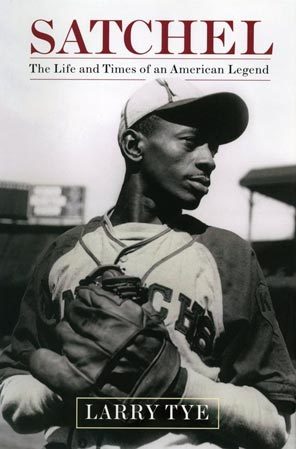
Many of those myths surrounding Paige, of course, were of the pitcher's own making via interviews and as-told-to autobiographies, and they were a crucial part of his public relations strategy. In his preface to the book (published as an excerpt at Bronx Banter), Tye explains Paige's obfuscation about his birthdate:
Satchel knew that, despite being the fastest, winningest pitcher alive, being black meant he never would get the attention he deserved. That was easy to see in the backwaters of the Negro Leagues but it remained true when he hit the Majors at age forty-two, with accusations flying that his signing was a mere stunt. He needed an edge, a bit of mystery, to romance sportswriters and fans. Longevity offered the perfect platform. "They want me to be old," Satchel said, "so I give 'em what they want. Seems they get a bigger kick out of an old man throwing strikeouts." He feigned exasperation when reporters pressed to know the secret of his birth, insisting, "I want to be the onliest man in the United States that nobody knows nothin' about." In fact he wanted just the opposite: Satchel masterfully exploited his lost birthday to ensure the world would remember his long life.While Tye digs deep — the book's bibliography and end notes are both at least 35 pages long, and he interviewed more than 200 Negro League and major league opponents and teammates — and lays waste to some of the tall tales surrounding Paige, what emerges is an altogether more nuanced and ultimately more compelling version of the ageless pitcher. Some of Paige's embellishments, such as his account of his pitching the championship finale for Dragones de Ciudad Trujillo in the Dominican Republic in 1937, don't stand up to the light of day. Others, such as the masterful control which allowed him to throw the ball over a chewing gum wrapper with amazing consistency or his brazen penchant for calling in his outfielders and then getting the crucial strikeout(s), he finds well-documented.
It was not a random image Satchel crafted for himself but one he knew played perfectly into perceptions whites had back then of blacks. It was a persona of agelessness and fecklessness, one where a family's entire history could be written into a faded bible and a goat could devour both. The black man in the era of Jim Crow was not expected to have human proportions at all, certainly none worth documenting in public records or engraving for posterity. He was a phantom, without the dignity of a real name (hence the nickname Satchel), a rational mother (Satchel's mother was so confused she supposedly mixed him up with his brother), or an age certain ("Nobody knows how complicated I am," he once said. "All they want to know is how old I am."). That is precisely the image that nervous white owners relished when they signed the first black ballplayers. Few inquired where the pioneers came from or wanted to hear about their struggles. In these athletes' very anonymity lay their value.
Playing to social stereotypes the way he did with his age is just half the story of Satchel Paige, although it is the half most told. While many dismissed him as a Stepin Fetchit if not an Uncle Tom, this book makes clear that he was something else entirely – a quiet subversive, defying Uncle Tom and Jim Crow. Told all his life that black lives matter less than white ones, he teased journalists by adding or subtracting years each time they asked his age, then asking them, "How old would you be if you didn't know how old you were?" Relegated by statute and custom to the shadows of the Negro Leagues, he fed Uncle Sam shadowy information on his provenance. Yet growing up in the Deep South he knew better than to flaunt the rules openly, so he did it opaquely. He made his relationships with the press and the public into a game, using insubordination and indirection to challenge his segregated surroundings.
As always, there are the quotes, most of which really did come out of Paige's mouth in some form or other. Asked by his manager if he threw fast consistently, he replied, "No sir, i do it all the time." Asked about his philosophy of pitching, he warned, "Bases on balls is the curse of a nation... throw strikes at all times. Unless you don't want to." Of course, it's interesting to learn that the six rules for staying young for which he's credited were partly the work of Collier's Richard Donovan, as the sidebar to a three-part profile from 1953. And, as Tye notes, not always taken to heart by the font of wisdom from which they supposedly flowed.
Through it all, Tye meticulously tracks Paige's peripatetic ways, noting not only his myriad stops both on his way up (he began pitching professionally in Chattanooga in 1926) and down (his last major league appearance was with the Kansas City A's in 1965; his last regular duty was with the Triple-A Miami Marlins from 1956-1958) but also his numerous barnstorming tours, not to mention the countless times he jumped teams to collect a bigger payday, often by less-than-honorably walking out on his contract. The book's appendix even has a well-compiled statistical thumbnail, collecting the best-researched data on Paige's time in the Negro Leagues, majors, minors, East-West All-Star Games, North Dakota, California Winter League and Latin leagues (though it misses two late stints in the minors in Portland and Hampton, Virginia).
The author offers a good deal of insight into the conditions Paige played under and the men he played for, such as Pittsburgh Crawfords owner Gus Greenlee and Kansas City Monarchs co-owner J.L. Wilkinson (whose business partner, Tom Baird, was a member of the Ku Klux Klan). If I have a quibble about the book it's that he doesn't go into great enough detail about many of the men he played with and against, particularly Josh Gibson, though the portraits of barnstorming rivals Dizzy Dean and Bob Feller do stand out. He's acutely aware of the generation gap between Paige and Robinson, or Paige and Indians teammate Larry Doby, who broke the American League color line in July 1947, and doesn't sugarcoat Paige's mixed emotions at being passed over as the man to break the majors' color barrier.
In all, Tye's created an impressive work that never feels bogged down by its lofty ambitions or the weight of the author's research; his prose is a breeze, for the most part. He makes a convincing case for Paige not only as one of baseball's all-time greats but as an agent of social change, covering seemingly millions of miles as he lay the groundwork for the game's integration, delighting fans and winning over doubters and even the occasional bigot while building a legacy that might be matched only by Babe Ruth's in its importance to the game and the nation. This one's a keeper.
For more about the book, see Tye's web site.
Labels: baseball history, books
Saturday, June 27, 2009
Cardboard Cut-Ups
Alternately hilarious and poignant, that book quickly became one of my all-time favorites; hell, I'll put it with The Summer Game and Ball Four on my shortest of short lists of baseball books. Two decades later it would become one of the initial inspirations for this site, albeit one I've invoked with decreasing frequency as my own work here and beyond has grown more analytical.
I'm reminded of all of this because of a Los Angeles Times article linked by Cardboard Gods' Josh Wilker, a man who adopted the book's style of incorporating baseball cards and the existential revelations they held into the narrative of his own journey. In it the LAT writer catches up with the authors of TGABC... — that thing just doesn't want to condense — Brendan Boyd and Fred C. Harris:
Boyd and Harris were twentysomething baseball geeks who worked together at a Boston bookstore. The idea, Boyd remembers today, came when a customer requested a book about baseball cards and he and Harris realized that there was none. After the store manager, Richard McDonough, left to become an editor at Little, Brown, he signed the pair to write their baseball card bookThe article also has a few choice quotes from Terry Cannon, the executive director of the Baseball Reliquary, even drawing a line from the book to the Pasadena-based Reliquary's intersection of baseball and art, including their upcoming exhibit, Cardboard Fetish. Good stuff, though a part of me wishes Boyd and Harris had more baseball writing in them than just that one tome.
At once irreverent and nostalgic, "Great American" is a hybrid of Roger Kahn's "The Boys of Summer" and Mad magazine. The first section is devoted to Boyd's memories of collecting cards in the 1950s and early 1960s, at "corner stores that were never on corners. Variety stores completely lacking in variety. They were generally owned by middle-aged men with psoriasis -- paunchy citizens with sallow complexions and sour outlooks, who wore plaid woolen shirts no matter how hot it was and little felt hats that had repeatedly been stepped on."
...Boyd went on to contribute the text for "Racing Days," a book featuring Henry Horenstein's exquisite horse racing photography. He also wrote the novel "Blue Ruin," about the fixing of the 1919 World Series. He was a pop music and financial columnist. Today, he is working on another novel.
"I'm proud of the baseball card book, but it feels like it was written by a different person," he says. "A lot of people thought I was interested in baseball cards, but I was really interested in the cards as a way of talking about childhood."
Harris owned a store in Boston called the Great American Baseball Card Company until, he says, "baseball cards stopped being about fun. The whole money motive got disgusting." He now works in IT analysis and writes a blog.
I guess it's up to the rest of us now.
Labels: books
Saturday, May 23, 2009
Joy in Mudonna-Ville
The Saints, an independent team in the independent American Association, won behind a couple of long home runs, but I didn't actually pay too close attention to the game, even failing to notice former big-leaguer Kerry Ligtenberg closed the door with the save. In addition to my own beverage and pork consumption, I was busy shelling peanuts and otherwise playing with five-year-old Kate and two-year-old Jackie, the daughters of our hosts, who also had a one-month-old infant son in tow. This was the kids' first baseball game, and while they weren't overly interested in the proceedings, they were thoroughly sugared up and entertained by the between-innings shenanigans, particularly the mascot Mudonna, a bright pink pig who alternately scared and fascinated my new buddy, Jackie, who understandably had trouble figuring out exactly what she was looking at: "Where pink bear go now? Where pink bear go now?"
I'd read about the Saints years ago in Neal Karlen's excellent Slouching Towards Fargo, a book that chronicled life in the independent Northern League during the mid-90s. The Saints, owned even to this day by a group that includes actor Bill Murray as well as baseball's Barnumesque scion, Mike Veeck, featured Darryl Strawberry on his way back to the majors as well as Jack Morris on his way out of baseball, along with a whole bunch of other characters just happy to be playing ball anywhere for a living. Anyway, more than a decade after reading Fargo, I was glad to finally get a chance to attend one of their games, a particularly welcome antidote to Epic Fail Stadium in the Bronx. Tomorrow, I'll pay a visit to the Metrodome (another first) for a Twins-Brewers game, but I'll be hard-pressed to top the fun I had here.
• • •
This week at Baseball Prospectus, I wrote a "Pair Up in Threes" piece about a trio of teams whose overall showings were in marked contrast to the performance of their rotations. Both the Red Sox and Phillies continue to contend despite abysmal 6.00+ ERA showings from their starters, while the Diamondbacks are deep into the second division despite strong showings from their starters even with Brandon Webb sidelined. Here's part of what I wrote about the D-Bags:
What's Happened: After lasting just four innings on Opening Day, Webb was pushed to the Disabled List due to bursitis in his shoulder. He was expected only to miss a few weeks, but since suffering a setback in late April, he's been limited to playing catch and won't be back until sometime in June. While Yusmeiro Petit has pitched poorly in his place (8.03 ERA, -0.2 SNLVAR, .367 SNWP), Haren leads the league in SNLVAR, [Doug] Davis is 11th, and [Max] Scherzer is 26th.As for the Hit List, the Dodgers continue to hold onto the top spot, the Brewers are third despite some bad news, and Yankees are 10th. Here's a taste:
Alas, Webb's absence has been the least of the club's problems; right now this may be the unhappiest team in the majors. Manager Bob Melvin was fired on May 8 with the team a disappointing 12-17, 8½ games out of first. They've gone just 2-6 under replacement A.J. Hinch, whose lack of managerial experience has drawn fire from the media as well as departed pitching coach Bryan Price. Last Friday, upon pulling Davis for a pinch-hitter, the pitcher — who had thrown just 80 pitches but trailed by a run in the seventh — confronted his new skipper in full view of the TV cameras, never a good sign.
The real problem isn't a lack of respect for the manager's authoritah, it's a snake-bitten offense that's scraping together just 3.9 runs per game, which ranks 15th in the league; their .236 EqA is the NL's worst. Three lineup regulars (Chad Tracy, Conor Jackson, and Chris B. Young) are below the Mendoza Line, and Stephen Drew and Eric Byrnes aren't much above it. As well as Haren and Davis have pitched, both rank in the league's bottom 10 in run support, well under three runs per game; Haren is second-to-last at 2.3. Meanwhile, the bullpen's been pretty lousy (12th in the league in WXRL and 13th in Fair Run Average), but most of the damage has been done in lower-leverage situations. Closer Chad Qualls and set-up men Tony Pena and Juan Gutierrez, the only relievers with Leverage scores above 1.00, are all in the black, WXRL-wise, while the mop-and-bucket patrol has sloshed kerosene around during their aisle nine cleanups.
What Will Fix It: Even if Webb returns at full strength, the Diamondbacks have dug themselves a huge hole. The PECOTA-based version of our Playoff Odds Report puts their chances at reaching the postseason at just 9.3 percent, down from 45.0 percent to start the year. The suspension of Manny Ramirez won't do very much to bring the Dodgers back to the pack; in fact, the Diamondbacks have lost three games in the standings since then. If they don't start scoring runs soon, it's going to be a long summer in the Arizona heat.
[#1 Dodgers] Life Without Manny: Clayton Kershaw no-hits the Marlins for seven innings; he's allowed just six runs and 13 hits and zero homers over his last four starts, and batters are hitting just .205/.313/.333 against him overall. The Dodger rotation has picked up the slack since Manny's suspension via a 2.81 ERA and just three homers in 80 innings despite the presence of both Jeff Weaver and Official Hit List Whipping Boy Eric Milton, two pitchers who survived the fly-ball pitcher's hell of Albuquerque to return to the majors.That last entry came out of an on-air conversation with WLQR-Toledo radio host Norm Wamer during my weekly spot, while the Ortiz one was something I made light of during my WWZN-Boston spot on the Young Guns (audio link hopefully forthcoming).
[#3 Brewers] Weeks, Months, Year: Amid a seven-game winning streak, the Brewers incur a loss of a different sort, as Rickie Weeks suffers a torn tendon sheath in his left wrist, ending his season at a point when he was hitting .272/.340/.517 while tied for the team high with nine homers. Given that the injury is in the opposite wrist as his 2006 season-ender, this only perpetuates the concern that he'll never be durable enough for full-time duty; he's topped 100 games only twice in five years. For the moment, the Brewers will patch from within via Craig Counsell, Casey McGehee, Hernan Irribaren, and perhaps Alcides Escobar.
[#21 Astros] Ortiz Finally Homers! Russ Ortiz beats Big Papi to the punch by a day with a two-run shot, his first homer since 2003. With a 5.81 ERA and a 21/22 K/BB rate, he ought to consider a career move, as he hit .252/.301/.403 with four homers in 2002-2003, numbers that outdo more than one current Astros lineup regular. On the other side of the coin, Wandy Rodriguez allows his first home run since last August 10, a span of 88 1/3 innings. He's second in the league in ERA and fourth in SNLVAR; the Astros are 7-2 in his starts.
[#23 Marlins] Crouching Tiger, Rotting Fish: Andrew Miller returns from the disabled list and notches his first win in 11 months, but it's the Marlins' only victory in an eight-game span. The Miguel Cabrera/Dontrelle Willis deal hasn't turned out well for the Fish thus far, as Miller's put up a 5.88 ERA in 124 innings, Cameron Maybin's been sent back to Triple-A after a .202/.280/.310 start, and Mike Rabelo, Burke Badenhop, and Eulogio de la Cruz have all been below replacement level as well.
Meanwhile, I've got one more article in the pipeline, an ESPN Insider/BP piece related to Randy Johnson's pursuit of his 300th win that will be held until he finally reaches the milestone. I hope it happens soon — he took a no-decision on Friday night, keeping him at 298 — because I gots to get paid.
Labels: books, Brewers, Dodgers, Hit and Run, Hit List, radio
Tuesday, May 12, 2009
The Dodger 100
And now for a welcome break from the steroids hubbub, I've got a couple books which recently landed in my in-box to plug this week. The first, which has actually been sitting on my desk for a few weeks, is Jon Weisman's 100 Things Dodger Fans Should Know & Do Before They Die, a 300-page paperback (Triumph Books, $14.95 list, $10.17 at Amazon) ideal for summer reading. If you've been reading this site or following the baseball blogosphere for any length of time, you know that Jon is the keeper of Dodger Thoughts, the top blog covering the boys in blue, and one of the best baseball blogs around.
He's also somebody I count as a friend, so I won't pretend to offer an objective review here (full disclosure: this site is generously included in his bibliography). Instead I'll note that even for a grizzled Dodger know-it-all such as myself, this book has plenty to offer. Leaning mostly on the key events and personalities (the Know, as opposed to the Do), Jon's selected 100 of the most important in the team's history across their Brooklyn and Los Angeles residencies and offered three or four well-researched pages on each. Not all of the players he profiles are Hall of Famers like Sandy Koufax (#3) and Duke Snider (#28); cult favorites like Pedro Guerrero (#40), Wes Parker (#64) and Manny Mota (#71) get their entries, as does the Fernandomania phenomenon (#7). Not all of the highlights are warm and fuzzy, either — hey, this is Dodger history we're talking, full of reckoning with what it means to wait 'til next year, so the painful endings to the 1980 and 1982 seasons (#42 and #48) are recounted, as is Mickey Owen's dropped third strike from the 1941 World Series (#54) and Al Campanis' disastrous Nightline appearance from 1987 (#39).
If I have a criticism of the book, it's that the Brooklyn side of things gets a bit of short shrift, with very little on longtime mananger Wilbert Robinson ("Uncle Robbie"), Dazzy Vance and Babe Herman. While Zack Wheat (#58) and Burleigh Grimes (#74) get to stretch their legs out, those three larger-than-life personalities — who helped define the Daffy Dodgers of the Twenties and Thirties — are all squashed into one entry, tenement style at #81. They're an essential, colorful part of Dodger history, because their antics, such as the time Herman, Vance and another baserunner all wound up at third base (briefly recounted here), made the team's evolution into National League powerhouse all the more surprising.
That still leaves plenty to cheer about, starting with the authority with which Jon stakes out his top two spots: Jackie Robinson and Vin Scully. By Jon's reckoning, the former still provides the best reason to celebrate the Dodgers and their history, and the latter is the strongest existing link to that history given his 60 years of service for the club. I was particularly struck by the combination of those choices when I sat down to watch the April 15 Dodgers game, the one where young Clayton Kershaw whiffed 13 Giants on the 62nd anniversary of Robinson's breaking of the color barrier. Though the event was noted with considerably less fanfare than on its decennial anniversaries, Scully interwove details from Robinson's debut with his account of the action at hand, providing both historical gravitas — particularly during his usual "this date in history" spot at the top of the sixth inning — with enthusiasm for the moment he was watching. Such a delicious combination, and so well suited to the top two spots of this book.
Here's how Jon starts the Robinson entry:
From beginning to end, we root for greatness.If that's not reason to pick up a copy and dig into the other 99 entries in this book, I don't know what is. Perhaps two entries a day will help the time between now and Manny Ramirez's return pass more quickly.
We root for our team to do well. We root for our team to create and leave lasting memories, from a dazzling defensive play in a spring training game to the final World Series-clinching out. With every pitch in a baseball game, we're seeking a connection to something special, a fastball right to our nervous system.
In a world that can bring frustration on a daily basis, we root as an investment towards bragging rights, which are not as mundane as that expression makes them sound. If our team succeeds, if our guys succeed, that's something we can feel good about today, maybe tomorrow, maybe forever.
The pinnacle of what we can root for is Jackie Robinson.
Robinson is a seminal figure — a great player whose importance transcended his team, transcended his sport, transcended all sports. We don't do myths anymore the way the Greeks did — too much reality confronts us in the modern age. But Robinson's story, born in the 20th century and passed on with emphasis into the 21st, is as legendary as any to come from the sports world.
And Robinson was a Dodger. If you're a Dodgers fan, his fable belongs to you. There's really no greater story in sports to share. For many, particularly in 1947 when he made his major league debut, Robinson was a reason to become a Dodger fan. For those who were born or made Dodgers fans independent of Robinson, he is the reward for years of suffering and the epitome of years of success.
Labels: baseball history, books, Dodgers
Thursday, February 19, 2009
BP09 Book Tour
March 10, 7 PM: Steven Goldman, Jay Jaffe
B&N @ Johns Hopkins University
3330 St. Paul Street
Baltimore, MD 21218
March 12, 6 PM: Kevin Goldstein, Steven Goldman, Jay Jaffe, Neil deMause, Cliff Corcoran
Barnes & Noble @ 18th Street
2 East 18th Street
New York, New York 10003
March 17, 7 PM: Steven Goldman, Jay Jaffe, Clay Davenport (dressed as leprechauns)
Politics & Prose Bookstore
5015 Connecticut Avenue NW
Washington, DC 20008
March 18, 5 PM: Steven Goldman, Jay Jaffe (dressed as hungover leprechauns)
McShain Lounge at McCarthy Hall (Building 42)
Georgetown University
37th and O St NW
Washington, DC
March 24, 5 PM: Steven Goldman, Jay Jaffe
Penn Bookstore @ University of Pennsylvania
3601 Walnut Street
Philadelphia, PA 19104
March 26, 6 PM: Steven Goldman, Jay Jaffe, Cliff Corcoran
Rutgers University Bookstore
Ferren Mall
One Penn Plaza
New Brunswick, NJ 08901
For more BP authors in other cities, please see here.
Wednesday, February 11, 2009
Angell's in the Outfield
Updike's sentences are fresh-painted. In all his writing, critical or fictional or reportorial, he is a fabulous noticer and expander; he's invented HD. So armed, he felt free from the start to take up and engage with all that lay within the range of his attention and put it down on paper. He had never to my knowledge written about sports when, on a morning in late September, 1960, he was stood up by a woman in Boston with whom he had an assignation and instead went to Fenway Park to see the Red Sox, in the final home game of Ted Williams's career. Ted hit a home run in his last at-bat, and Updike came home and wrote "Hub Fans Bid Kid Adieu" and sent it off to the magazine: the most celebrated baseball piece ever. The text grew not just out of the event but from Updike's youthful attachment to the Splendid Splinter; when he decided to leave New York and The New Yorker, in 1957, and move his young family to the suburbs, he chose Boston, as he later explained, in part to be closer to Ted Williams. My own baseball writing was still two years away when I first read "Hub Fans Bid Kid Adieu," and though it took me a while to become aware of it, John had already supplied my tone, while also seeming to invite me to try for a good sentence now and then, down the line, like the one he slips in when Williams fails to doff his cap after circling the bases in the wake of that homer: "Gods do not answer letters."How about that? Not only was Updike's piece worthy of such a superlative (testifying to the esteem in which it's held, I own it as part of three separate anthologies), but it essentially served as a prototype for one of the great baseball writers of all time. You learn something new every day.
Angell was a latecomer to the world of baseball writing, taking up the challenge when he was in his early forties. His first pieces ran in 1962, not coincidentally the first year of the Mets' existence. This page has a couple of his pieces from around that time. One is about taking up the Mets' cause in their inaugural year, during a stretch where the two former New York teams, the Dodgers and Giants, returned to play the Mets at the Polo Grounds, Angell's favorite haunt:
"I tell you, there isn't one of 'em -- not one -- that could make the Yankee club," one of them said. "I never saw such a collection of dogs."Right out of the box, that last line is almost good enough to hang with Updike's most famous phrase. Here's a shorter piece that leads off The Summer Game, Angell's first collection of essays. Devoted to the arrival of pitchers and catchers, it's a nice little tonic to chase away what is turning out to be one of the ugliest weeks for baseball in a long time:
"Well, what about Frank Thomas?" said the other. "What about him?What's he batting now? .315? .320? He's got thirteen homers, don't he?"
"Yeah, and who's he going to push out of the Yankee outfield? Mantle? Maris? Blanchard? You can't call these characters ballplayers. They all belong back in the minors -- the low minors."
I recognized the tone. It was knowing, cold, full of the contempt that the calculator feels for those who don't play the odds. It was the voice of the Yankee fan. The Yankees have won the American League pennant twenty times in the past thirty years; they have been world champions sixteen times in that period. Over the years, many of their followers have come to watch them with the smugness and arrogance of holders of large blocks of blue-chip stocks. These fans expect no less than perfection. They coolly accept the late-inning rally, the winning homer, as only their due. They are apt to take defeat with ill grace, and they treat their stars as though they were executives hired to protect their interests. During a slump or a losing streak, these capitalists are quick and shrill with their complaints: "They ought to damn well do better than this, considering what they're being paid!"
Suddenly the Mets fans made sense to me. What we were witnessing was precisely the opposite of the kind of rooting that goes on across the river.This was the losing cheer, the gallant yell for a good try -- antimatter to the sounds of Yankee Stadium. This was a new recognition that perfection is admirable but a trifle inhuman, and that a stumbling kind of semi-success can be much more warming. Most of all, perhaps, these exultant yells for the Mets were also yells for ourselves, and came from a wry, half-understood recognition that there is more Met than Yankee in every one of us. I knew for whom that foghorn blew; it blew for me.
Today the Times reported the arrival of the first pitchers and catchers at the spring training camps, and the morning was abruptly brightened,as if by the delivery of a seed catalogue. The view from my city window still yields only frozen tundras of trash, but now spring is guaranteed and one of my favorite urban flowers, the baseball box score, will burgeon and flourish through the warm, languid, information-packed weeks and months just ahead. I can remember a spring, not too many years ago,when a prolonged New York newspaper strike threatened to extend itself into the baseball season, and my obsessively fannish mind tried to contemplate the desert prospect of a summer without daily box scores. The thought was impossible; it was like trying to think about infinity. Had I been deprived of those tiny lists of sporting personae and accompanying columns of runs batted in, strikeouts, double plays, assists, earned runs, and the like, all served up in neat three-inch packages from Pittsburgh, Milwaukee, Baltimore,Houston, and points east and west, only the most aggressive kind of blind faith would have convinced me that the season had begun at all or that its distant, invisible events had any more reality than the silent collision of molecules. This year, thank heaven, no such crisis of belief impends; summer will be admitted to our breakfast table as usual, and in the space of half a cup of coffee I will be able to discover, say, that Ferguson Jenkins went eight innings in Montreal and won his fourth game of the season while giving up five hits, that Al Kaline was horse-collared by Fritz Peterson at the Stadium,that Tony Oliva hit a double and a single off Mickey Lolich in Detroit, that Juan Marichal was bombed by ye Reds in the top of the sixth at Candlestick Park, and that similar disasters and triumphs befell a couple of dozen-odd of the other ballplayers -- favorites and knaves -- whose fortunes I follow from April to October.Hang in there, folks. It's just a couple more days...
The box score, being modestly arcane, is a matter of intense indifference,if not irritation, to the non-fan. To the baseball-bitten, it is not only informative, pictorial, and gossipy but lovely in aesthetic structure. It represents happenstance and physical flight exactly translated into figures and history. Its totals -- batters' credit vs. pitchers' debit -- balance as exactly as those in an accountant's ledger. And a box score is more than a capsule archive. It is a precisely etched miniature of the sport itself, for baseball, in spite of its grassy spaciousness and apparent unpredictability, is the most intensely and satisfyingly mathematical of all our outdoor sports. Every player in every game is subjected to a cold and ceaseless accounting; no ball is thrown and no base is gained without an instant responding judgment -- ball or strike, hit or error, yea or nay -- and an ensuing statistic. This encompassing neatness permits the baseball fan, aided by experience and memory,to extract from a box score the same joy, the same hallucinatory reality, that prickles the scalp of a musician when he glances at a page of his score of Don Giovanni and actually hears bassos and sopranos, woodwinds and violins.
The small magic of the box score is cognominal as well as mathematical.Down the years, the rosters of the big-league teams have echoed and twangled with evocative, hilarious, ominous, impossible, and exactly appropriate names. The daily, breathing reality of the ballplayers' names in box scores accounts in part, it seems to me, for the rarity of convincing baseball fiction.No novelist has yet been able to concoct a baseball hero with as tonic a name as Willie Mays or Duke Snider or Vida Blue. No contemporary novelist would dare a supporting cast of characters with Dickensian names like those that have stuck with me ever since I deciphered my first box scores and began peopling the lively landscape of baseball in my mind -- Ossee Schreckengost, Smead Jolley, Slim Sallee, Elon Hogsett, Urban Shocker, Burleigh Grimes,Hazen Shirley Cuyler, Heinie Manush, Cletus Elwood Poffenberger, Virgil Trucks, Enos Slaughter, Luscious Easter, and Eli Grba. And not even a latter-day O. Henry would risk a tale like the true, electrifying history of a pitcher named Pete Jablonowski, who disappeared from the Yankees in 1933 after several seasons of inept relief work with various clubs. Presumably disheartened by seeing the losing pitcher listed as "J'bl'n's'i" in the box scores of his day, he changed his name to Pete Appleton in the semi-privacy of the minors, and came back to win fourteen games for the Senators in 1936 and to continue in the majors for another decade.
Archives
June 2001 July 2001 August 2001 September 2001 October 2001 November 2001 December 2001 January 2002 February 2002 March 2002 April 2002 May 2002 June 2002 July 2002 August 2002 September 2002 October 2002 November 2002 December 2002 January 2003 February 2003 March 2003 April 2003 May 2003 June 2003 July 2003 August 2003 September 2003 October 2003 November 2003 December 2003 January 2004 February 2004 March 2004 April 2004 May 2004 June 2004 July 2004 August 2004 September 2004 October 2004 November 2004 December 2004 January 2005 February 2005 March 2005 April 2005 May 2005 June 2005 July 2005 August 2005 September 2005 October 2005 November 2005 December 2005 January 2006 February 2006 March 2006 April 2006 May 2006 June 2006 July 2006 August 2006 September 2006 October 2006 November 2006 December 2006 January 2007 February 2007 March 2007 April 2007 May 2007 June 2007 July 2007 August 2007 September 2007 October 2007 November 2007 December 2007 January 2008 February 2008 March 2008 April 2008 May 2008 June 2008 July 2008 August 2008 September 2008 October 2008 November 2008 December 2008 January 2009 February 2009 March 2009 April 2009 May 2009 June 2009 July 2009 August 2009 September 2009 October 2009 November 2009 December 2009 January 2010 February 2010 March 2010 April 2010 May 2010

Subscribe to Posts [Atom]